Agile project development has become the backbone of how modern teams design, build, and deliver digital products. As customer expectations evolve faster than traditional plans can adapt, agile offers a way to stay responsive without sacrificing structure or accountability. Instead of following a linear path with fixed requirements, teams work in short, focused cycles that prioritize real value over rigid documentation.
From startups launching their first MVPs to enterprises modernizing legacy systems, organizations use agile to improve speed, transparency, and collaboration. This guide explains what agile project development is, its core principles, how the lifecycle works in practice, and how tools like Lark bring planning, execution, and communication into a single unified workspace.
Experience a simpler way to manage agile project work
What agile project development means
Agile project development is an , building, and delivering projects that prioritizes flexibility, collaboration, and continuous value creation. Instead of defining all requirements upfront and following a fixed, linear plan, agile encourages teams to work in short, iterative cycles where progress is reviewed and refined regularly. This allows teams to respond quickly to changing customer needs, market conditions, and technical challenges without losing overall direction.
At its core, agile project development emphasizes close collaboration among stakeholders and . Work is broken into small, manageable pieces that can be completed, tested, and delivered incrementally. Regular feedback loops, such as reviews and retrospectives, help teams learn from each cycle and improve both their processes and outcomes.
By emphasizing transparency, shared ownership, and adaptability, agile project development helps organizations reduce risk, improve product quality, and deliver meaningful results faster.
12 core principles behind agile project development
Core principles behind agile project development guide how teams think, plan, and deliver work in dynamic environments. Instead of rigid processes, these principles emphasize flexibility, collaboration, and ongoing alignment with real business and user needs.
- Customer satisfaction through early and continuous delivery: Delivering usable software early helps teams validate assumptions and . Regular releases ensure feedback is incorporated before problems grow larger. This approach keeps development aligned with real user needs over time.
- Welcome changing requirements, even late in development: Agile teams accept change as a natural part of building valuable products. New insights from users or the market often lead to better outcomes when embraced. Flexibility allows teams to stay relevant without restarting the entire project.
- Deliver working software frequently: Frequent delivery breaks large projects into manageable increments. Short cycles make progress visible and r. This rhythm supports faster learning and more predictable outcomes.
- Business stakeholders and developers work together daily: Close collaboration reduces misalignment between technical execution and business goals. Daily interaction allows questions to be resolved quickly and priorities to stay clear. This shared understanding leads to smoother delivery and fewer last-minute changes.
- Build projects around motivated individuals: Agile teams perform best when people are trusted to make decisions about their work. Providing the right tools, environment, and support encourages ownership and accountability. Motivation leads to higher-quality results and stronger team commitment.
- Face-to-face conversation is the most effective communication: and speeds up decision-making. Complex problems are resolved more efficiently through discussion than through documentation alone. This principle strengthens collaboration and team cohesion.
- Working software is the primary measure of progress: Completed features that function as intended provide the clearest indicator of progress. Plans and reports are useful, but they do not replace real outcomes. Focusing on working software keeps teams accountable to results.
- Maintain a sustainable pace of work: Agile promotes consistent delivery rather than short bursts of intense effort. A sustainable pace helps teams avoid burnout and maintain quality over time. Long-term productivity depends on balance, not constant urgency.
- Continuous attention to technical excellence and good design: High technical standards make systems easier to maintain and extend. Investing in quality reduces long-term costs and complexity. Strong design supports adaptability as requirements evolve.
- Simplicity is essential: Agile teams focus on doing only the work that delivers clear value. Removing unnecessary features and processes improves speed and clarity. Simplicity makes systems easier to understand and manage.
- Self-organizing teams produce the best results: Teams that manage their own work can respond faster to challenges. Autonomy encourages problem-solving and shared responsibility. This structure supports innovation and continuous improvement.
- Regular reflection and adjustment: Agile teams regularly review both outcomes and processes. Reflection helps identify what is working and what needs improvement. Continuous adjustment ensures teams evolve alongside their projects.
Agile project development lifecycle
The agile project development lifecycle defines how teams move from ideas to working solutions through a structured yet flexible flow. Instead of following a rigid sequence, the lifecycle supports and adjustment at every stage:
- Discovery and planning: The lifecycle begins with discovery and planning, where teams define the problem they are trying to solve and establish a shared understanding of goals. This stage focuses on identifying user needs, business objectives, and success metrics, rather than documenting every requirement in detail. Teams create and prioritize a backlog of work based on value and feasibility, ensuring that the most important items are addressed first. Planning in agile is intentionally lightweight, providing direction without locking teams into long-term commitments that may become outdated as new information emerges.
- Iterative build and release: Once priorities are set, teams move into iterative build and release cycles. Work is broken into small, manageable increments that can be designed, developed, tested, and delivered within short timeframes. Each iteration results in a usable outcome, allowing teams to validate assumptions early and often. Frequent releases reduce risk by exposing issues sooner, supporting continuous improvement in both product quality and delivery speed. This approach also keeps stakeholders engaged through regular progress updates.
- Review, learn, and adapt: At the end of each cycle, teams review outcomes with stakeholders and gather feedback. These reviews assess whether the delivered work meets user needs and business expectations. Teams also hold retrospectives to reflect on their process, identify challenges, and agree on improvements. Insights gained during this stage inform adjustments to priorities, workflows, and planning for the next cycle, reinforcing agile’s focus on adaptability and sustainable progress.
Popular agile frameworks used in project development
Scrum for iterative delivery
Scrum is one of the most widely used agile frameworks, particularly for product and software development. It organizes work into time-boxed sprints, typically lasting one to four weeks, supported by defined roles and recurring ceremonies such as sprint planning, reviews, and retrospectives. This structure helps teams maintain focus, track progress consistently, and deliver usable outcomes at the end of each cycle. Scrum works well for teams building new products or features where priorities may evolve over time.
Kanban for continuous flow
Kanban focuses on visualizing work as it moves through a continuous workflow rather than fixed iterations. Tasks are displayed on a board, allowing teams to limit work in progress and quickly identify bottlenecks. This approach supports steady delivery and incremental improvement, making it well-suited for operational teams, maintenance work, or projects with frequently changing priorities. In agile development project management, Kanban offers flexibility without the overhead of sprint planning.
Extreme Programming (XP) for technical excellence
Extreme Programming focuses on technical excellence and close collaboration between developers and customers. Practices such as pair programming, test-driven development, and continuous refactoring aim to improve code quality and responsiveness to change. XP is especially effective in agile software development projects where requirements evolve rapidly, and technical reliability is critical.
Lean software development for efficiency
Lean applies principles from manufacturing to software delivery, emphasizing waste reduction, fast feedback, and continuous learning. Teams prioritize only the work that creates real value and actively remove delays, handoffs, and unnecessary processes. that embrace Lean help reinforce efficiency and outcome-driven thinking, making it a strong complement to agile development project management.
SAFe (Scaled Agile Framework) for large organizations
SAFe is designed for large organizations managing multiple agile teams working toward shared goals. It introduces structured coordination, governance, and planning at scale while preserving team-level flexibility. Enterprises often adopt SAFe to align agile software development with strategic planning and compliance requirements.
Disciplined Agile (DA) for situational flexibility
Disciplined Agile offers a flexible toolkit rather than a prescriptive framework. Teams choose practices based on their specific situation, including team size, regulatory needs, and organizational culture. This adaptability makes DA suitable for organizations transitioning from traditional project management to agile methods.
Hybrid agile approaches
Many organizations adopt hybrid agile models that combine elements of Scrum, Kanban, and traditional planning methods. These approaches allow teams to retain necessary structure, such as milestone tracking or governance requirements, while still benefiting from agile adaptability. Hybrid models are common in environments where different teams or stakeholders operate at varying levels of agility.
How to implement agile into your projects
Implementing agile is less about following a strict rulebook and more about changing how teams plan, work, and adapt. The steps below focus on practical adoption rather than theory.
Step 1: Start with agile principles
Before choosing Scrum or Kanban, align the team with agile values such as customer focus, adaptability, and continuous improvement.
Step 2: Build a cross-functional team
Agile works best when teams have all the skills needed to deliver outcomes. Create small, empowered teams with clear ownership and shared accountability, rather than relying on handoffs between departments.
Step 3: Break work into small, valuable increments
Convert large into manageable pieces of work that deliver value quickly. Use a prioritized backlog to ensure the most important items are addressed first.
Step 4: Plan in short cycles
Work in short iterations with clear goals. Regular planning and review cycles allow teams to adjust scope, timelines, and priorities based on feedback and real progress.
Step 5: Establish regular feedback loops
Hold frequent reviews with stakeholders to validate outcomes early. Retrospectives help teams reflect on what's working, what's not, and how to improve in the next cycle.
Step 6: Make progress visible
Use visual boards, status tracking, and simple metrics to give everyone a shared view of progress. Transparency builds trust and helps teams identify blockers early.
Build a clearer, faster path for agile development
Action time: Try Lark as a workspace for agile project development
brings agile teams into a single, connected workspace where planning, execution, and communication happen seamlessly. Instead of switching between multiple tools, teams can manage backlogs, track progress, and collaborate in real time within one unified platform. Built-in automation and analytics help reduce manual effort while and stakeholders. With Lark, agile project development becomes more transparent, coordinated, and easier to scale as teams and project complexity grow.
Agile project planning
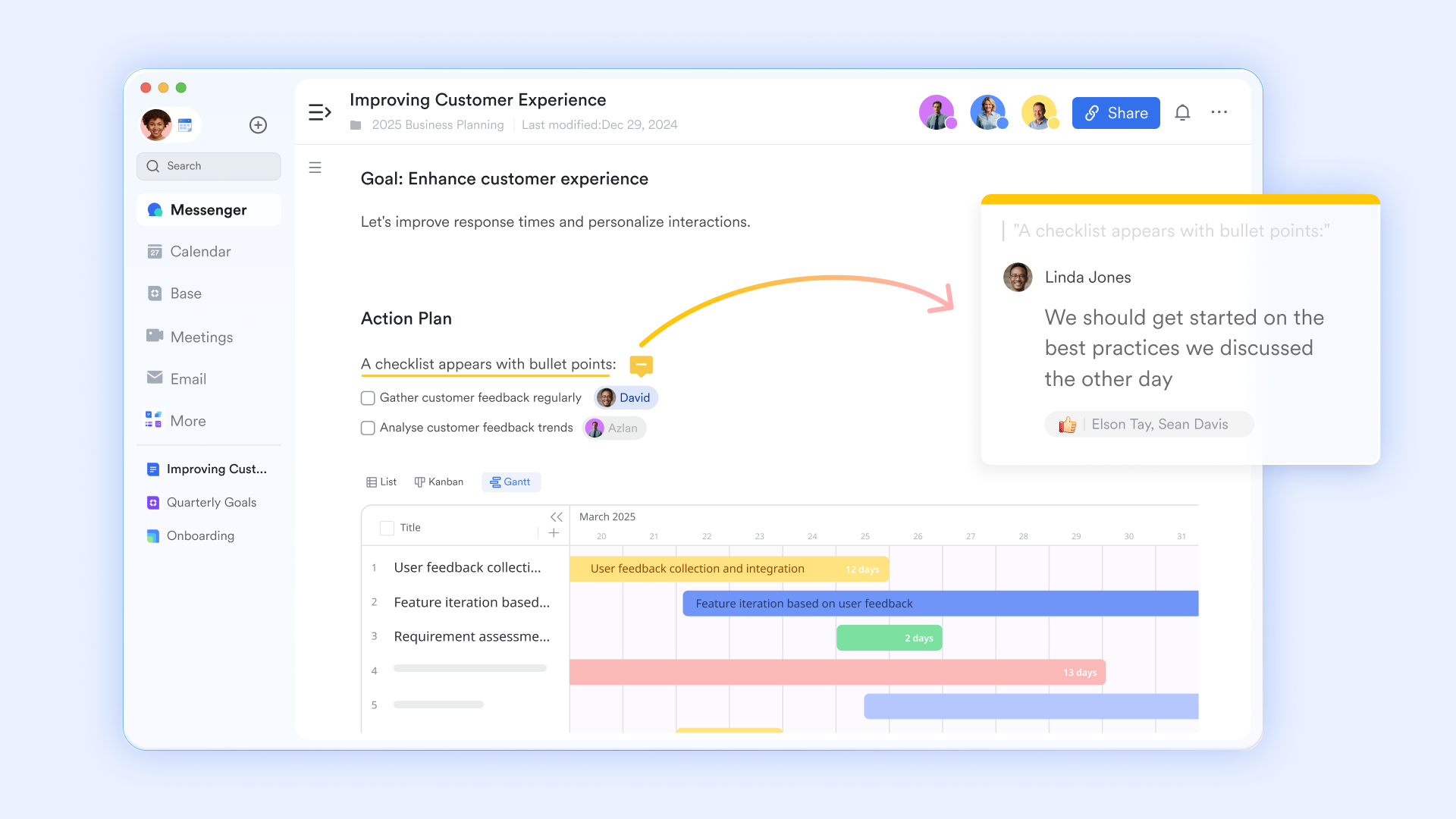
Because agile methodologies require tight feedback loops to be successful, serves as an essential centralized hub for project context. By using it to , technical specifications, and meeting notes, you ensure that all strategic documentation lives in one place. The ability to embed a live Base view directly into a doc means your high-level plans and granular task lists remain perfectly synced; any update made on the table reflects instantly within the document.
Centralized Sprint backlog
serves as the primary engine for managing both the product backlog and the active sprint backlog. It is a relational database that lets you define custom fields for "Story Points", "Priority Levels", and "Sprint IDs". For a growing team, this provides a structured environment to track the "Definition of Ready" for every user story, ensuring that technical requirements and dependencies are never lost between . 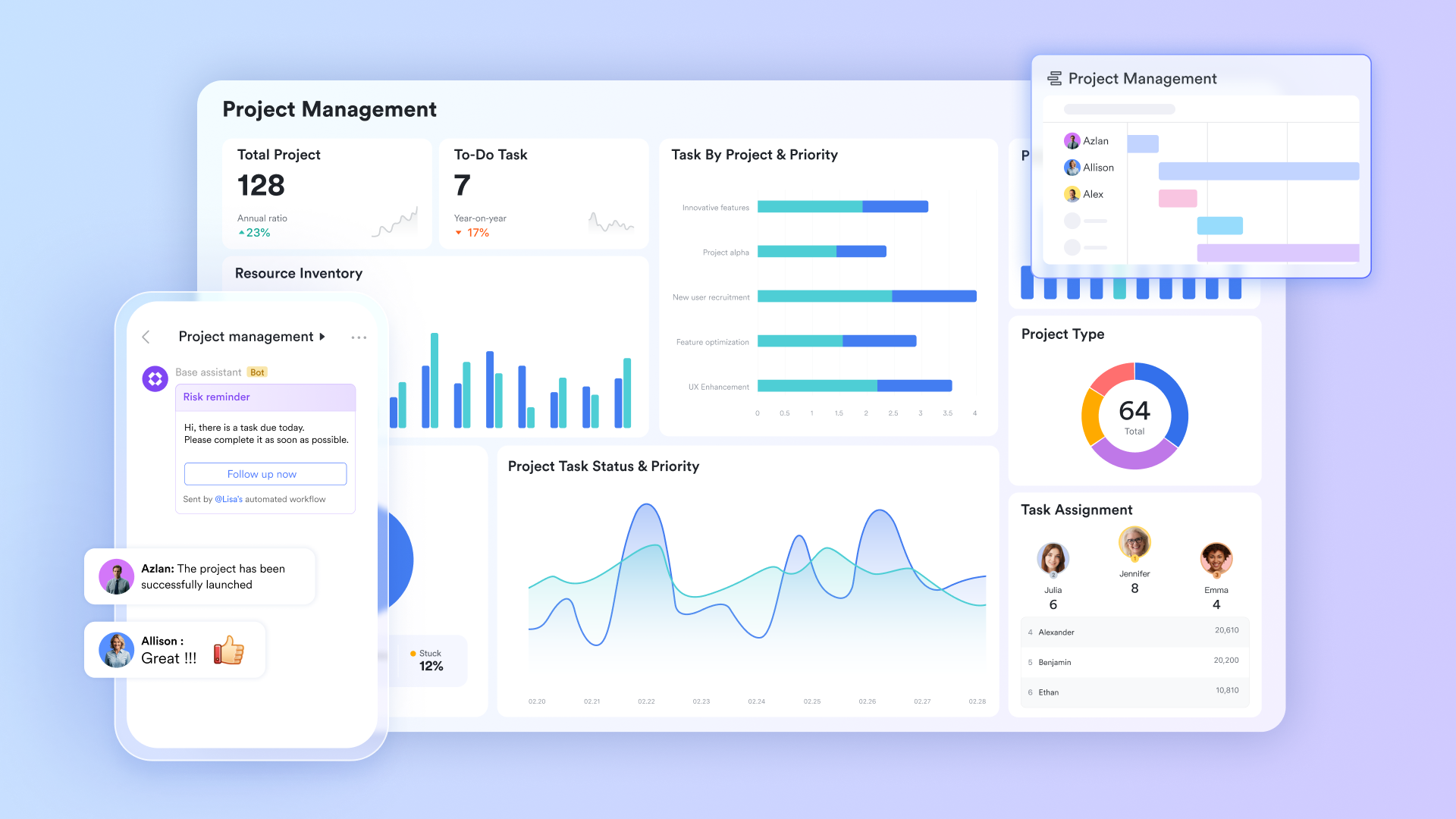
Dynamic workflow visualizer
The view switching function allows the team to visualize the same project data in different formats based on the ceremony. During a daily stand-up, developers use the to track task movement and identify blockers. During a roadmap review or sprint planning, the team can toggle between the Gantt and timeline views to see how the current sprint aligns with long-term milestones, without manual data re-entry. 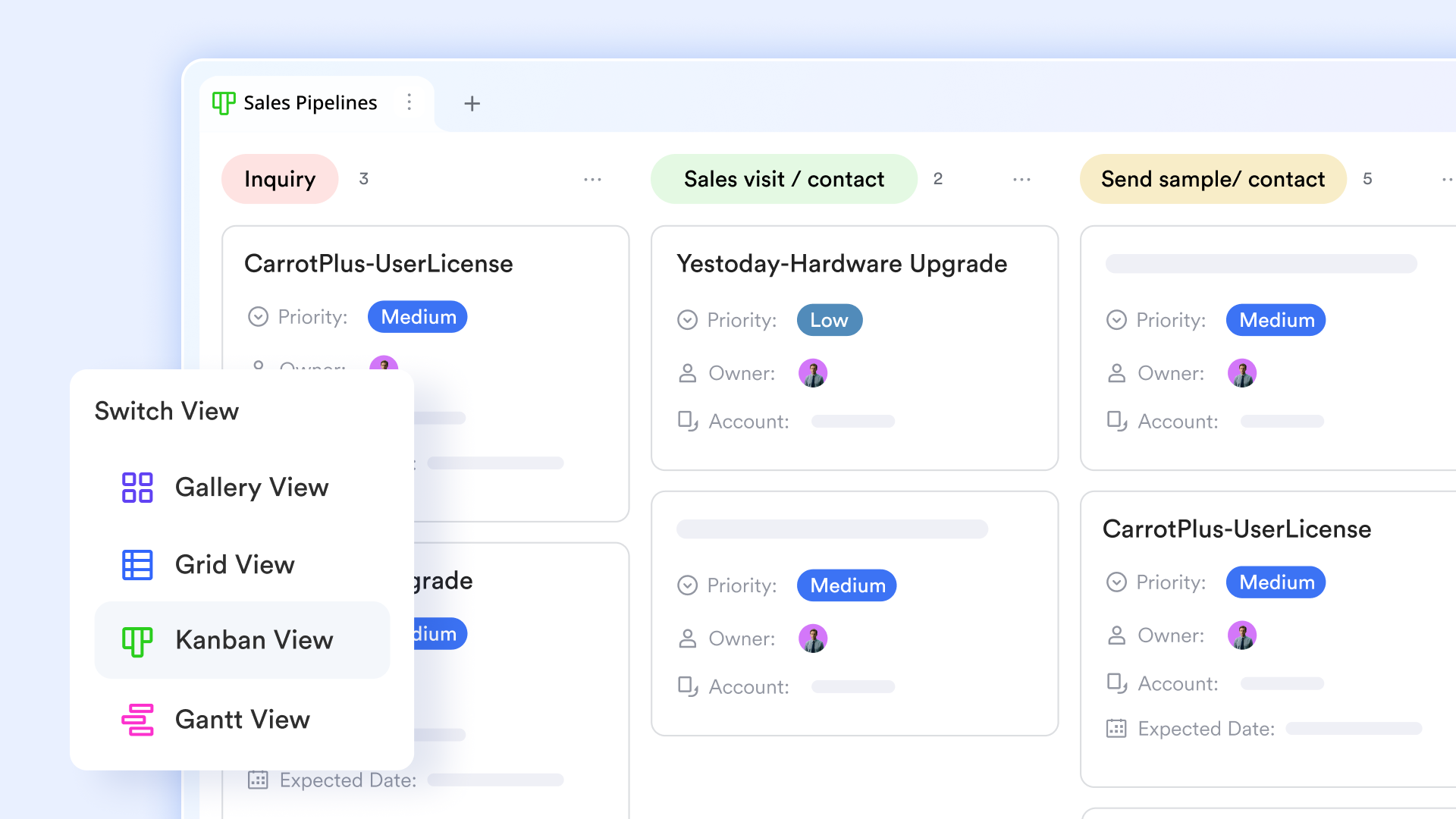
Automated Sprint velocity triggers
The automations in Lark Base use no-code "If/Then" logic to maintain the team's momentum. You can configure triggers so that when a developer moves a card to "Code Review," the system automatically sends a notification to a specific group or assigns a QA engineer. This eliminates manual hand-offs and ensures that the "Definition of Done" is enforced through immediate, system-led notifications. 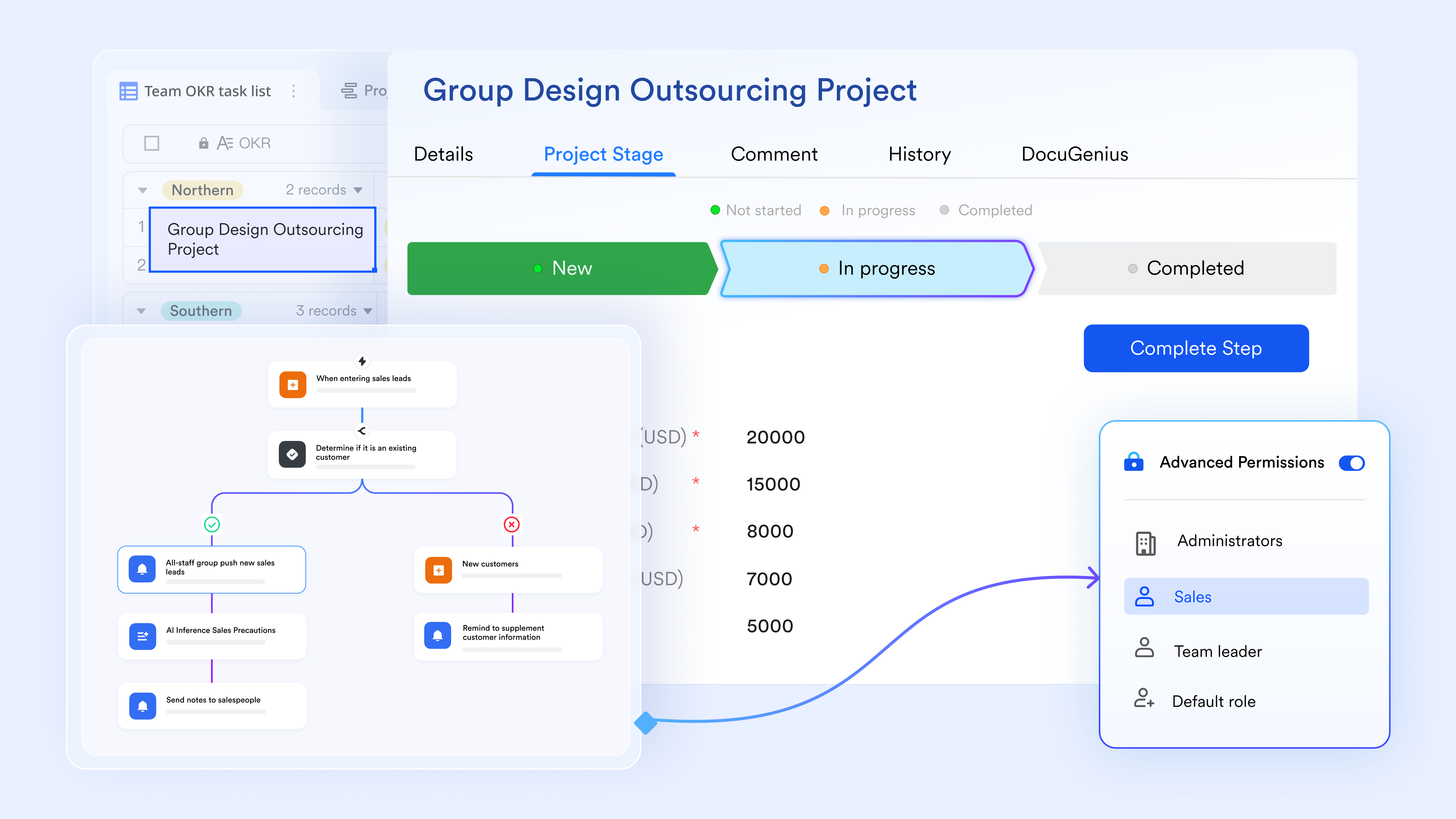
Real-time performance analytics
The dashboard function pulls live data from your active sprints to generate visual reports. Teams can configure widgets to display "Burndown Charts", "Cumulative Flow Diagrams", and "Sprint Velocity". For an Agile team, these provide the objective data needed for honest retrospectives, allowing members to identify trends in their output and adjust their commitment levels for the next sprint with higher accuracy. 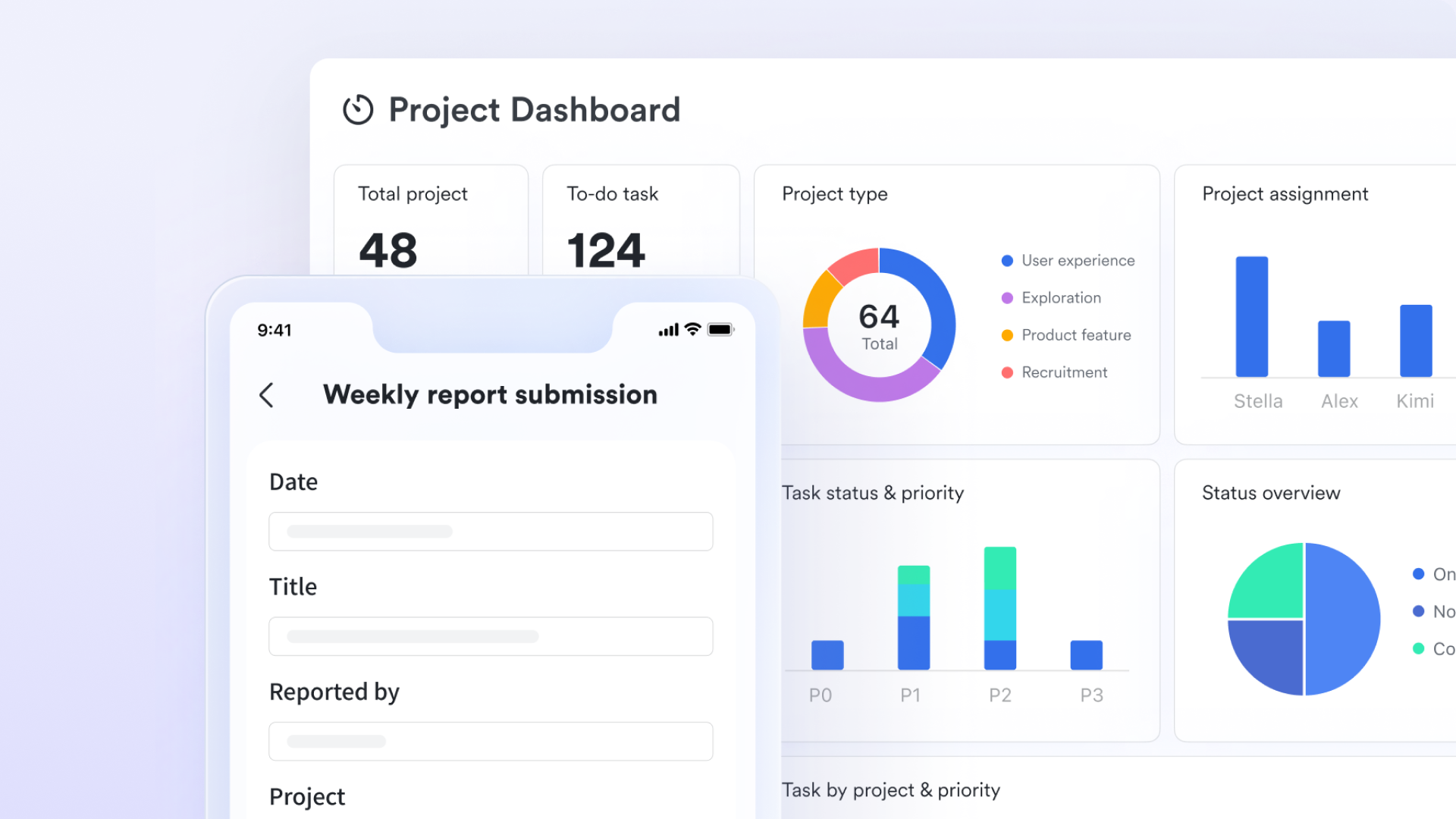
:
- Starter plan: Free forever plan that includes 11 powerful tools for up to 20 users. It also includes 100GB of storage, 1,000 automation runs, AI translations, and more.
- Pro plan: $12/user/month (billed annually) for up to 500 users. It includes everything in Starter plus group calling for up to 500 attendees, 15 TB of storage, 50,000 automation runs, and more.
- Enterprise plan: for custom pricing. Supports unlimited users and includes even more automation runs and advanced security, compliance, and management features.
For small teams with simple communication needs

18 months message history
1000 Base automation runs/month
2000 rows per table in Base
Most POPULAR
For companies with comprehensive collaboration and management needs
Unlimited message history
500-participant video meetings
50k Base automation runs/month
20k rows per table in Base
For large companies with advanced security and organizational management needs
Get a personalized demo and pricing
Unlimited message history
500-participant video meetings
15 TB storage + 30 GB storage/user
500k Base automation runs/month
50k Base automation runs/month
Most POPULAR
For companies with comprehensive collaboration and management needs
Unlimited message history
500-participant video meetings
50k Base automation runs/month
20k rows per table in Base
Benefits of agile project development for modern teams
Agile project development delivers clear advantages for organizations operating in fast-changing environments. Beyond faster delivery, it reshapes how teams collaborate, manage risk, and create long-term value.
- Faster time to value: Agile teams deliver work in small, usable increments rather than waiting for a final release. This allows organizations to realize value earlier, validate ideas quickly, and adjust direction before significant time or budget is spent. In , this incremental delivery model reduces waste and improves return on effort.
- Reduced project risk: By reviewing progress frequently and gathering feedback at every stage, teams identify issues earlier. Technical risks, scope misalignment, and usability problems surface sooner, when they are easier and less costly to resolve. This continuous validation makes agile development management especially effective for complex or uncertain projects.
- Stronger alignment with customer needs: Agile emphasizes ongoing collaboration with stakeholders and users. Instead of relying solely on assumptions defined at the start, teams adapt based on real feedback. This leads to solutions that more accurately reflect user needs and changing market conditions, which is critical in agile development in software engineering. Organizations often complement agile practices with to accelerate development, maintain code quality, and deliver solutions that evolve alongside business requirements.
- Improved team engagement and ownership: Cross-functional agile teams operate with shared responsibility and clear goals. This autonomy increases accountability and motivation, as team members can see how their work contributes directly to outcomes. Over time, this ownership helps teams become more resilient and self-improving.
- Greater transparency and predictability: , regular reviews, and clear metrics provide stakeholders with a realistic view of progress. While agile accepts change, it also offers predictable delivery through consistent cycles and visible priorities. This balance helps leaders make informed decisions without relying on rigid, long-term plans.
Conclusion
Agile project development empowers teams to move faster, stay , and deliver meaningful results through continuous learning and collaboration. By focusing on core principles like adaptive planning, cross-functional teamwork, and ongoing improvement, organizations can replace rigid processes with flexible systems that evolve alongside their projects. From discovery and planning to iterative delivery and regular reviews, the agile lifecycle creates transparency and reduces risk at every stage.
However, successfully scaling agile requires more than the right mindset—it also requires tools that connect people, processes, and data in one place. That's where Lark stands out. With integrated task management, real-time communication, automation, and performance dashboards, helps teams turn agile practices into everyday habits. If you're ready to simplify workflows, improve visibility, and build a more responsive project environment, try Lark and experience a smarter way to manage agile project development.
Create a more focused workflow for agile project teams
FAQs
How is agile project development different from Scrum?
Agile project development is a broad mindset and set of principles, while Scrum is a specific framework for applying those ideas in practice. In agile development and , teams can choose from multiple methods, not just Scrum. Lark helps unify planning, communication, and tracking regardless of which agile approach you follow.
Can agile project development work without sprints?
Yes, teams can use continuous flow models like Kanban instead of fixed sprints to manage work and deliver value steadily. This flexibility is common in agile software development project management, especially for support or operations-focused teams. Lark supports both sprint-based and flow-based workflows in one workspace.
How do teams handle long-term planning in agile projects?
Teams use high-level roadmaps and evolving backlogs to set direction while keeping short-term plans flexible. In agile software development, this balance allows organizations to align strategy with real progress and feedback. Lark helps visualize long-term goals alongside day-to-day execution through timelines and dashboards.
What skills are critical for agile project development success?
Strong communication, adaptability, and collaborative are essential for cross-functional teams. In agile development in software engineering, technical skills must be paired with the ability to learn and improve continuously. Lark supports these skills by enabling real-time collaboration, shared visibility, and transparent workflows.
Related reading