Modern teams face escalating demands amidst diverse digital tools. AI agent apps offer a pivotal innovation, enabling intelligent automation and advanced task execution beyond simple scripts. This article will define AI agents, present leading options, and discuss critical selection criteria. Crucially, we'll highlight challenges posed by fragmented AI solutions, demonstrating how a unified platform approach maximizes their effectiveness and transforms productivity.
Understanding AI agent apps: Defining the autonomous workforce
At its core, an AI agent app is an autonomous software program engineered to observe its digital environment, make informed decisions, and execute actions to achieve specific objectives – often with very little human intervention. Think of them as digital assistants with a higher degree of independence and cognitive ability than the basic automation scripts we've grown accustomed to.
What truly differentiates an AI agent from traditional automation or even a conventional virtual assistant is its capacity for advanced reasoning, continuous learning, and independent task execution. While an automation script follows a fixed set of instructions, an AI agent can adapt, learn from new data, and even plan multi-step processes to reach a goal. For example, a basic automation might send an email every Monday, but an AI agent could analyze project progress, identify a bottleneck, then proactively schedule a meeting with relevant team members and prepare a summary brief.
Within this broader category, we encounter various types. Virtual agents often serve customer-facing roles, handling inquiries and providing support. Intelligent agents possess a more sophisticated ability to learn and make decisions. A subset of these are knowledge-based agents, which leverage vast amounts of information to reason and solve problems, acting almost like a digital expert. Many modern AI agents are powered by Large Language Models (LLMs), which give them their impressive ability to understand, generate, and process human language, making their interactions and reasoning more fluid and human-like.
The business case: Why AI agent apps are essential for productivity
Why should your business consider integrating AI agent apps? The answer lies in addressing several critical pain points that many organizations face today.
Addressing fragmented workflows and tool silos
Many teams operate with a sprawling collection of specialized tools for , , document creation, and more. This often leads to fragmented workflows where information , creating new inefficiencies. AI agents offer a path to bridge these gaps, allowing data and tasks to flow more freely across different systems, reducing the need for manual transfers and reconciliation.
Mini-scenario: Imagine a marketing team using one tool for social media scheduling, another for email campaigns, and a third for analytics. An AI agent could analyze social media engagement metrics, identify underperforming content, then automatically suggest adjustments to the email campaign schedule and draft initial copy, pulling data from all three systems into a unified view.
Boosting operational efficiency through smart automation
AI agents excel at across various business functions. This goes beyond simple "if-this-then-that" rules, enabling agents to handle more complex sequences. By offloading these time-consuming activities, your human resources are freed up to focus on higher-value, creative, and strategic work that truly requires human intellect and empathy.
Enhancing decision-making with data-driven insights
The sheer volume of data businesses generate can be overwhelming. AI agents can process, synthesize, and analyze vast datasets far more rapidly than any human. They can identify patterns, flag anomalies, and present complex information in an digestible format, empowering leaders and teams to make more informed and timely strategic choices.
Reducing context switching and cognitive load
Constantly switching between applications, re-entering data, and trying to piece together context from disparate sources takes a heavy toll on productivity and focus. The right AI agent strategy can help teams stay "in the zone" by handling routine interruptions, fetching relevant information proactively, and managing background tasks, significantly reducing mental fatigue.
Top AI agent apps and platforms for enhanced productivity
The market for AI agent apps and platforms is growing rapidly, with new solutions emerging that cater to various business needs. Here's a curated look at some of the leading tools designed to enhance productivity and automate workflows.
1. Gumloop: Best visual no-code platform for automating complex marketing workflows
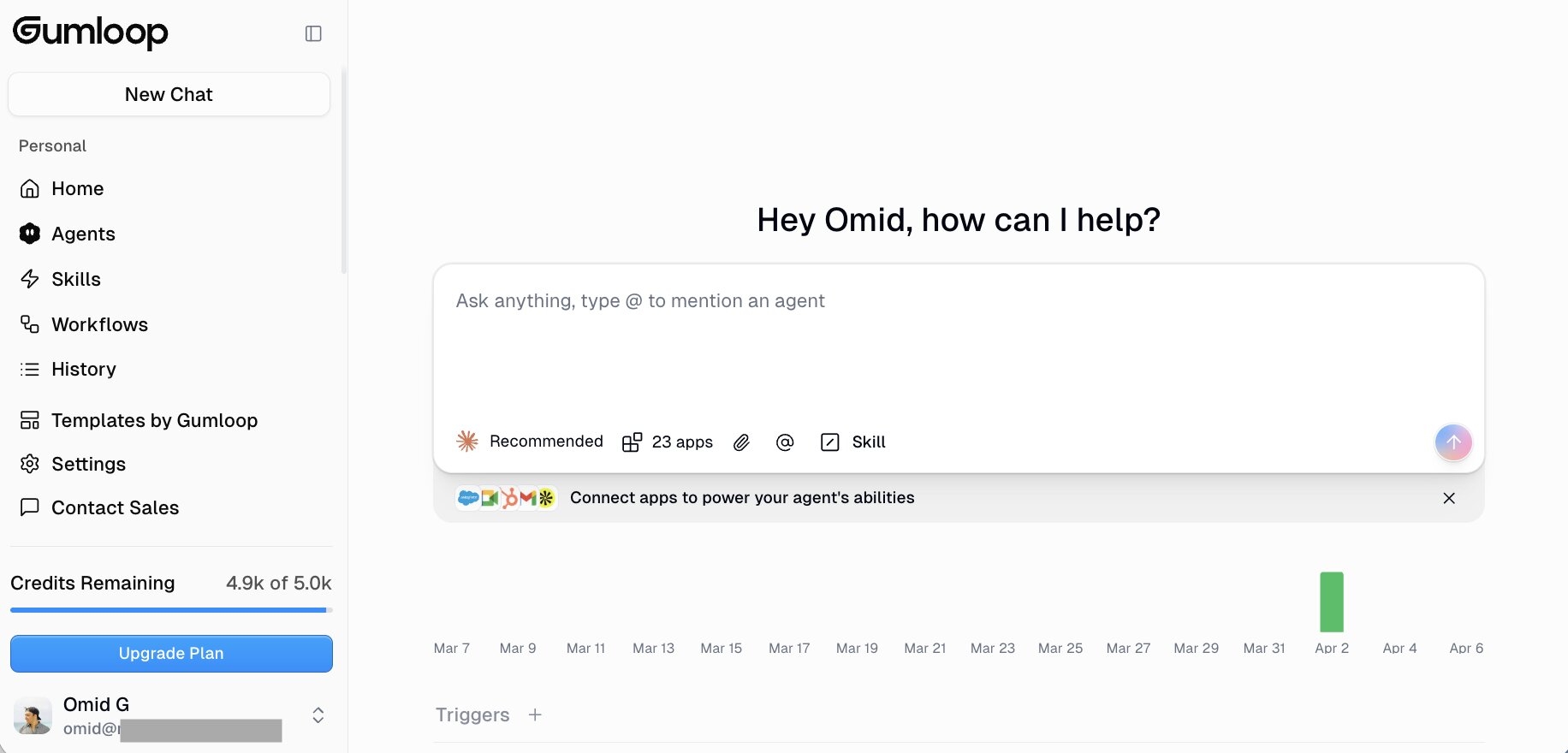
Image source: marketermilk.com
Gumloop is ideal for marketing teams and individuals seeking a visual, no-code platform to automate complex, multi-step workflows like SEO, advertising, and web scraping. Its "Zapier meets ChatGPT" approach provides an intuitive builder for creating autonomous AI agents.
Founded in 2023, Gumloop has quickly established itself as a favored no-code AI agent builder. It allows users to automate nearly any workflow through a visual interface, similar to a flowchart. The platform operates on four core concepts: Nodes (elements like software tools and LLMs), Flows (connections between nodes to create workflows), Subflows (reusable workflows within larger ones, offering advanced modularity), and Agents (fully autonomous entities configured to specific instructions and premium AI models). Gumloop distinguishes itself with a wide range of templates that showcase different use cases, making it easier for users to envision and implement for marketing-specific tasks.
Pricing: Includes free plan, then starts at $37 per month.
2. Relay.app: Best user-friendly automation tool for agencies and customer success teams
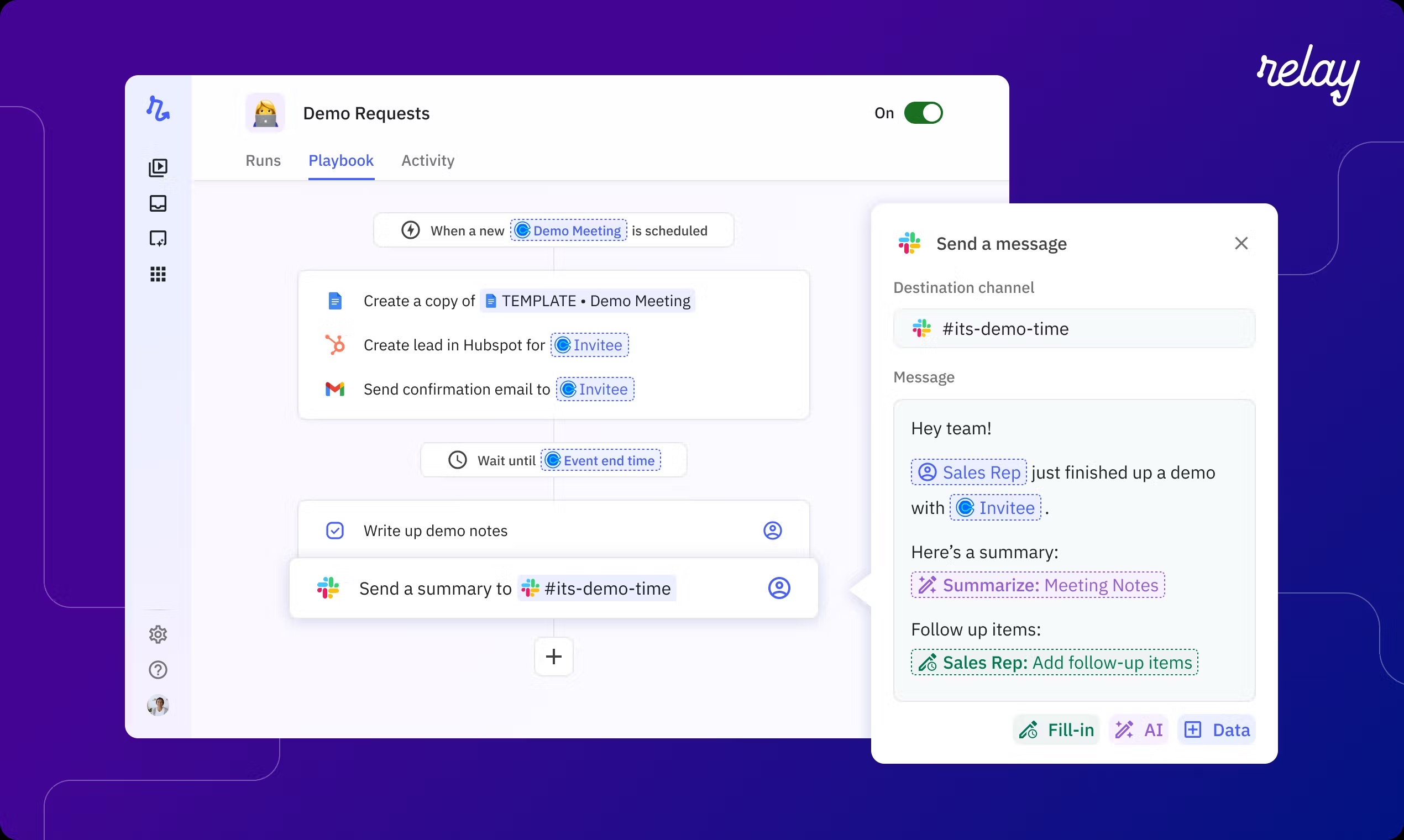
Image source: relay.app
Relay.app is best suited for agencies, service providers, and customer success teams who need a clean, visually appealing platform to automate diverse workflows and integrate seamlessly with a wide array of existing applications.
Launched in 2021, Relay.app provides a clean and user-friendly interface for building AI agents to automate workflows. It shares a visual appeal with platforms like Gumloop and boasts extensive app integrations, simplifying the process of connecting with tools already in use. Relay.app offers an inspiration gallery, providing examples of how to create various , such as an AI Discord bot or an AI agent that enriches CRM contacts with LinkedIn information. This makes it a valuable tool for managing leads, contacts, and automating support tickets, particularly for businesses that rely on extensive client interaction.
Pricing: Includes free plan, then starts at $38 per month.
3. Claude Code: Best advanced framework for developers building highly customized AI agents
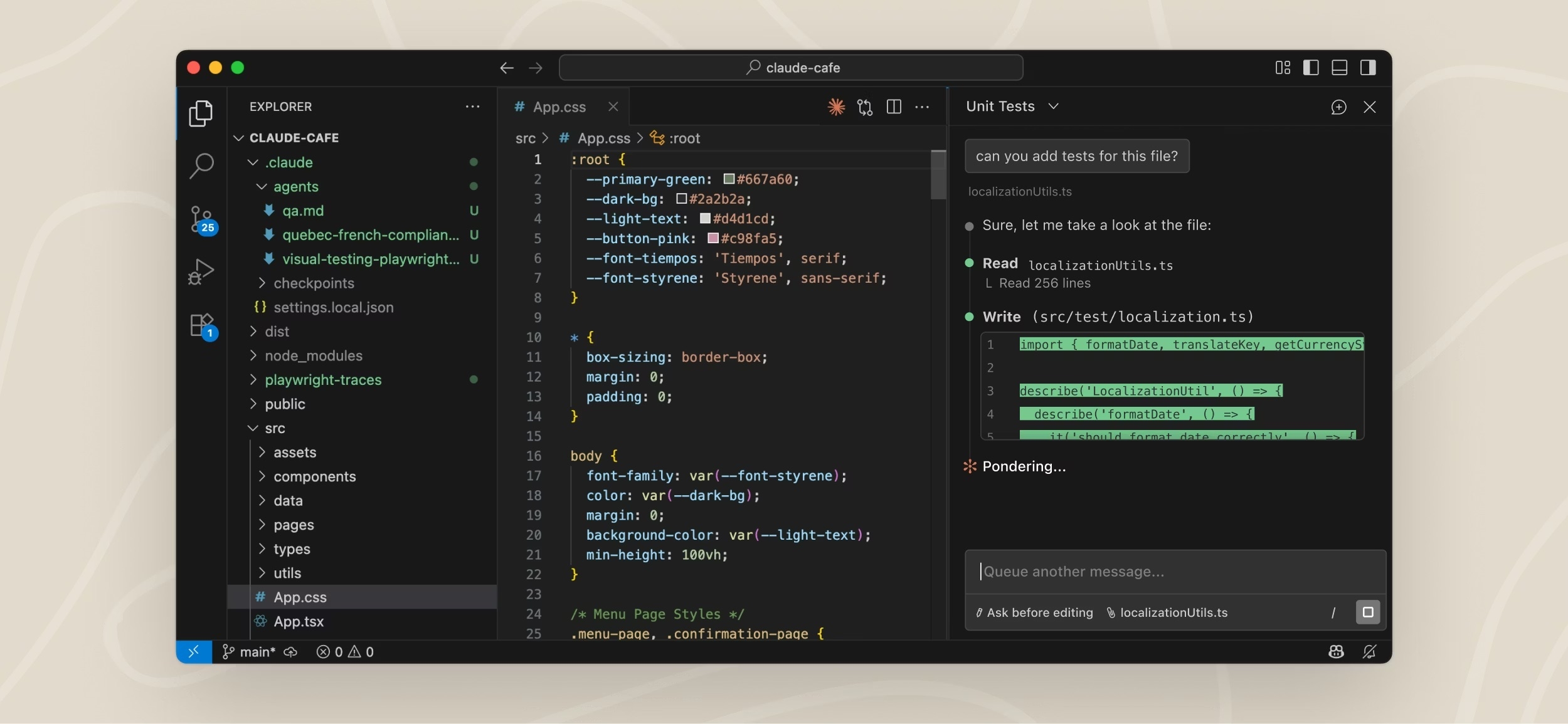
Image source: code.claude.com
Claude Code provides complete flexibility for developers and technically proficient users to build custom AI agents with granular control, leveraging Anthropic's powerful Claude models for complex reasoning and multi-agent orchestration.
Developed by Anthropic, Claude has evolved beyond a conversational AI into a robust platform for AI agent development, including Claude Code. It offers both non-technical routes (using chat features and skills) and a technical route for building highly customized AI agents with natural language. Users can orchestrate multi-agent systems, gaining full control over their specific requirements, either through a terminal or an Integrated Development Environment (IDE). This makes Claude Code a powerful option for those who need deep customization and control over their AI agent's behavior and integrations, particularly in scenarios requiring advanced reasoning and complex logical sequences.
Pricing: Includes free plan, then starts at $20 per month.
4. Zapier: Best foundational integration platform for connecting diverse web applications
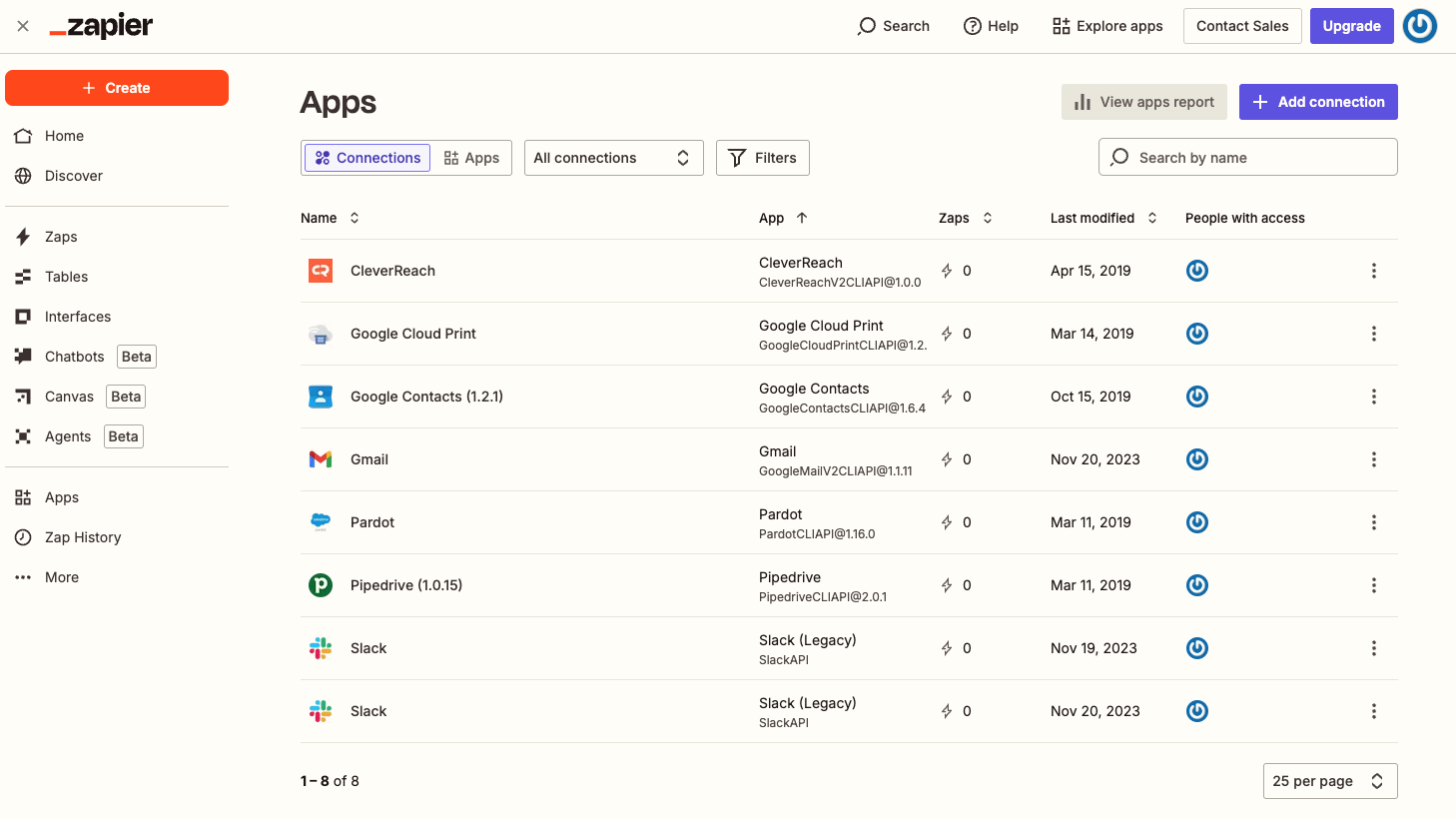
Image source: zapier.com
Zapier is an excellent choice for businesses of all sizes seeking to connect virtually any web application and create automated workflows. While not an AI agent itself, its vast integration library acts as a foundational layer for building powerful, agent-like automations.
Zapier is a widely recognized automation platform that allows users to connect over 6,000 web applications without writing any code. It enables the creation of "Zaps," which are automated workflows where an event in one app (the trigger) automatically causes an action in another app. While primarily an automation tool, its extensive integration capabilities mean it can serve as a powerful backbone for building agent-like behaviors, where data from one AI agent or system can trigger complex sequences across other applications. This flexibility makes it indispensable for streamlining operations and ensuring data flows between otherwise disparate tools.
Pricing: Includes free plan, then starts at $29.99 per month.
5. CrewAI: Best developer framework for building collaborative multi-agent systems
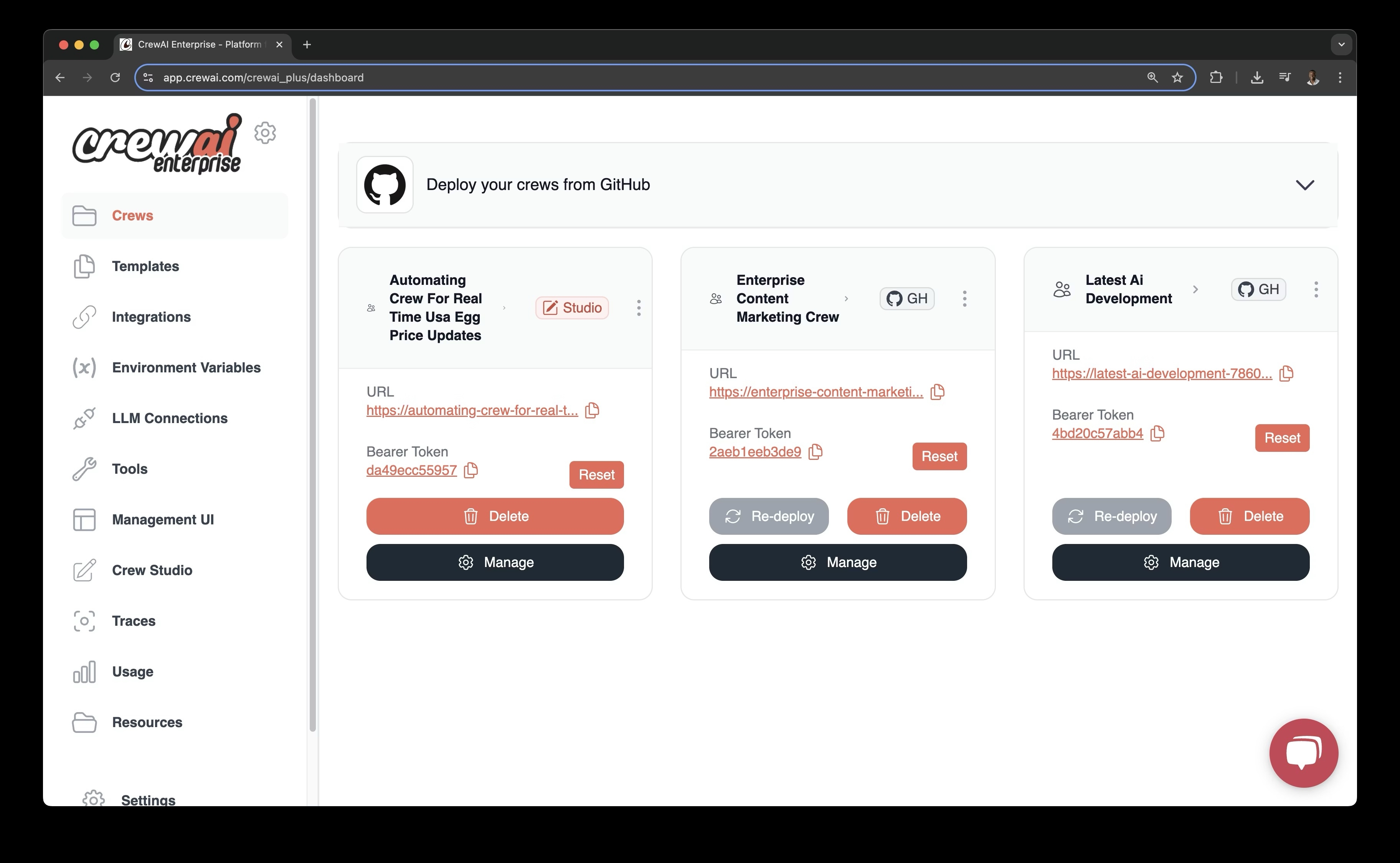
Image source: docs.crewai.com
CrewAI is a powerful framework for developers and teams looking to build sophisticated multi-agent systems, where multiple AI agents collaborate to tackle complex problems and achieve shared goals through orchestrated interaction.
CrewAI is designed specifically for creating "agentic AI" where several AI agents work together, each assigned a specific role, task, and even a "backstory." This allows for the creation of highly intelligent systems capable of complex problem-solving. For instance, a "Researcher Agent" could gather information, a "Writer Agent" could draft content based on that research, and an "Editor Agent" could refine it, all within a single orchestrated workflow. This collaborative approach enhances the overall intelligence and efficiency of the system, making it suitable for intricate projects that require diverse AI capabilities.
Pricing: Includes free plan, then paid plans should contact sales for a quote.
6. Gemini Spark: Best personal AI agent for 24/7 autonomous daily task management
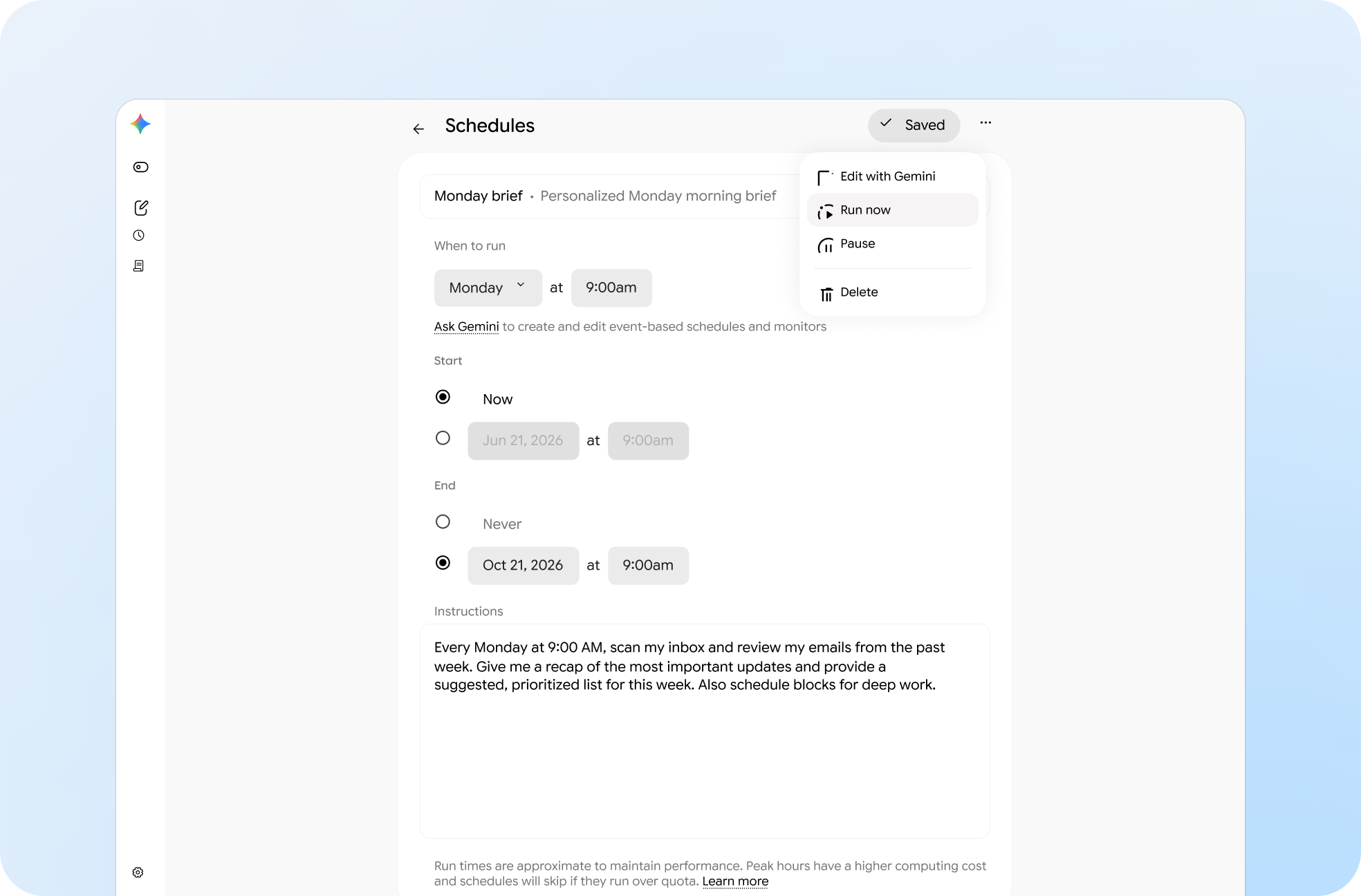
Image source: gemini.google
Gemini Spark is an excellent choice for individuals and professionals seeking a personal AI agent to autonomously manage daily tasks, from scheduling and communication to information retrieval, enhancing personal productivity around the clock.
Gemini Spark positions itself as a 24/7 personal AI agent specifically designed for productivity. It aims to simplify various aspects of digital life by autonomously managing tasks. This includes capabilities like scheduling appointments, setting reminders, handling routine communications, and retrieving information on demand. The focus is on offloading mundane but necessary tasks from the user, allowing them to concentrate on higher-priority work. It's built for ease of use, often emphasizing that no coding skills are needed to leverage its autonomous task management capabilities.
Pricing: No public pricing.
7. Lindy: Best customizable AI employee for automating routine business workflows
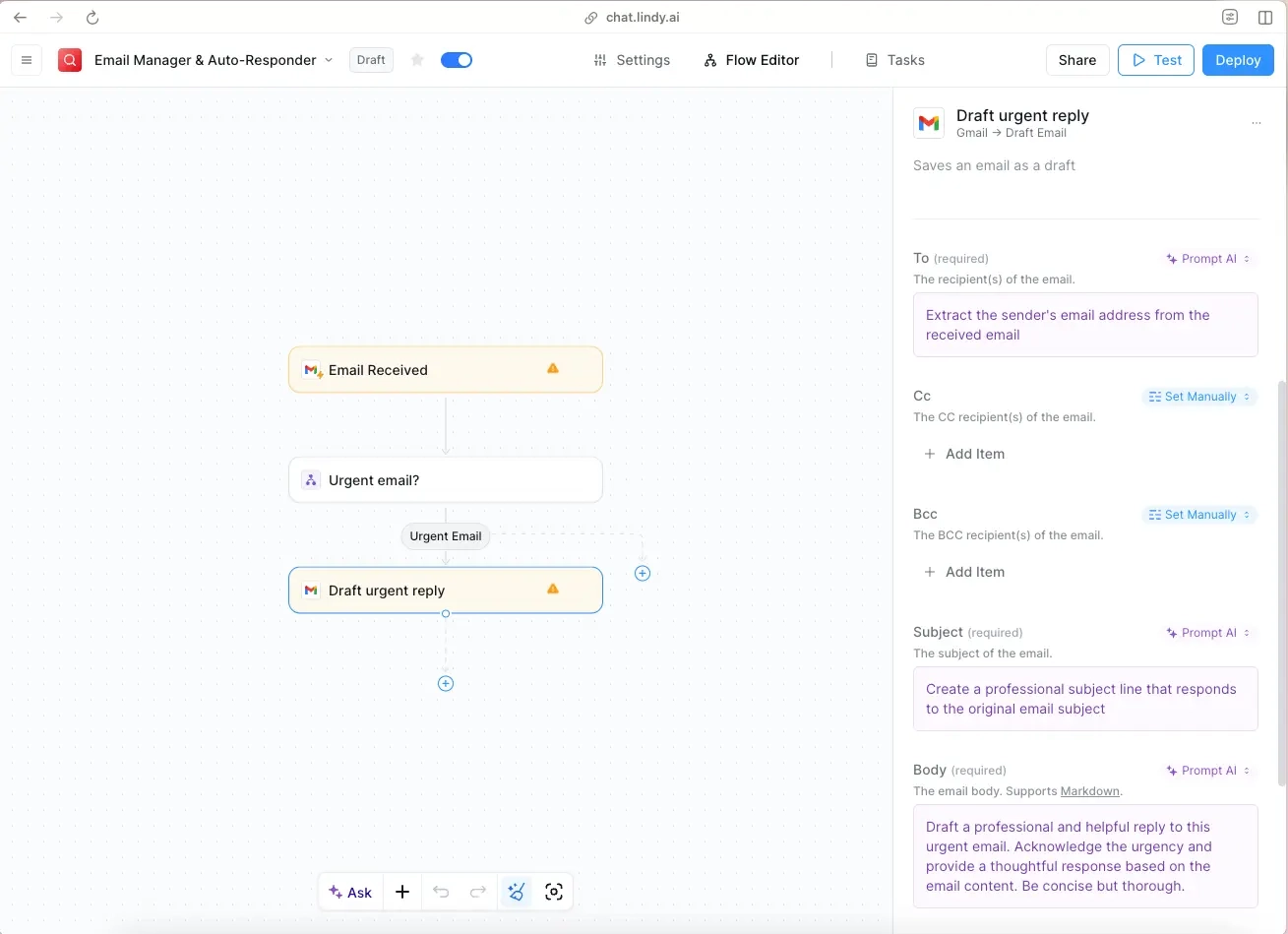
Image source: max-productive.ai
Lindy is an excellent choice for individuals and teams looking to deploy autonomous "AI employees" to handle routine administrative, scheduling, and communication tasks without needing to write code.
Positioning itself as an autonomous AI assistant, Lindy allows users to create specialized agents that can triage emails, manage complex calendar scheduling, draft responses, and update CRM records. It operates based on natural language instructions and triggers. What makes Lindy stand out is its focus on being an active participant in your workflows rather than just a passive chatbot; you can invite Lindy to meetings to take notes, or have it monitor your inbox and independently draft replies based on your company's knowledge base. It is a prime example of an intelligent agent offloading routine work to free up human capacity.
Pricing: Includes free plan, then starts at $49.99 per month.
Critical considerations: The Challenges of Isolated AI Agents
While the potential of individual AI agent apps is compelling, my experience tells me there's a crucial caveat: the true value of these tools can be severely limited by their isolated nature. Many AI agents, powerful as they may be on their own, often operate within their own confined digital worlds. This leads to a set of critical challenges that can actually hinder, rather than help, overall business productivity.
The Integration Conundrum
We've all experienced the frustration of tools that operate in silos, unable to communicate effectively with each other. This is a core challenge highlighted by users, who often ask, "Is there an AI agent that can actually work across multiple apps, or are they all stuck in silos?" . When you deploy several AI agents, each specializing in a different function (e.g., one for , another for , a third for ), you risk creating new fragmented workflows. Information created by one agent might not be accessible or understood by another, leading to a loss of crucial context and defeating the very purpose of automation.
Mini-scenario: A customer support AI agent might resolve a complex query and update the support ticket. However, if this agent can't connect with the product development AI agent, the valuable customer feedback might never reach the team responsible for implementing improvements, creating an operational gap.
Security and Compliance Risks in a Disparate Ecosystem
becomes significantly more complex when information is scattered across numerous, uncoordinated AI agent applications. Each tool comes with its own security protocols, data handling policies, and potential vulnerabilities. Ensuring consistent compliance and safeguarding sensitive business information across such a disparate ecosystem introduces a substantial burden and heightened risk.
Lost Context and Reduced Intelligence
The effectiveness of an AI agent, particularly a knowledge-based agent, depends heavily on its access to comprehensive and relevant information. If an AI agent cannot access and synthesize data across all relevant sources within a team's digital workspace – from chat conversations to project documents and calendars – its reasoning and decision-making capabilities are inherently limited. It becomes less "intelligent" because it operates with an incomplete picture.
Scalability Challenges and Management Overhead
While individual AI agents promise efficiency, attempting to scale multiple, independent solutions can quickly . Each agent might require separate configuration, maintenance, and monitoring. This fragmented management approach can become counterproductive for growing teams, negating the expected productivity gains and adding complexity rather than reducing it.
Intelligence and Adaptability
While individual agents might be smart, their true "intelligence" and adaptability are amplified when they operate within a unified context. When an agent can learn from and adapt based on a holistic view of your business operations, rather than just its siloed function, its value multiplies. The challenge is enabling this unified context across your tool stack.
Orchestrating Intelligence: How Lark transforms AI Agent potential
Having discussed the inherent pitfalls of deploying AI agents in isolation, I want to introduce a strategic approach that addresses these challenges head-on: the unified platform. This is where tools like come into play, offering a comprehensive, all-in-one environment designed to integrate and orchestrate AI agent capabilities effectively. My belief is that a truly powerful AI agent strategy isn't about collecting the most individual agents, but about ensuring they work together harmoniously within a shared, intelligent workspace.
is built to directly counteract the fragmentation and context loss I outlined earlier. By combining , , , , , , , , and into a single platform, Lark provides an ideal foundation for AI agent integration and orchestration.
The power of context
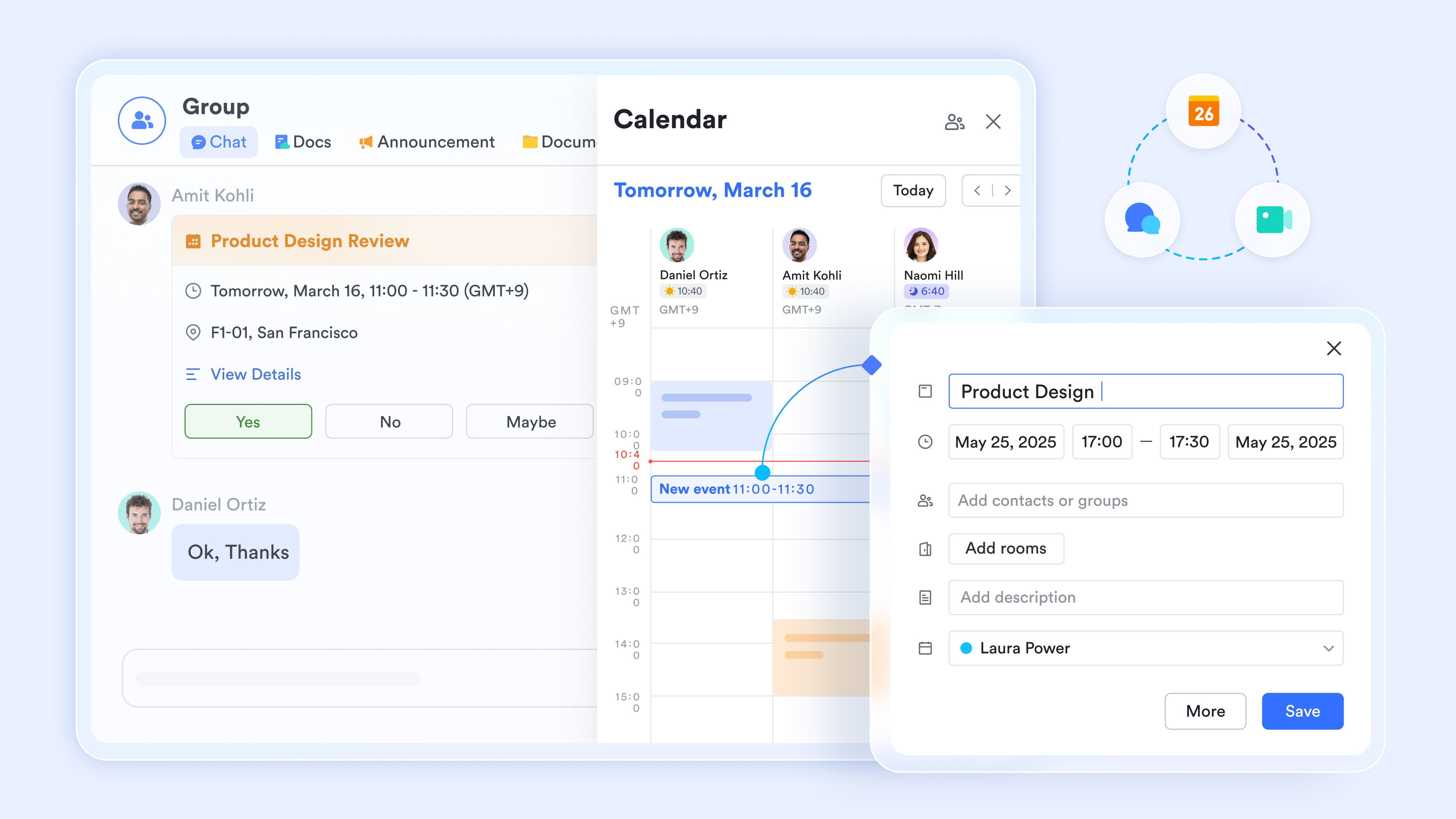
Imagine an AI agent attempting to summarize a project's status. In a fragmented environment, it would need to access chat logs from , documents from , tasks from , and meeting notes from . This patchwork approach often means incomplete information and a struggle to maintain context. fundamentally changes this. Its integrated suite means that all these elements exist within a single, interconnected ecosystem. This rich, shared context allows AI agents operating within or integrated with Lark to perceive a much fuller picture. They can access and synthesize information across functions effortlessly, making their reasoning more robust and their actions more intelligent.
Mini-scenario: Consider an AI agent tasked with drafting a weekly project update. Within Lark, this agent can access the project's dedicated chat group for recent discussions, review the associated for the latest progress, check the shared calendar for upcoming deadlines, and even pull data from related approval workflows. This holistic view enables the AI to generate an update that is not just accurate but also deeply informed by real-time team activities and broader project goals.
Streamlining operations through integrated automation
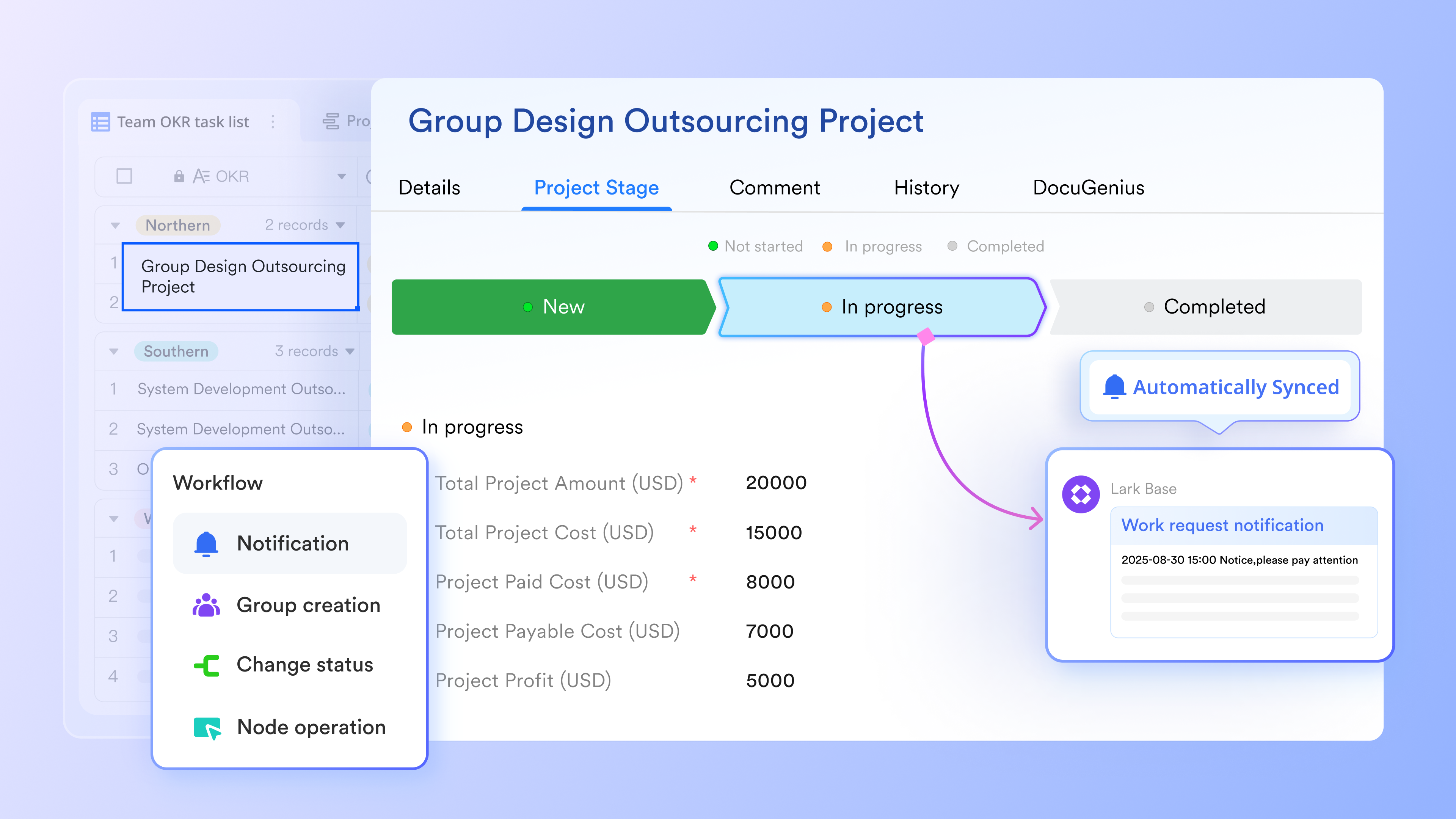
’s robust automation tools and open API capabilities are not just for basic workflow automation; they are designed to be a powerful conduit for AI agents. This means businesses can either integrate their chosen AI agents into Lark or build AI-powered workflows directly within the platform. This centralized approach reduces the complexity of managing disparate automation systems. For example, an AI agent could monitor external data streams (like market trends or customer feedback) and, upon detecting a significant trigger, automatically initiate an approval workflow in Lark for a , complete with pre-filled forms and stakeholder notifications. Similarly, once an AI agent verifies that all required tasks for a product launch are complete, it could automatically update the project status in a shared and notify the relevant teams via chat.
Enhancing collaborative intelligence
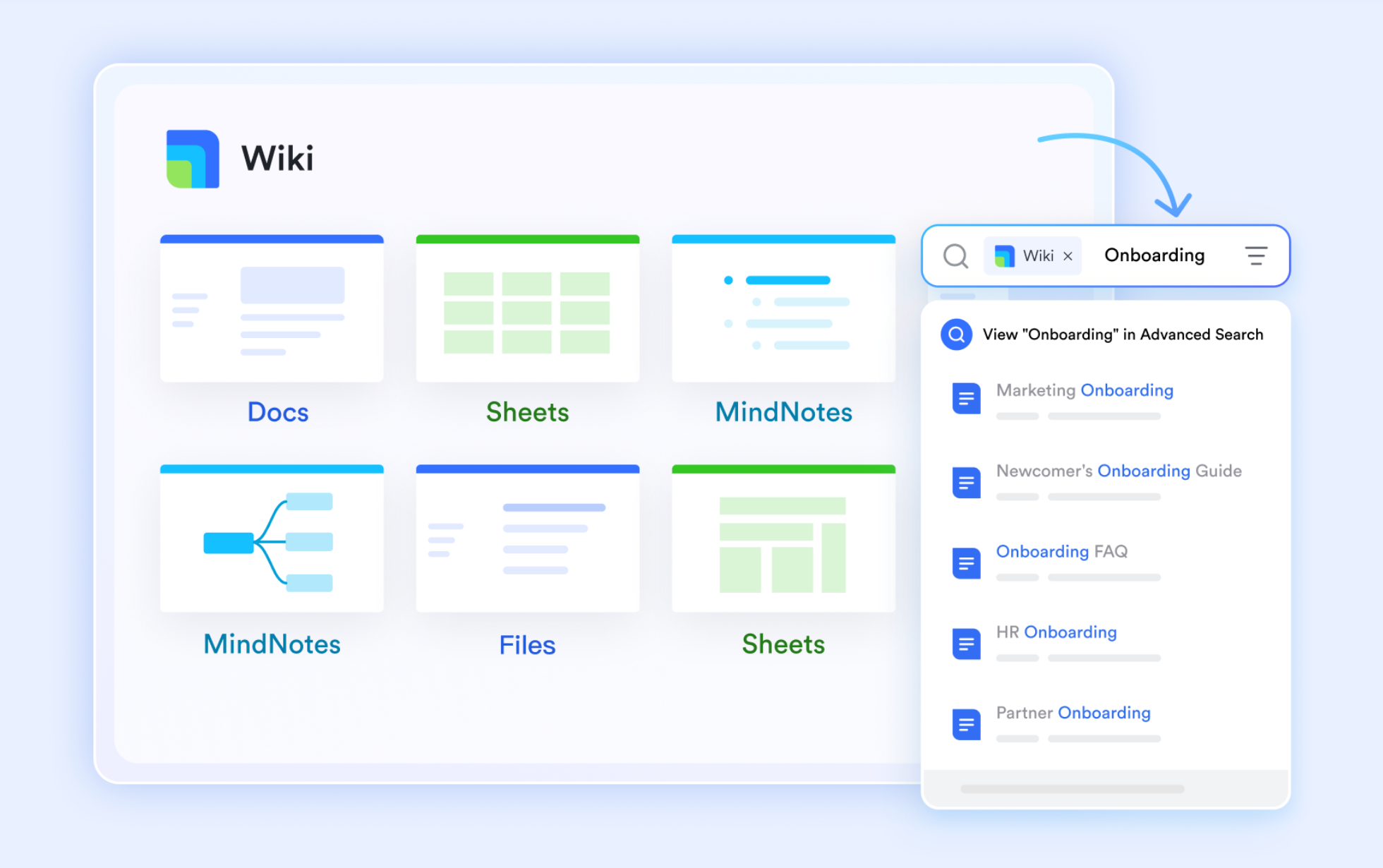
is at the heart of Lark. When augmented by AI agents, this collaboration becomes even more powerful. Imagine a video meeting where an AI agent provides real-time summaries, identifies action items during discussions, and automatically assigns these tasks to relevant team members in . Furthermore, Lark’s integrated and knowledge management features can be supercharged by AI agents that continuously organize, update, and retrieve crucial information, ensuring that teams always have immediate access to the most current knowledge without ever leaving their workspace.
Cost-effective productivity for teams of all sizes
Beyond enhanced functionality, Lark also offers a compelling value proposition in terms of cost. By consolidating numerous essential tools into one platform, it reduces the need for multiple, expensive subscriptions – a common issue when teams haphazardly adopt various standalone AI agent tools. Lark’s flexible pricing models cater to teams of all sizes.
- Starter plan: Free forever plan with 11 powerful tools for up to 20 users, 100GB storage, 1,000 automation runs, AI translations, and more. No credit card needed.
- Basic plan: $6/user/month (billed annually) for up to 500 users. Includes everything in Starter plus unlimited message history, 5TB storage, 1,000 automation runs, and more. Some users may need to to purchase.
- Pro plan: $12/user/month (billed annually) for up to 500 users. Includes everything in Basic plus group calling for up to 500 attendees, 15TB storage, 50,000 automation runs, and more.
- Enterprise plan: for custom pricing. Supports unlimited users and includes advanced automation, security, compliance, and management features.
For small teams with simple communication needs

18 months message history
1000 Base automation runs/month
2000 rows per table in Base
Most POPULAR
For companies with comprehensive collaboration and management needs
Unlimited message history
500-participant video meetings
50k Base automation runs/month
20k rows per table in Base
For large companies with advanced security and organizational management needs
Get a personalized demo and pricing
Unlimited message history
500-participant video meetings
15 TB storage + 30 GB storage/user
500k Base automation runs/month
50k Base automation runs/month
Most POPULAR
For companies with comprehensive collaboration and management needs
Unlimited message history
500-participant video meetings
50k Base automation runs/month
20k rows per table in Base
This consolidated solution helps businesses manage their digital ecosystem more efficiently, reducing both direct software costs and the hidden costs associated with managing fragmented tool stacks.
Overcome fragmented data and enhance agent intelligence
The Road Ahead: The Evolving Landscape of AI Agent Technology
The journey of AI agent technology is still in its early stages, yet the pace of innovation is extraordinary. Looking ahead, we can anticipate several key developments that will further shape how these intelligent systems transform our work environments. Expect to see agents with even more enhanced reasoning capabilities, moving beyond to truly proactive problem-solving and . Multi-agent collaboration, where diverse AI entities work together on complex problems (much like CrewAI aims to do), will become more sophisticated, leading to intricate, self-optimizing business processes.
Perhaps most critically, the future will bring more refined and intuitive human-AI interaction models. We're moving towards a world where interacting with AI agents feels less like giving commands to a machine and more like collaborating with an exceptionally efficient and informed colleague. However, as these systems become more autonomous and integrated into our daily operations, and robust governance cannot be overstated. Ensuring transparency, accountability, and fairness in their deployment will be paramount to building trust and realizing their full, positive potential.
Conclusion
AI agent apps hold transformative potential for business productivity and operational intelligence. Their true power, however, emerges when orchestrated within an integrated environment, not when operating in isolation. Relying on disparate agents risks recreating fragmentation and lost context. My professional assessment recommends a unified platform like . It provides the essential shared workspace, allowing AI agents to operate with rich context, enhancing collaboration, and driving efficiency for greater organizational success.
Unlock the full potential of AI agents for your organization
FAQs
What are the best platforms for building AI agents without coding?
The article highlights platforms like Gumloop and Relay.app as excellent choices for building AI agents and automating workflows with a visual, no-code approach. Zapier is also mentioned for its extensive no-code integration capabilities, which can be used to create powerful, agent-like automations across various applications.
Can we use an AI agent to build apps?
While AI agents are highly capable of automating tasks, generating content, and even assisting with code generation (as suggested by tools like Claude Code for developers), using an AI agent to autonomously build entire applications is generally beyond the scope of their current capabilities described in this article. Their primary strength lies in executing complex workflows and tasks within existing systems or orchestrating interactions between them, rather than creating new software from scratch without human intervention.
What is the main challenge with using multiple AI agent apps in isolation?
The article points out that the true value of individual AI agent apps can be severely limited by their isolated nature. The main challenges include integration issues (agents operating in silos, unable to communicate), increased security and compliance risks, loss of context leading to reduced intelligence, and significant management overhead when scaling multiple independent solutions.
How does a unified platform like Lark help maximize the potential of AI agents?
A unified platform like Lark maximizes AI agent potential by providing a comprehensive, all-in-one environment that counteracts fragmentation. It offers a rich, shared context across messaging, documents, meetings, and calendars, allowing AI agents to access and synthesize information holistically. This enables more robust reasoning, streamlined operations through integrated automation, and enhanced collaborative intelligence, leading to a truly powerful and harmonious AI agent strategy.
What differentiates an AI agent from traditional automation scripts?
The article explains that an AI agent differentiates itself from traditional automation scripts by its capacity for advanced reasoning, continuous learning, and independent task execution. Unlike a fixed automation script, an AI agent can observe its digital environment, adapt to new data, make informed decisions, and plan multi-step processes to achieve objectives with a higher degree of independence and cognitive ability.
Related reading