Kanban flow explains how work moves through a system in a continuous, visible, and controlled manner. This approach helps teams respond to changes while maintaining predictability and efficiency. By visualizing flow and tracking key metrics, teams can improve delivery without increasing workload pressure. As organizations increasingly manage ongoing and fast-changing work, Kanban flow provides a practical framework for sustainable improvement.
What is Kanban flow?
Kanban flow refers to the continuous movement of work items through a defined process without fixed iterations or timeboxes. It emphasizes finishing work before starting new tasks to avoid congestion and delays. By implementing , teams can balance demand with capacity. Focusing on movement rather than milestones, teams gain clearer insight into how work actually gets done. Kanban flow is not about speed alone but about consistency and predictability. When work flows smoothly, teams experience fewer surprises and less rework.
Kanban process flow explained
A Kanban process flow shows how work moves through a system in a continuous and structured way. It helps teams manage demand, reduce delays, and improve delivery consistency.
From request to delivery
This flow covers the full journey of work from initial request to completion. It helps teams understand where time is spent and where improvements are needed.
Typical stages in a : Typical stages represent key steps such as intake, in review, process, and done. Each stage reflects a real state of work rather than a status update. Clear stages improve coordination and reduce confusion during handoffs.
Entry and exit criteria: Entry and exit criteria define when work can move into or out of a stage. These rules ensure tasks are ready before work begins and are completed before advancing. Clear criteria help reduce rework and improve flow stability.
Pull-based movement
Pull-based movement means work is started only when capacity is available. This approach prevents overload and supports a sustainable delivery pace.
How work progresses without : Work moves forward based on readiness instead of fixed deadlines. Teams focus on finishing current work before starting new items. This flexibility helps maintain a steady flow even as priorities change.
Kanban flow chart and diagram examples
Kanban flow charts and diagrams make the movement of work visible. They help teams understand how tasks progress, where delays occur, and how flow can be improved.
Basic Kanban flow diagram
A basic Kanban flow diagram shows work moving through clearly defined stages, such as "To do" → "In progress" → "Review" → "Done".
Useful for new Kanban teams: This diagram is ideal for teams just starting with Kanban. The simple structure makes easy to grasp. It reduces time and confusion.
Highlights stage transitions and handoffs: Stage transitions clearly show how work moves between steps. This visibility improves coordination and ownership. Handoffs become more predictable and consistent.
Makes work-in-progress limits easy to explain: WIP limits are easier to understand when shown visually. Teams can clearly see capacity constraints at each stage. This supports disciplined and balanced flow management.
Kanban flow chart with WIP limits
This type of diagram adds explicit WIP limits to each stage.
Helps prevent overloading the team: WIP limits restrict how much work can be active at one time. This reduces multitasking and stress. Teams can focus on .
Makes bottlenecks visible when work piles up: When a stage reaches its limit, delays become immediately visible. Teams can identify constraints quickly. This supports faster problem resolution.
Reinforces pull-based movement instead of task pushing: Work is pulled into a stage only when space is available. This prevents forced task assignments. Flow remains balanced and predictable.
Continuous flow diagram in Kanban
A continuous flow diagram focuses on steady movement rather than batches or iterations.
Emphasizes finishing work before starting new items: This approach prioritizes completing active tasks before beginning new ones. By integrating this into your , you reduce context switching and delays. Flow efficiency improves as work moves forward consistently.
Common in support, operations, and service teams: Teams with ongoing incoming work benefit most from continuous flow. It adapts easily to changing demand. Predictability improves without rigid planning.
Supports faster feedback and shorter cycle times: Steady completion allows teams to receive feedback quickly. Issues are identified earlier. Cycle times become shorter and more consistent.
Kanban process flow diagram
This diagram zooms out to show the end-to-end journey of work, from request intake to delivery.
Includes entry and exit criteria: This diagram clearly defines when work can move between stages. Entry and exit rules help maintain quality and consistency. They reduce rework and uncertainty.
Useful for aligning stakeholders on how work enters the system: The gains clarity on intake, prioritization, and decision points. This alignment reduces confusion and conflicting expectations. improves across teams.
Often paired with policies that define ready and done: Clear policies establish shared standards for work readiness and completion. Teams follow consistent guidelines. Flow becomes more predictable and reliable.
How to choose different Kanban flow diagram
Kanban flow diagrams serve different purposes depending on a team's maturity, workload patterns, and delivery challenges. Choosing the right diagram helps work more effectively, apply appropriate controls, and improve kanban flow efficiency without unnecessary complexity. This section explains when each kanban flow diagram is most useful and how it supports better decision-making and continuous improvement.
Key Kanban flow metrics you should track
Tracking the right kanban flow metrics helps teams understand how work actually moves through their system. These metrics reveal delays, capacity issues, and improvement opportunities, enabling teams to optimize based on real data rather than assumptions.
- Lead time: Lead time measures how long a work item takes from request to delivery. It reflects the full customer-facing experience. Shorter and more predictable lead times indicate a healthier kanban flow and better service reliability.
- Cycle time: Tracks how long work takes once it actively starts. It helps teams understand execution efficiency. Monitoring this highlights internal bottlenecks and opportunities to streamline .
- Throughput: Throughput shows how many work items are completed over a given period. It provides insight into team capacity and delivery trends. Stable throughput supports better forecasting and continuous flow planning.
- Work in progress (WIP): WIP measures how many items are actively being worked on at once. Limiting WIP reduces multitasking and congestion. Controlled WIP is essential for maintaining smooth, predictable kanban flow.
Kanban flow vs traditional project management
Kanban flow and represent two fundamentally different ways of organizing and delivering work. While traditional approaches emphasize upfront planning and task control, kanban flow focuses on continuous movement, adaptability, and flow-based optimization. Understanding these differences helps teams choose the right approach based on work type, uncertainty level, and delivery goals.
When Kanban flow works better
Kanban flow is best suited for work that is continuous, change-driven, and capacity-based. It helps teams stay flexible while maintaining visibility and control over how work progresses by adopting principles.
- Environments with frequent changes: In fast-changing environments, priorities often shift based on customer needs, incidents, or market conditions. Kanban flow allows teams to reprioritize work without disrupting the entire system. Because work is pulled based on capacity, changes are absorbed smoothly rather than causing delays or rework.
- Ongoing operational or service work: Operational teams handle a steady stream of requests rather than a fixed scope of tasks. Kanban continuous flow diagrams help visualize intake, processing, and completion in real time. This supports predictable delivery while avoiding overload in high-volume environments.
- Teams aiming to improve delivery speed and stability: Kanban flow metrics such as lead time and cycle time highlight where work slows down. Teams can use to experiment with small process changes and measure results quickly. Over time, this leads to faster delivery and more stable performance without increasing workload pressure.
When traditional project management works better
Traditional project management fits work that requires a fixed scope, formal planning, and strong control mechanisms. It provides structure and predictability for initiatives with defined outcomes and timelines.
- Fixed-scope initiatives: When , timelines, and budgets are defined early, traditional project management provides clarity and alignment. Detailed planning helps teams coordinate dependencies and manage expectations. This approach reduces uncertainty when scope flexibility is limited.
- Regulatory or contract-driven projects: Projects governed by regulations or contracts often require formal documentation, approvals, and audits. Traditional project management supports these needs through structured phases and review gates. This ensures compliance while maintaining traceability and control.
- Work with a clear start and end point: Projects such as system implementations or facility builds have a defined lifecycle. Traditional methods help teams track progress through milestones until formal closure. This makes it easier to measure success against planned outcomes.
Practice the flow right in real projects
Turning Kanban flow diagrams into working systems with Lark
Kanban flow diagrams are only valuable when they translate into real, day-to-day execution. Teams need tools that not only visualize work but also keep the flow accurate as priorities, ownership, and capacity changes. This is where Kanban concepts move from theory into practice. By connecting boards, tasks, data, and , , one of the robust , helps teams turn Kanban flow diagrams into living systems that support continuous delivery and improvement.
Visual project control with flexible Kanban views
Lark Base lets teams turn structured tables into Kanban views with a single switch, making work instantly easier to read and manage. Tasks can be organized by status, priority, owner, or any custom field, so each team sees progress in a way that matches how they work. Every Kanban card surfaces essential details at a glance, helping teams quickly spot active work, blocked items, and upcoming priorities. The result is a visual flow that adjusts naturally to different processes without complex setup. 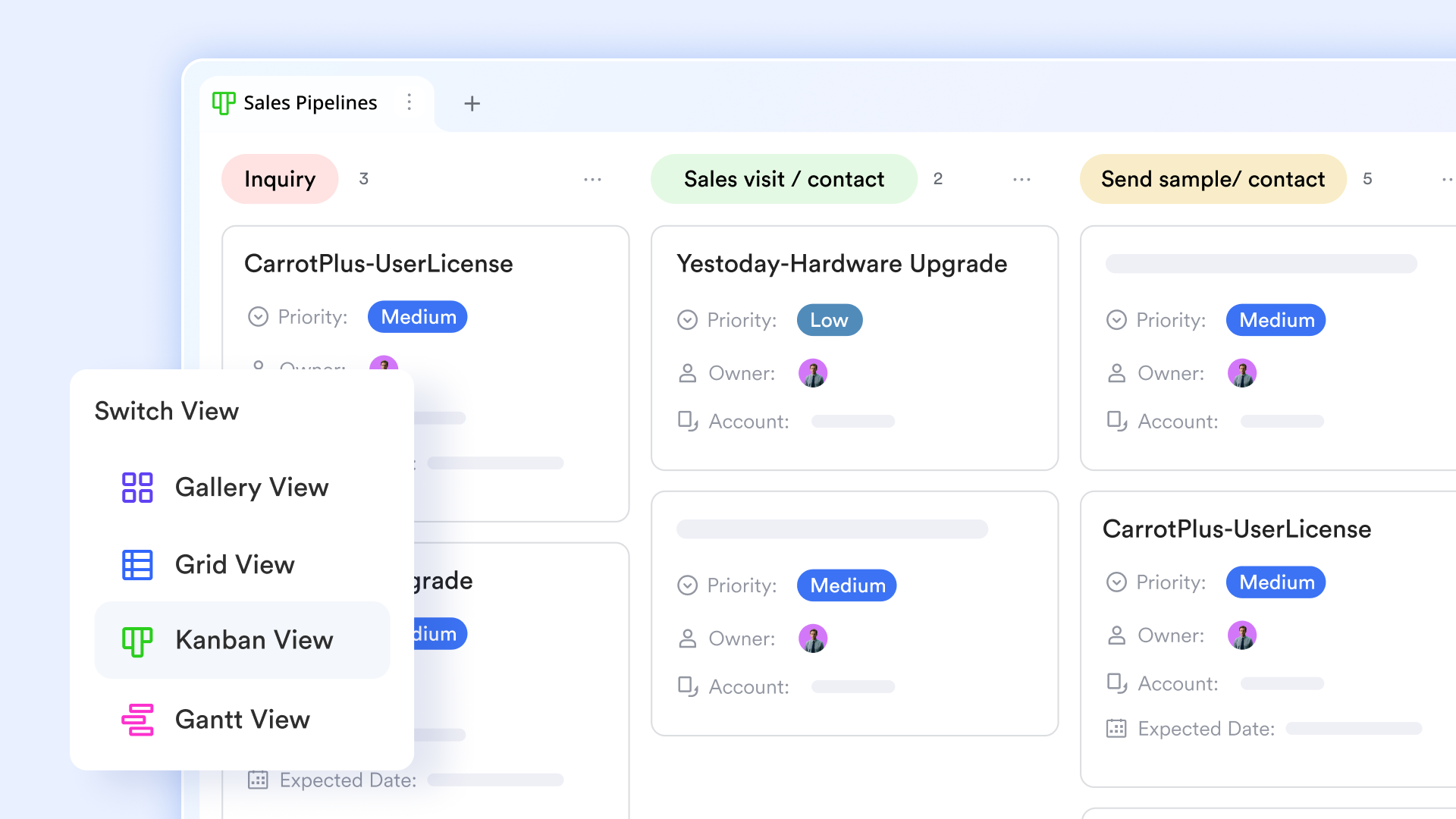
Kanban-style task execution is built into daily work
Lark Tasks brings Kanban thinking directly into task execution. Teams can move work forward simply by dragging task cards across customizable columns, keeping progress up to date in real time. Tasks can be grouped by sections, due dates, or other attributes, while filters and sorting help teams zero in on what matters most. With discussions and updates happening in the same workspace, teams stay aligned as work moves from start to completion. 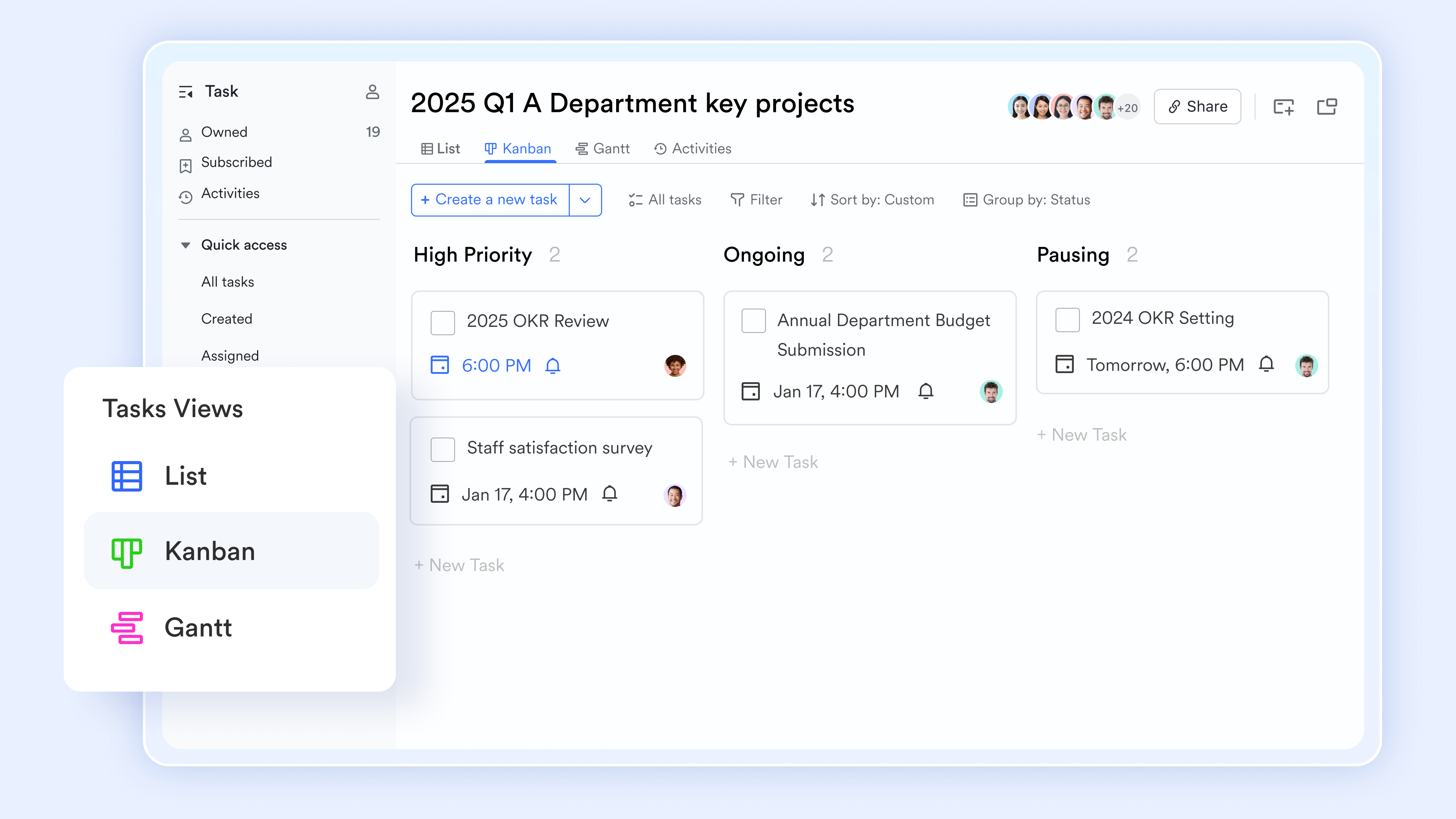
Dashboards that expand Kanban visibility beyond the board
Lark Base dashboards make it possible to surface Kanban views alongside metrics and summaries in one place. Teams can combine Kanban blocks with charts, tables, and rollups to create real-time views of workflow health and performance. This approach gives managers a broader perspective on progress without requiring them to switch between multiple views or datasets, supporting faster and more informed decisions. 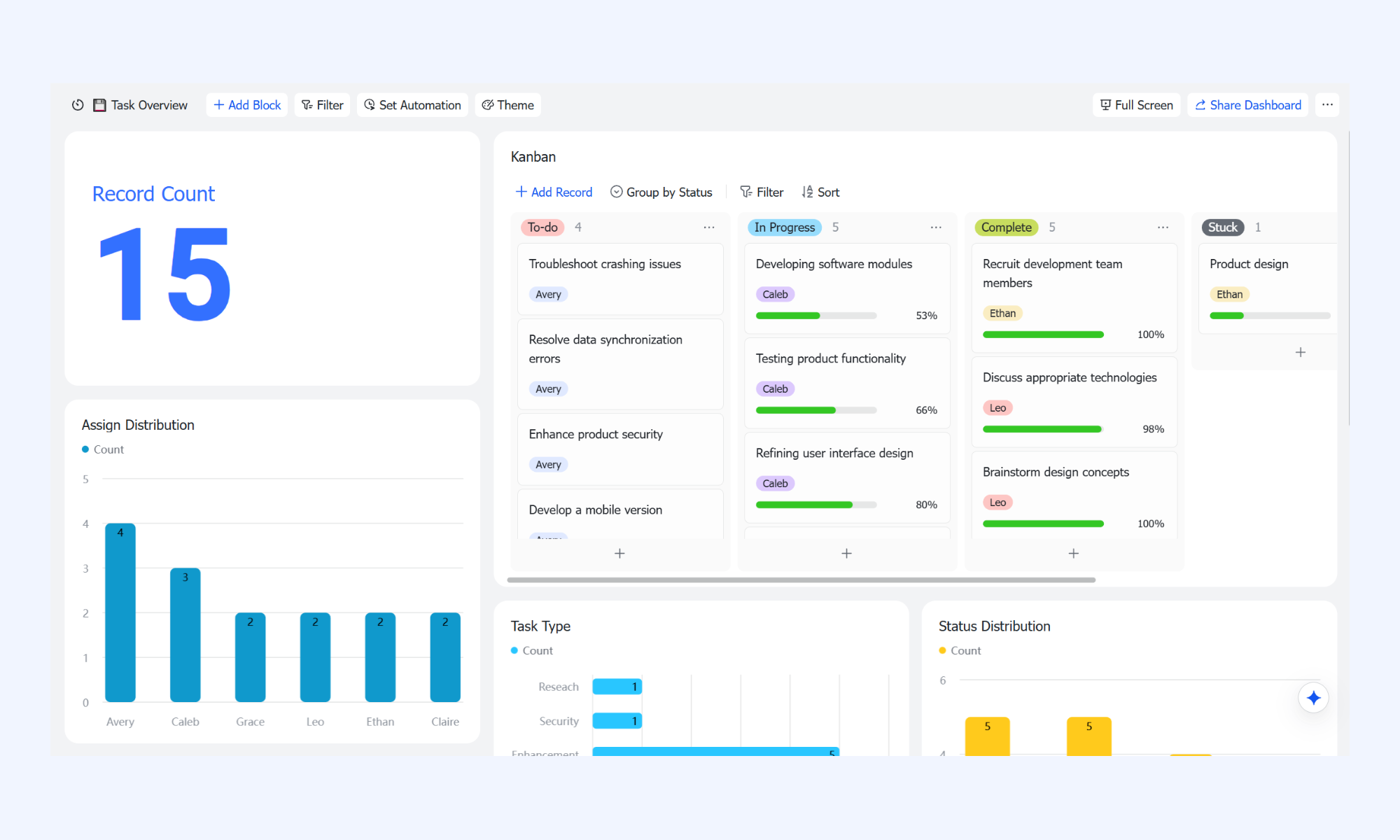
Connected Kanban workflows through linked records
With one-way and two-way links in Lark Base, Kanban boards can reflect relationships across projects, tasks, and supporting data. Cards can connect to related records such as parent projects, deliverables, or dependent work, making dependencies visible directly within the Kanban view. This creates a more complete picture of how work fits together across teams, rather than treating tasks as isolated items. 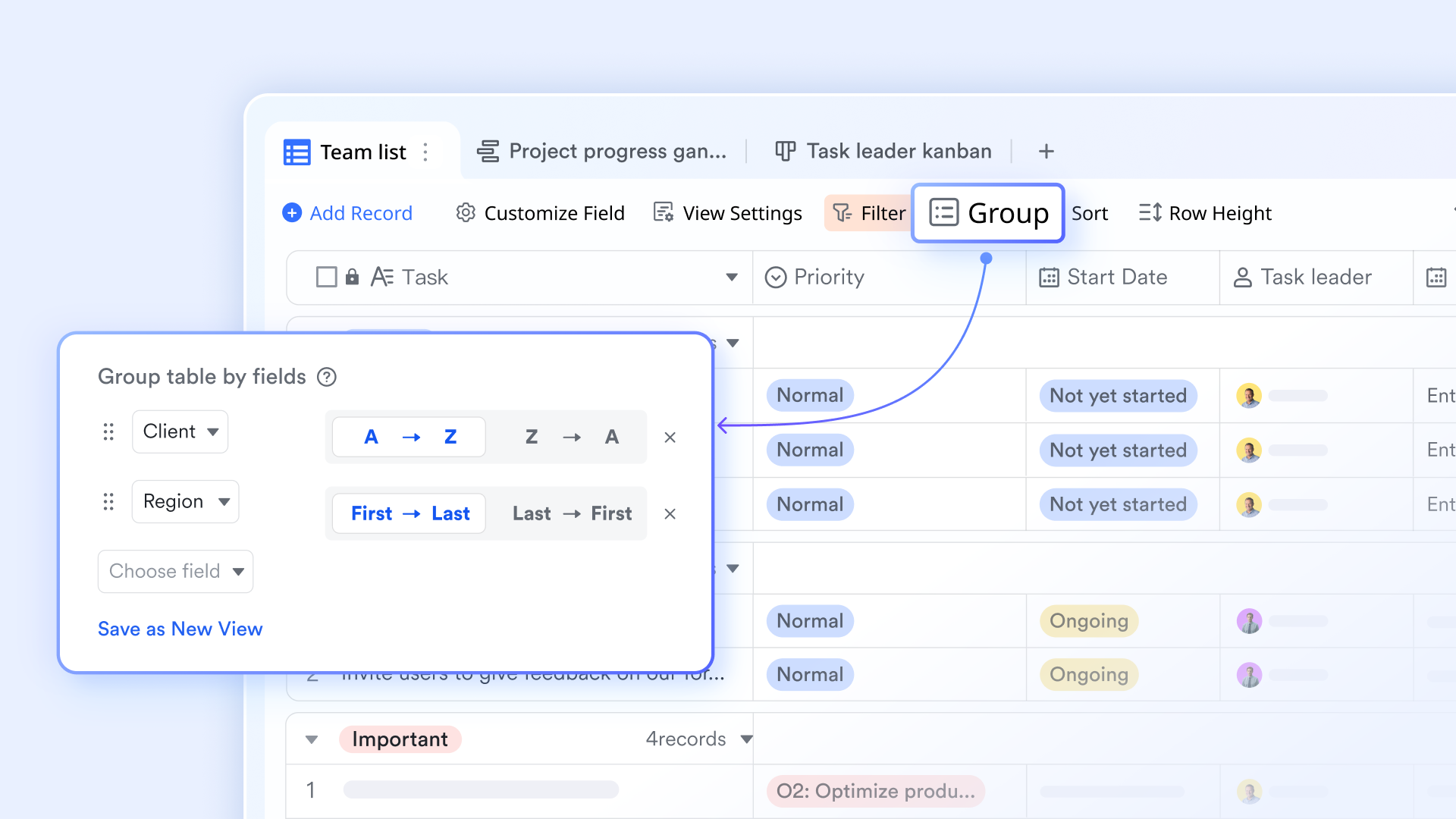
Ready-made templates for faster Kanban adoption
Lark provides ready-to-use templates that help teams start with Kanban workflows immediately. These templates include predefined fields for task status, owners, deadlines, priorities, and reminders, offering a solid foundation from day one. Teams can easily tailor the setup by adding fields, adjusting stages, or changing how work is grouped. This makes it easier to roll out consistent while still allowing flexibility as workflows evolve.
:
- Starter plan: Free forever plan that includes 11 powerful tools for up to 20 users. It also comes with 100GB of storage, 1000 automation runs, AI translations, and more.
- Pro plan: $12/user/month (billed annually) for up to 500 users. It includes everything in Starter plus group calling for up to 500 attendees, 15TB of storage, 50,000 automation runs, and more.
- Enterprise plan: for custom pricing. Supports unlimited users and includes even more automation runs and advanced security, compliance, and management features.
For small teams with simple communication needs

18 months message history
1000 Base automation runs/month
2000 rows per table in Base
Most POPULAR
For companies with comprehensive collaboration and management needs
Unlimited message history
500-participant video meetings
50k Base automation runs/month
20k rows per table in Base
For large companies with advanced security and organizational management needs
Get a personalized demo and pricing
Unlimited message history
500-participant video meetings
15 TB storage + 30 GB storage/user
500k Base automation runs/month
50k Base automation runs/month
Most POPULAR
For companies with comprehensive collaboration and management needs
Unlimited message history
500-participant video meetings
50k Base automation runs/month
20k rows per table in Base
Common Kanban flow problems and solutions
Even well-designed Kanban systems can lose effectiveness if flow principles are not actively maintained. These common problems usually emerge as teams scale or when practices drift over time. Identifying and correcting them early helps restore smooth flow, predictability, and continuous improvement.
- Too many stages: Excessive columns make the Kanban flow diagram hard to read and slow decision-making. Teams should consolidate stages to reflect real workflow steps rather than detailed status updates. Fewer stages improve clarity, reduce handoff delays, and make bottlenecks easier to spot.
- Unclear policies: Without defined entry and exit rules, work moves inconsistently. Teams should use integrated to document explicit "Ready" and "Done" policies, reducing rework and stabilizing the delivery pipeline.
- Metrics without action: metrics like lead time and cycle time lose value when they are only recorded. Teams should review these kanban flow metrics regularly to spot delays and bottlenecks. Insights from time tracking must drive clear improvement actions to strengthen kanban flow efficiency.
- Overloaded teams: Ignoring WIP limits leads to multitasking, delays, and burnout. Teams should enforce realistic work-in-progress limits and pause new intake when stages are full. This restores balance and improves overall kanban flow efficiency.
Conclusion
Kanban flow provides a practical way for teams to manage work in a continuous, predictable, and sustainable manner. By visualizing how tasks move through a system, teams gain clarity into bottlenecks and capacity constraints that often remain hidden. When supported by clear policies and the right metrics, this approach helps teams improve delivery speed and stability, perfectly illustrating the core in action
As organizations scale and work becomes more dynamic, turning Kanban flow diagrams into living systems becomes essential. Tools that connect visualization, task execution, and real-time insights help teams maintain flow as priorities changes. Platforms like support this evolution by bringing Kanban views, collaboration, and performance visibility into one workspace, enabling teams to continuously improve how work moves from request to delivery with confidence.
Master Kanban flows with Lark today
FAQs
What are the 4 principles of Kanban?
The four principles of Kanban are starting with what you do now, agreeing to pursue incremental changes, respecting current roles and responsibilities, and encouraging leadership at all levels. These principles allow teams to improve workflows without disruptive changes. Over time, visual tools and make it easier to apply these principles consistently, which is where platforms like Lark naturally support day-to-day Kanban adoption.
What are the 6 practices of Kanban methodology?
The six practices include visualizing the workflow, limiting work in progress, managing flow, making policies explicit, implementing feedback loops, and improving collaboratively through experimentation. Together, they help teams build predictable and efficient delivery systems. Using a connected workspace like Lark helps teams visualize work, track flow metrics, and keep policies and feedback visible in one place.
How does Kanban work for non-technical teams?
Kanban works well for non-technical teams such as marketing, HR, operations, and support because it focuses on visualizing work rather than technical processes. Tasks move through clear stages, making priorities and blockers easy to see. Non-technical teams often benefit from simple, like Lark that combine Kanban boards with communication and task ownership.
How to use Kanban for project management?
Kanban can be used for project management by breaking work into manageable tasks, defining workflow stages, and limiting work in progress to maintain steady delivery. Progress is tracked continuously rather than through fixed phases or timelines. Project teams often enhance this approach by using platforms like Lark to link with tasks, discussions, and real-time updates.
What is the difference between Kanban and Scrum?
Kanban and Scrum are both agile approaches, but they work in different ways. Kanban focuses on continuous flow and limiting work in progress, while Scrum uses fixed-length sprints and defined roles. Many teams choose Kanban for its flexibility, especially when priorities changes often. Tools like Lark help teams compare and even blend these approaches by supporting both visual flow and structured planning in one workspace.
Related reading





























