This Oracle NetSuite review explores how the platform performs as a full-scale ERP for growing and established organizations. NetSuite review is often positioned as an all-in-one system for finance, operations, CRM, and inventory, making it attractive for businesses seeking centralized control. At the same time, many teams report trade-offs around complexity, cost, and long-term flexibility.
This NetSuite ERP review examines real-world usage across accounting, CRM, inventory, payroll, and reporting to help teams understand whether NetSuite fits their operational maturity. It also highlights where modern teams begin evaluating lighter alternatives as workflows evolve.
Exploring a lighter way to work
What NetSuite is and who it's built for?
NetSuite is a ERP platform built for mid-sized to large organizations with complex financial, operational, and compliance needs. In online Oracle NetSuite reviews, the platform is often positioned as a strong fit for multi-entity businesses, global operations, and finance-driven teams that require centralized control. Its modular architecture allows companies to enable accounting, CRM, inventory, payroll, and project management features as they grow, making it a common topic in NetSuite ERP and NetSuite accounting reviews. This breadth gives leadership a single system of record across departments, which is a key reason it performs well in enterprise-focused evaluations like a , NetSuite review.
At the same time, many netsuite crm review and NetSuite inventory management review discussions highlight the trade-offs of this flexibility. Implementation often requires consultants, ongoing configuration, and dedicated administration. Smaller teams or fast-scaling startups may find the learning curve steep, especially when managing payroll, AP automation, or add-ons referenced in a zone and co netsuite ap automation review or netsuite payroll review. As a result, NetSuite is powerful, but best suited for organizations prepared to invest in long-term ERP complexity rather than lightweight operational speed.
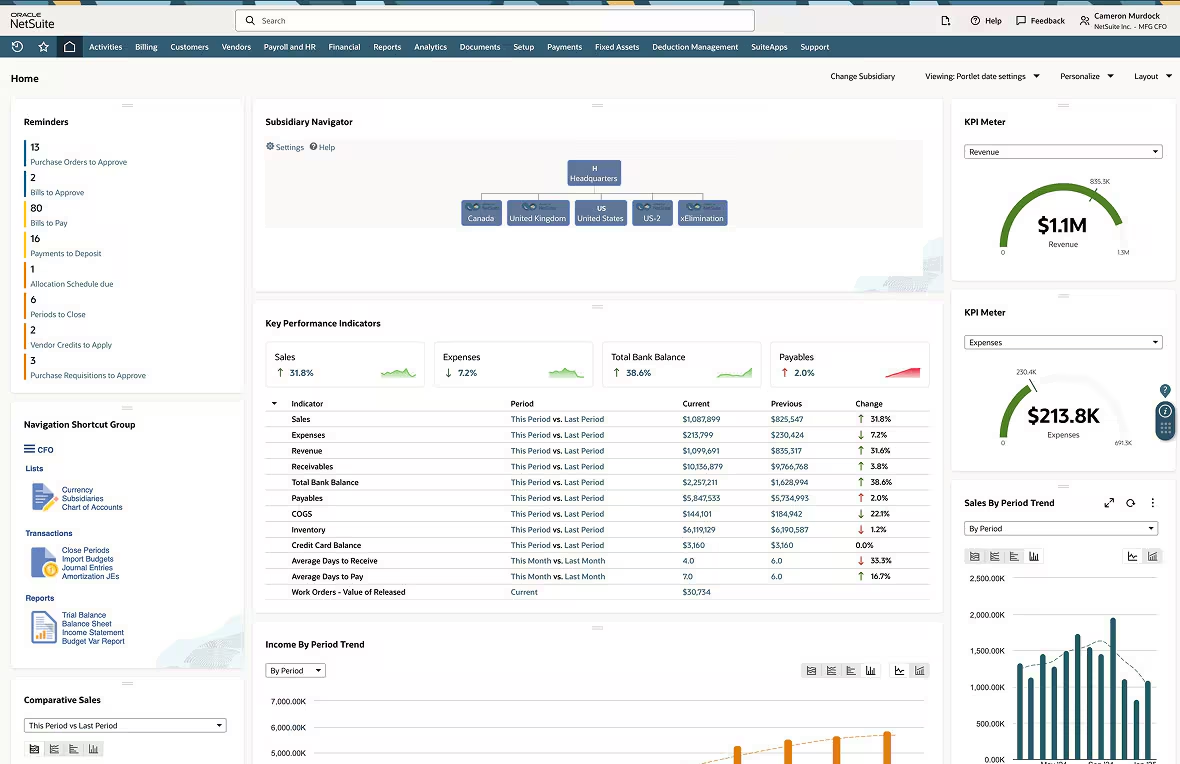
Image source: netsuite.com
Oracle NetSuite review: Core ERP capabilities explained
Oracle NetSuite is a comprehensive cloud ERP platform built for organizations that need deep financial control, operational visibility, and global scalability within a single system. In the context of an Oracle NetSuite review, it is often positioned as a mature, enterprise-grade solution capable of unifying finance, operations, and compliance across growing and multinational businesses. However, this same breadth introduces higher implementation complexity, longer timelines, and ongoing administrative effort when compared to lighter or more modular ERP platforms.
- Financial management and accounting: NetSuite delivers a robust financial management suite centered on a unified general ledger that supports real-time visibility across entities. It includes accounts payable and receivable, budgeting, revenue recognition, and advanced financial controls designed for audit-ready operations. Multi-currency and multi-subsidiary accounting make it especially suitable for organizations with international operations. As a result, NetSuite is frequently adopted by finance-led organizations that prioritize accuracy, compliance, and consolidated reporting.
- Order and billing management: The platform supports end-to-end order lifecycle management, from quote to cash, across multiple channels and regions. Invoicing, subscription billing, and complex pricing models can be managed within the same system as financials. Automated revenue tracking ensures alignment between sales activity and accounting outcomes. This tight combination reduces manual handoffs and improves billing accuracy at scale.
- Inventory and supply chain control: NetSuite provides inventory tracking with real-time stock visibility across warehouses and locations. Demand planning and procurement tools help organizations forecast needs and manage supplier relationships more effectively. Fulfillment workflows support both simple and complex distribution models. These capabilities are often highlighted in a NetSuite inventory management review for businesses with growing operational complexity.
- Customer Relationship Management: The built-in CRM module encompasses core sales automation, lead tracking, and pipeline management. Customer records are directly connected to financial and order data, creating a unified customer view. However, the CRM functionality is generally more transactional than relationship-focused. As a result, many NetSuite CRM reviews note limitations compared to dedicated 。
- Project and : NetSuite supports project-based businesses with tools for project costing, time tracking, and resource allocation. Project financials are tightly merged with core accounting, improving margin visibility. Teams can track billable and non-billable work within the same ERP environment. This makes NetSuite a practical choice for professional services and service-led organizations.
- Human resources and payroll: The platform includes and core HR functionality within the ERP. Payroll capabilities are available but vary significantly by region and regulatory requirements. Many organizations rely on third-party payrolls to fill regional gaps. This regional inconsistency is a common theme in NetSuite payroll review discussions.
- Reporting and analytics: NetSuite offers customizable dashboards, saved searches, and real-time reporting across financial and operational data. Users can build role-based views to surface relevant KPIs and performance metrics. Reports update dynamically as transactions occur in the system. This enables data-driven decision-making without relying heavily on external BI tools.
- Global business management: NetSuite is designed to support multi-entity organizations operating across countries and regions. It enables subsidiary management, tax compliance, and financial consolidation within a single ERP instance. Localization features help businesses meet regional regulatory requirements. These capabilities reinforce NetSuite's positioning as a full-scale ERP solution for global operations.
NetSuite review across different uses
NetSuite accounting review
A NetSuite accounting review consistently highlights NetSuite's finance-first design and strong control over complex accounting environments. Built around a robust general ledger, the platform supports multi-entity structures, multi-currency operations, and advanced . Finance teams benefit from automated revenue recognition, detailed audit trails, and consolidated financial reporting across subsidiaries. However, this depth introduces complexity in setup, configuration, and ongoing maintenance. Many organizations require experienced administrators or consultants to manage changes effectively. In an Oracle NetSuite review context, accounting is clearly one of NetSuite's strongest areas, but it is best suited for teams prepared to handle long-term ERP complexity.
NetSuite inventory management review
A NetSuite review shows NetSuite as a powerful system for controlling inventory across multiple locations and channels. Operational teams gain real-time visibility into stock levels, transfers, procurement, and fulfillment workflows. Demand planning and inventory costing are tightly merged with financials, improving accuracy and margin tracking. This level of control works well for complex supply chains, but everyday usability can be challenging for frontline teams. Many workflows feel finance-driven rather than operations-focused. In broader NetSuite ERP review discussions, inventory management is seen as reliable and scalable, though less flexible for teams that need rapid process changes.
NetSuite CRM review
A netsuite crm review often emphasizes data consistency over sales experience. NetSuite CRM keeps leads, opportunities, orders, and invoices within the same ERP system, creating a single source of truth for customer data. This combines the benefits of finance and operations teams by reducing reconciliation issues and improving forecast accuracy. Sales teams can and basic forecasting, but the interface lacks the ease and automation of dedicated CRM tools. As a result, many netsuite crm review discussions describe the system as transactional rather than relationship-driven, making it better suited for structured sales processes than fast-moving, customer-centric teams.
NetSuite payroll review
A NetSuite frequently highlights regional variability in payroll capabilities. NetSuite includes core HR features such as employee records, roles, and compensation tracking, but payroll support depends heavily on country-specific regulations. Some regions offer native payroll, while others require third-party combinations. This makes NetSuite effective as a system of record rather than a complete people operations platform. Time tracking and workforce costs merge well with finance and projects, which benefits service organizations. In many Oracle NetSuite review summaries, payroll and HR are viewed as functional but not comprehensive for global or employee-centric teams.
Factors to consider: Implementation, customization, and maintenance
NetSuite is designed for structured, , which means setup requires careful planning and governance. Across NetSuite ERP reviews, teams consistently note that implementation is not just a one-time project but an ongoing operational commitment. The platform delivers value over time, but only with sustained investment in configuration, administration, and process alignment.
- Implementation timeline and onboarding process: A typical in a NetSuite ERP review ranges from several months to over a year, depending on the scope. Core accounting, inventory, and CRM modules are often rolled out in phases. Data validation and testing extend timelines. Faster go-lives usually trade depth for speed.
- Need for consultants and implementation partners: Most Oracle NetSuite review discussions highlight reliance on certified consultants or partners. These specialists handle configuration, combinations, and compliance requirements. Internal teams often lack expertise initially. Consultant dependency increases both cost and implementation stability.
- Customization scope and complexity: NetSuite allows extensive customization through scripts, workflows, and custom objects. In a NetSuite accounting review, this flexibility supports complex financial rules. However, heavy customization increases technical debt. Long-term maintenance becomes more resource-intensive.
- Data migration and system configuration: is a critical phase in any NetSuite inventory management review or finance rollout. Historical transactions, customer records, and inventory balances must be cleaned and mapped accurately. Configuration errors can impact reporting. Multiple testing cycles are common.
- Training and change management: Training plays a major role in adoption across a netsuite crm review and operational use. Finance teams adapt faster than sales or operations. Structured training programs are required for non-financial users. Change resistance often slows productivity early on.
- Ongoing administration and system upkeep: Most organizations assign dedicated NetSuite administrators after go-live. In a NetSuite payroll review, admin oversight ensures compliance and data accuracy. Routine tasks include role management, workflow updates, and reporting support. Admin costs persist long-term.
- Impact of upgrades and version changes: NetSuite releases regular system updates that affect custom workflows and scripts. According to many Oracle NetSuite review insights, upgrades require testing before deployment. Customizations can break unexpectedly. Ongoing vigilance is required to avoid disruptions.
- Long-term cost and resource commitment: Beyond licensing, long-term costs include consultants, administrators, and internal support teams. A NetSuite ERP review often stresses total cost of ownership over subscription pricing. Resource commitment grows as usage expands. Budget planning must account for multi-year operational investment.
NetSuite pricing model and total cost of ownership:
NetSuite's pricing typically includes an annual subscription fee for the core platform, plus per-user licenses and optional modules that extend functionality such as advanced financials, inventory, or CRM. This modular approach lets tailor the system to their needs, but it also means the base price can grow rapidly as requirements evolve.
Information source: vendor website
Update time: 2025-12-29
Note: Pricing and plan details reflect publicly available data as of the update date and may vary based on region, billing cycle, and number of agents.
Primary cost components
- Base subscription fee: The starting point for access to the platform, often reported at around several thousand dollars per month, billed annually.
- User licenses: Each named user typically incurs an additional monthly charge, which increases total expenses for larger teams.
- Optional modules: Additional capabilities (e.g., advanced inventory, warehouse management) are licensed separately, adding to ongoing costs.
Total cost of ownership beyond subscription
In any Oracle NetSuite review, the total cost of ownership is framed as a long-term financial commitment rather than a simple . Beyond the annual license, organizations incur high costs during implementation, including system design, data migration, and module configuration. These upfront efforts are essential to align NetSuite with accounting, inventory, and CRM processes described across a NetSuite ERP review. For many teams, implementation spending alone can equal or exceed the first year of subscription fees.
Ongoing expenses continue well after go-live and shape the true NetSuite accounting review narrative over time. Customization updates, compliance adjustments, and reporting enhancements often require external consultants or internal specialists. Training new users and supporting evolving business requirements add recurring costs. As a result, long-term usability and value depend heavily on sustained investment, not just initial licensing decisions.
Operational and indirect costs
A deeper Oracle NetSuite review reveals high operational and indirect costs that affect day-to-day efficiency. Many organizations allocate internal resources to dedicated administrators who manage configurations, user access, and reporting. Business disruptions may occur during system upgrades or workflow changes, requiring testing and retraining. becomes an ongoing effort as processes evolve. In a NetSuite inventory management review or NetSuite payroll review, these hidden costs often influence satisfaction levels. Modeling long-term operational impact helps teams budget realistically and avoid underestimating the resources needed to sustain NetSuite effectively.
Discover an alternative with transparent pricing
Real voice: User feedback of NetSuite
User feedback in an Oracle NetSuite review often reflects strong confidence in NetSuite’s financial control and reporting capabilities. Finance teams value accuracy, compliance, and consolidation across entities, as noted in many NetSuite ERP review discussions. Once fully implemented, the system provides a reliable, enterprise-grade structure. However, users frequently emphasize that this value comes after significant setup, training, and ongoing administrative effort.
From a broader user perspective, NetSuite inventory management review, netsuite , and NetSuite payroll review feedback highlight usability challenges for non-finance teams. Everyday tasks can feel complex, and workflow changes often depend on administrators or consultants. commonly occurs outside the system, creating friction. These factors lead many modern teams to question whether NetSuite’s operational weight aligns with their need for speed and flexibility.
Time to change: Where NetSuite feels heavy for modern teams
In many Oracle NetSuite review discussions, teams describe NetSuite as powerful but operationally heavy. The platform excels at control and compliance, yet often slows execution for fast-moving teams. Across a NetSuite ERP review, this heaviness becomes more visible outside finance-led workflows.
- High setup and customization overhead: NetSuite typically requires extensive configuration before teams can use it effectively. Workflows, permissions, and data structures must be defined in advance. This slows experimentation and limits rapid iteration. In many NetSuite review cases, early productivity is delayed.
- Steep learning curve for non-finance teams: Sales, marketing, and often find NetSuite difficult to navigate. Common actions require training or administrative assistance. Adoption outside finance can suffer as a result. This theme appears frequently in netsuite crm review feedback.
- Slower iteration for fast-moving workflows: Changes to forms, approvals, or reports usually require technical work. Many updates depend on consultants or admins. This reduces agility for evolving processes. A recurring concern in NetSuite ERP review discussions.
- Heavy reliance on administrators and partners: Most organizations rely on dedicated NetSuite administrators or external partners. Day-to-day adjustments often cannot be handled by end users. This increases cost and dependency. A common point in Oracle NetSuite review is insights.
- Collaboration happens outside the system: NetSuite focuses on a , not collaboration. Teams discuss decisions in chat or email tools instead. Context often becomes fragmented. This gap is widely noted across modern NetSuite review experiences.
For teams that value speed, visibility, and , this heaviness becomes a bottleneck. This is where platforms like Lark take a different approach-prioritizing flexible workflows, real-time collaboration, and execution without the operational overhead of a traditional ERP.
Build workflows that adapt quickly
How Lark supports lightweight operations and collaboration
As teams reflect on the challenges highlighted in an Oracle NetSuite review, many start exploring tools that emphasize usability, speed, and . Lark emerges as a modern workspace built to support how teams actually work day to day, bringing communication, data, and workflows into one place. Rather than functioning as a traditional ERP, focuses on execution, visibility, and cross-functional alignment. This approach allows teams to manage finance, CRM, operations, and HR workflows without the heavy setup, rigid structures, or ongoing administrative burden commonly associated with enterprise ERP systems.
Operations and inventory management without heavy configuration
links procurement requests, shared records, inventory levels, and warehouse movements in shared tables. Restock thresholds trigger alerts and approval workflows automatically, and dashboards give teams instant insight into stock status. While NetSuite includes advanced supply chain capabilities, those systems typically require ongoing administration. Lark allows operations teams to adjust processes quickly as needs change, without heavy technical involvement. 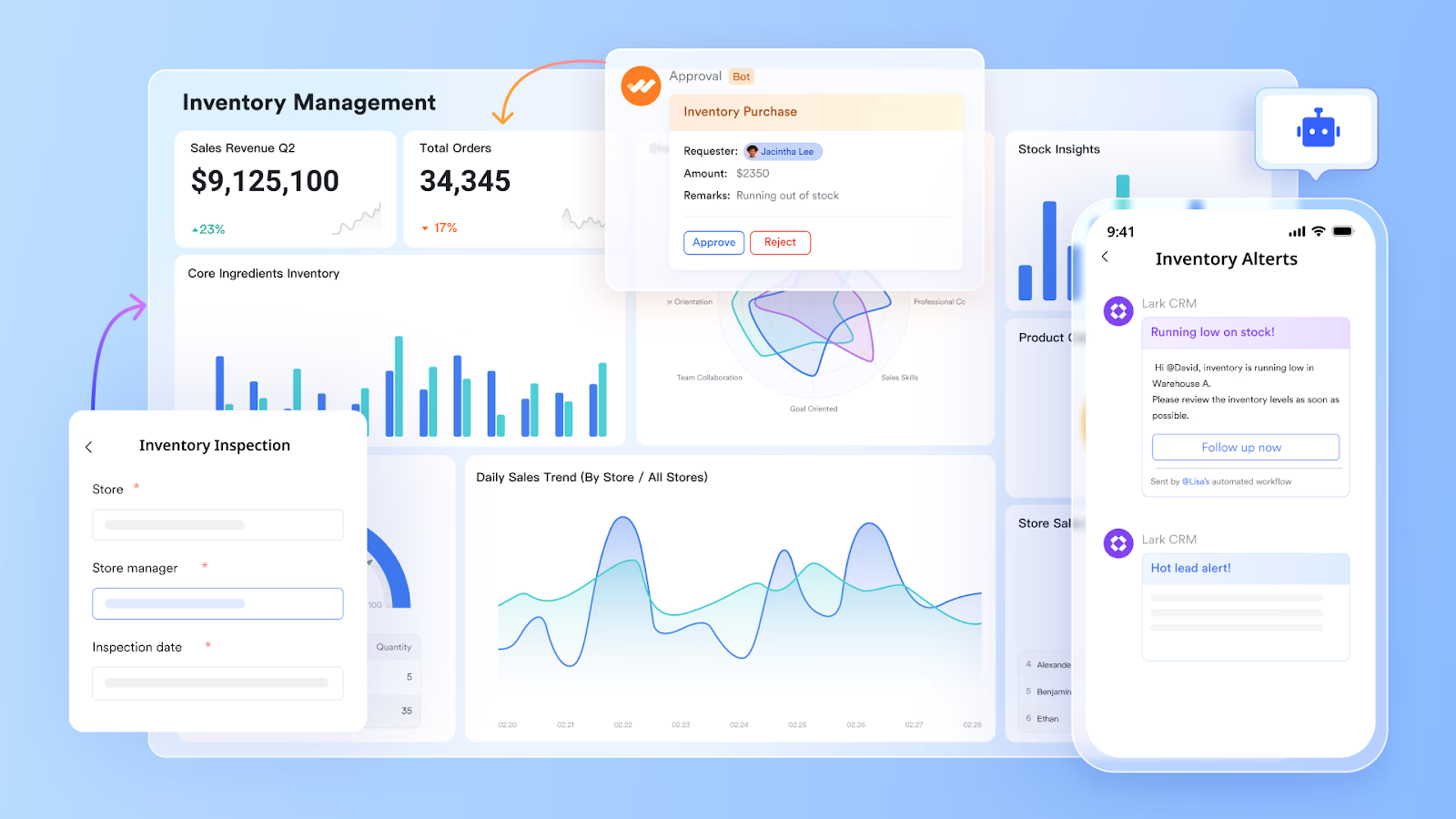
Financial management with shared visibility and lightweight controls
allows teams to track budgets, expenses, invoices, revenue, and forecasts using tables tailored to their financial processes. Real-time dashboards are used for surface cash flow, spending trends, and performance metrics, which can be shared through for transparent reporting. With , expense claims and payment steps follow automated review paths, reducing manual coordination. Compared to NetSuite's finance modules, which often require extensive setup and specialist roles, Lark enables finance and non-finance teams to work from the same data with far less operational overhead. 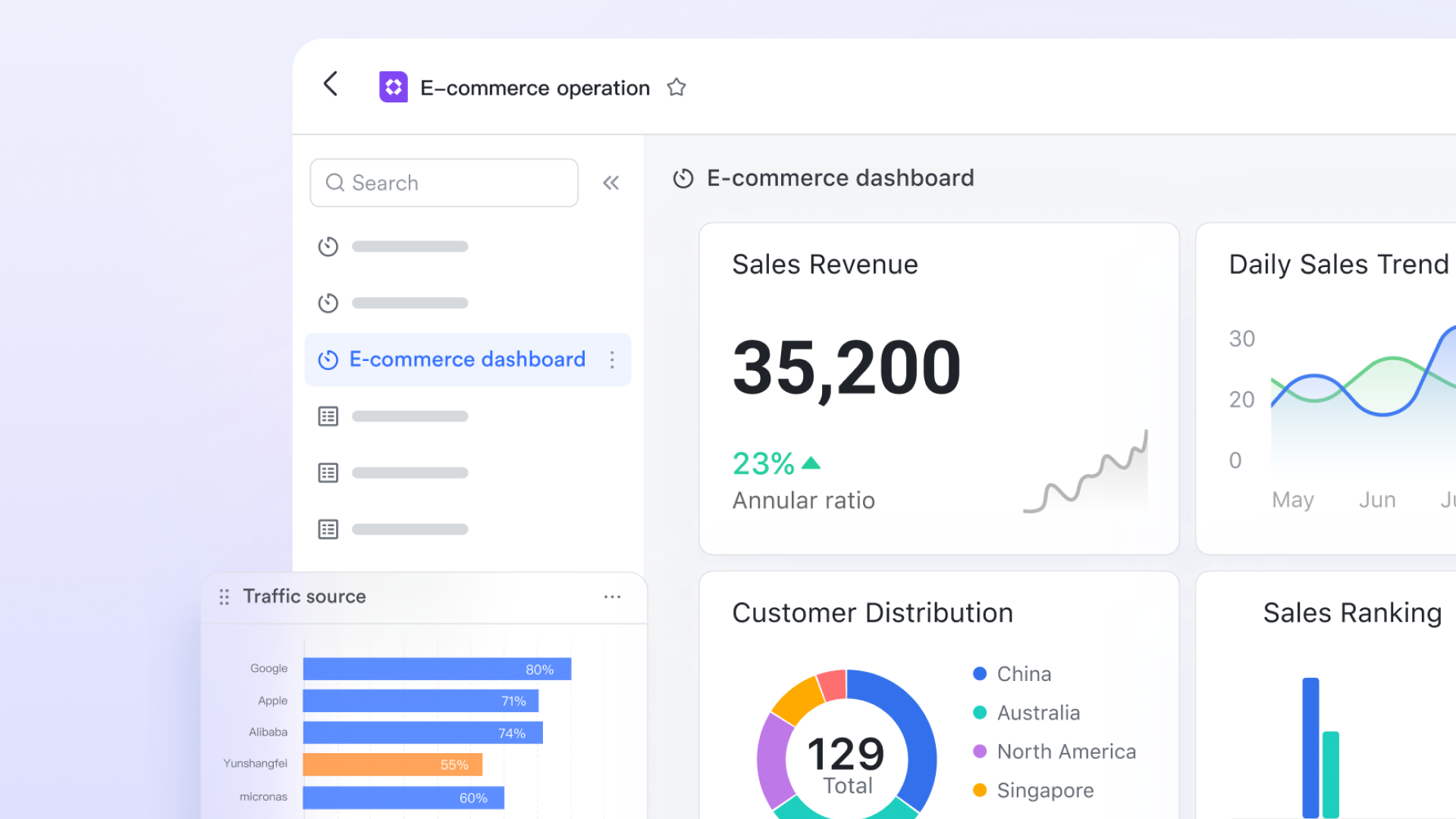
Adaptable CRM for fast-moving sales teams
Lark Base functions as a flexible CRM where teams manage leads, accounts, opportunities, and activities using views such as Kanban, grid, or timeline. Ownership, priorities, and progress tracking live directly within the same records, while keeps discussions tied to customer context. Proposals, contracts, and sales notes are stored in Lark Docs and linked back to CRM data. Unlike NetSuite CRM, which can feel rigid and transactional, Lark adapts easily to evolving sales processes and keeps collaboration embedded in daily work. 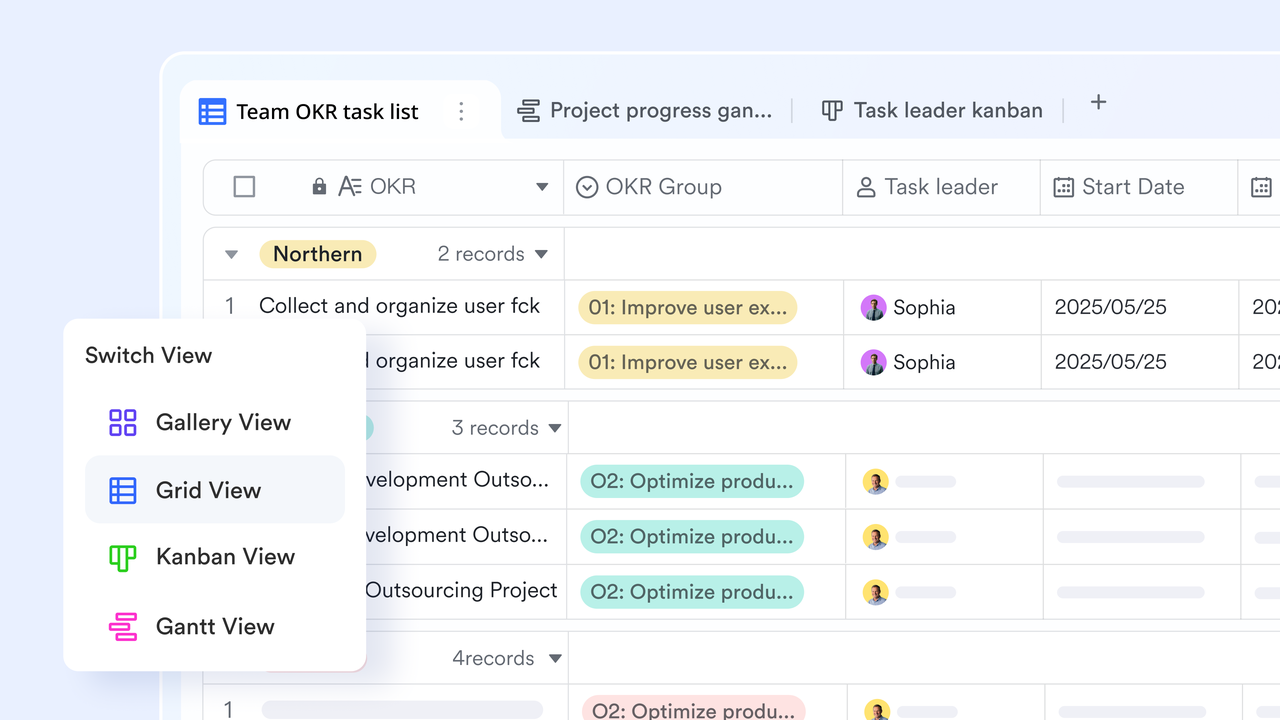
Lightweight e-commerce and order management workflows
For e-commerce and order-related workflows, captures customer and import data, which flows directly into Base for tracking and execution. Automation updates , triggers alerts, or creates tasks when action is required, while dashboards provide visibility across fulfillment stages. NetSuite offers deep order and financial tracking, but often relies on specialized modules and configuration. Lark provides a more visual and collaborative approach that small and mid-sized teams can manage without ERP expertise. 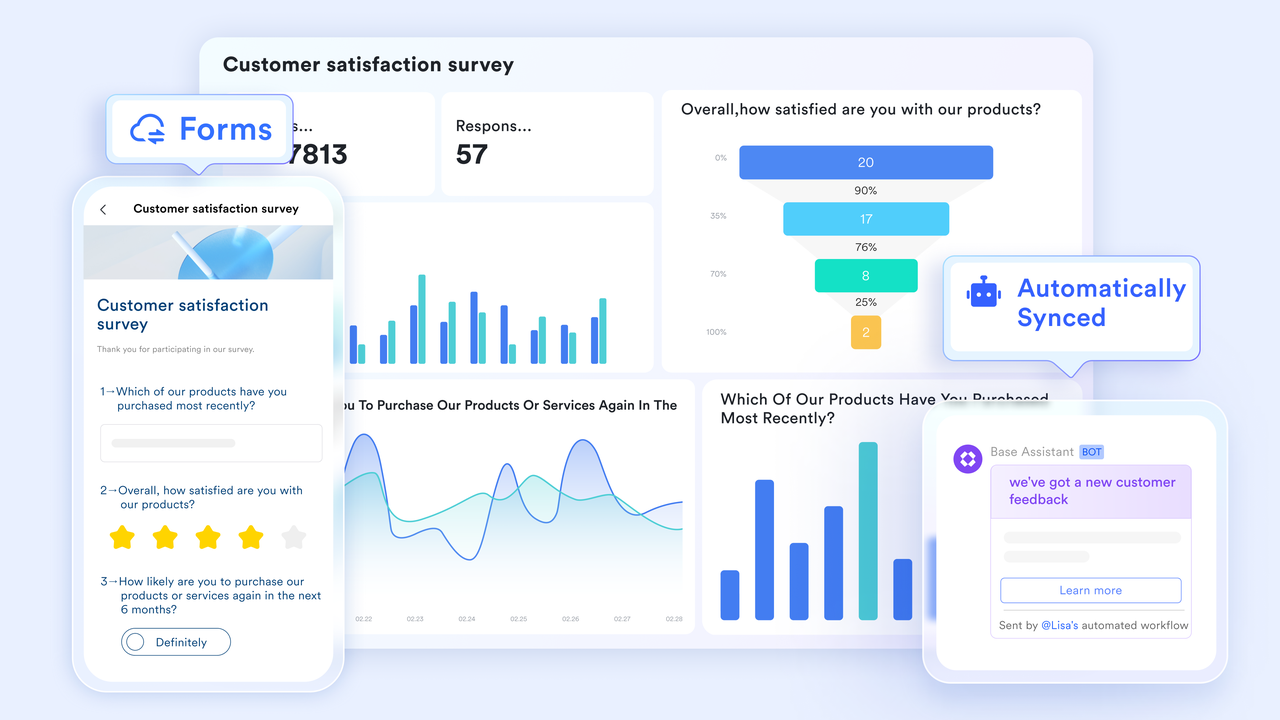
HR workflows built for collaboration and growth
With features like Attendance and Lark Docs, Lark supports HR processes such as an onboarding guide, employee timesheet, performance check-ins, and time-off tracking through structured tables in Base. Lark Forms simplifies employee submissions and approval processes, manages leave and policy reviews, and works alongside to improve scheduling and internal coordination. NetSuite's HR tools are part of a broader suite that can feel excessive for many teams. Lark offers a flexible, collaboration-first experience that scales naturally without complex ERP customizations. 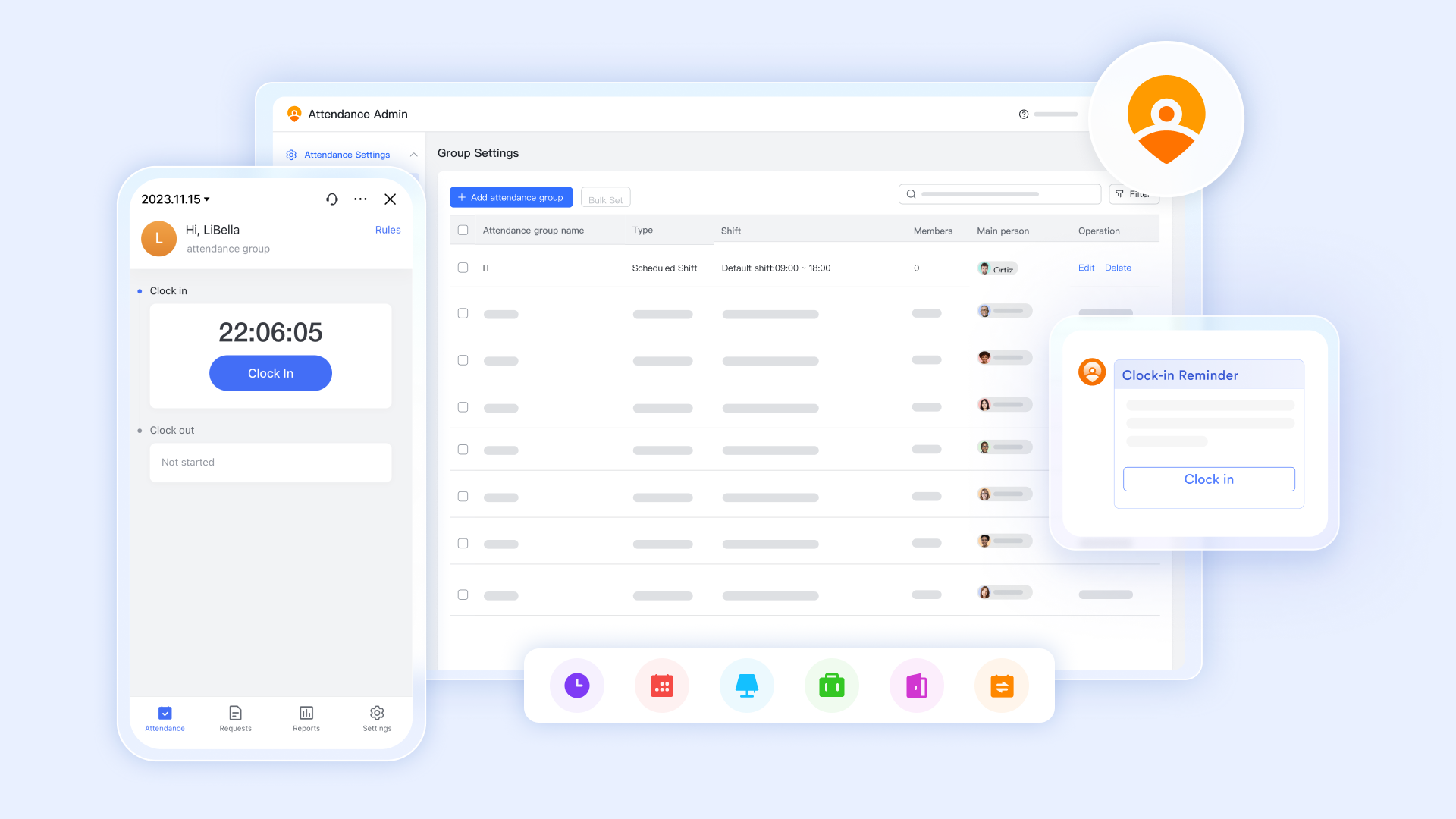
:
- Starter plan: Free forever plan that includes 11 powerful tools for up to 20 users. It also comes with 100GB of storage, 1000 automation runs, AI translations, and more.
- Pro plan: Unlike untransparent pricing, Lark offers a Pro plan at $12/user/month (billed annually) for up to 500 users. It includes everything in Basic plus group calling for up to 500 attendees, 15TB of storage, 50,000 automation runs, and more.
- Enterprise plan: for custom pricing. Supports unlimited users and includes even more automation runs and advanced security, compliance, and management features.
For small teams with simple communication needs

18 months message history
1000 Base automation runs/month
2000 rows per table in Base
Most POPULAR
For companies with comprehensive collaboration and management needs
Unlimited message history
500-participant video meetings
50k Base automation runs/month
20k rows per table in Base
For large companies with advanced security and organizational management needs
Get a personalized demo and pricing
Unlimited message history
500-participant video meetings
15 TB storage + 30 GB storage/user
500k Base automation runs/month
50k Base automation runs/month
Most POPULAR
For companies with comprehensive collaboration and management needs
Unlimited message history
500-participant video meetings
50k Base automation runs/month
20k rows per table in Base
Final checklist: NetSuite vs Lark
While both are "all-in-one" platforms, they serve fundamentally different purposes. Here is a final checklist for you to compare them both:
Conclusion
NetSuite continues to stand out as a robust ERP for organizations that prioritize financial accuracy, regulatory compliance, and centralized control. Across accounting, inventory, CRM, and payroll, the platform delivers depth and reliability that finance-led and multi-entity businesses depend on. A typical Oracle NetSuite review makes it clear that this strength comes with trade-offs, including longer implementation cycles, higher operating costs, and reduced flexibility for non-finance teams. For organizations with stable processes and long-term ERP maturity, NetSuite remains a dependable foundation.
At the same time, modern teams increasingly expect faster execution, clearer ownership, and built-in collaboration around their data. As workflows evolve, many organizations complement NetSuite with like to reduce friction in day-to-day work. This combination allows teams to retain ERP-level control while improving speed, visibility, and cross-functional alignment without adding more complexity.
Choose a plan that scales simply
FAQs
What are the downsides of NetSuite?
In many Oracle NetSuite review discussions, the most common downside mentioned is complexity. NetSuite requires significant configuration before teams can work efficiently, and this slows early adoption. Non-finance users often need training or admin support for routine tasks, which impacts productivity. Over time, teams sometimes add lighter collaboration tools like Lark to handle communication and execution more smoothly.
How long does a typical NetSuite implementation take?
A typical NetSuite implementation can range from several months to over a year, depending on customization, combinations, and data migration. Accounting and inventory modules often take longer due to compliance and testing requirements. involvement is common throughout the process. During long rollouts, teams frequently rely on collaborative workspaces such as Lark to keep projects, discussions, and coordination moving forward.
Does NetSuite require dedicated administrators to run effectively?
Most organizations using NetSuite rely on dedicated administrators or external partners. These admins manage workflows, permissions, reporting, and system updates to keep operations stable. While this ensures control and accuracy, it reduces flexibility for everyday users. To regain autonomy in daily work, many teams layer in tools like Lark for faster collaboration and ownership outside the ERP.
What are the common reasons companies move away from NetSuite?
Companies often move away due to rising costs, heavy requirements, and slow iteration cycles. As businesses evolve, making changes in NetSuite can feel restrictive and expensive. Non-finance teams may feel disconnected from the system. Many organizations begin transitioning by first adopting collaborative platforms like Lark to handle execution before reassessing ERP needs.
Can NetSuite support fast-changing startup environments?
NetSuite can support startups with complex financial structures or regulatory needs. However, it often struggles to keep pace with rapid and frequent process changes. Startups typically need speed, flexibility, and constant collaboration. For this reason, many fast-growing teams pair NetSuite with tools like Lark to stay agile while maintaining financial control.
Related reading