Agile teams can deliver change quickly, but many organizations still rely on slow, rigid governance. The result is tension: Leaders worry about risk and compliance, while teams feel blocked by outdated rules and ceremonies. Agile governance provides a means to maintain oversight and accountability without compromising speed, learning, or innovation.
In this article, we will explore what agile governance is, its significance in both business and government, and how to develop a practical framework tailored to your specific context. I will also touch on areas like agile PMO governance, agile data governance, and metrics, and briefly mention how modern collaboration platforms such as Lark can support more transparent, adaptive decision-making.
What is agile governance?
Agile governance is the way an organization guides decisions, manages risk, and ensures accountability while supporting . It is the set of lightweight structures, roles, and practices that keep teams aligned to strategy and public or customer value, without slowing them down with unnecessary bureaucracy. At its core, agile governance connects three elements:
- Strategic intent: What outcomes the organization is trying to achieve.
- Decision-making: Who decides what, at which level, and on what cadence.
- Feedback loops: How information about progress, risk, and value flows back to leaders.
- The primary purpose of agile governance is to make sure the goals of an organization align with the .
Instead of relying on long upfront plans and heavy documentation, agile governance emphasizes visibility, frequent inspection, and adaptation. It aims to create clear guardrails and agile governance metrics, so that teams can move quickly while leaders still have confidence that risks and obligations are being managed responsibly.
Agile governance vs traditional governance
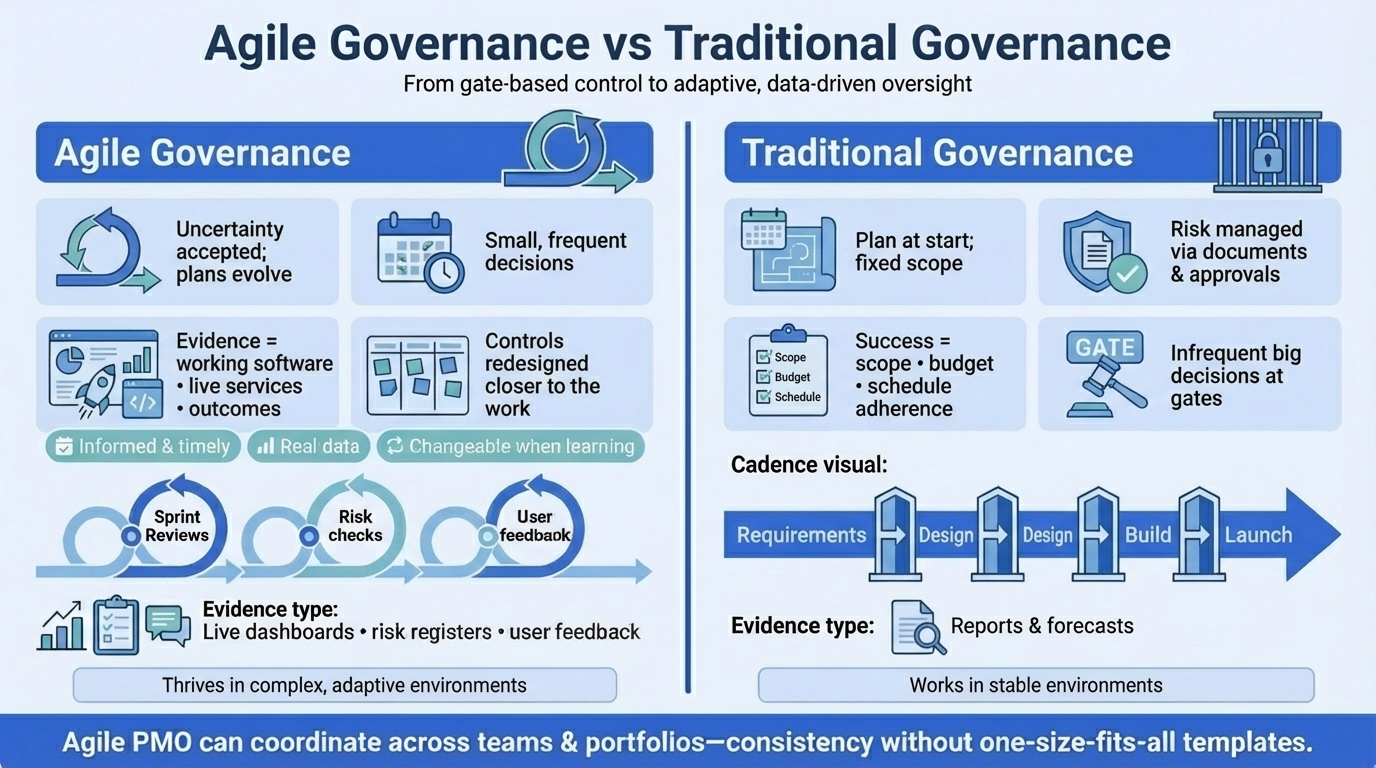
The agile governance process fosters collaboration, self-organization, and continuous improvement by enabling teams to make decisions together, adapt quickly, and learn from , moving away from traditional monitoring toward a more flexible, adaptive approach. In some organizations, an agile PMO governance model coordinates this shift across multiple teams and portfolios, ensuring consistency without forcing everyone into the same template.
Traditional governance often assumes that:
- Work can be fully planned at the start.
- Risks can be predicted and controlled mainly through documents and approvals.
- Success is measured by adherence to , budget, and schedule.
In such models, governance bodies meet infrequently, review large documents, and make big decisions at a few key "gates." This can work in stable environments, but it tends to break down when technology, customer expectations, or regulations change quickly.
Agile governance, by contrast:
- Accepts that uncertainty is normal and plans will evolve.
- Focuses on small, frequent decisions rather than rare, high‑stakes ones.
- Relies on working software, live services, and real‑world outcomes as evidence.
This does not mean removing controls. It means redesigning them to be:
- Closer to where the work is done, so decisions are informed and timely.
- Based on real data, not just reports or forecasts.
- Easier to change when learning shows that something is not working.
For example, instead of a quarterly steering committee that approves large documents, a team might have shorter, more frequent governance touchpoints that review live dashboards, , and user feedback.
Agile governance vs Agile government
Both contexts benefit from frameworks that make these practices explicit. For instance, an agile data governance framework can help ensure that data is used ethically and securely while still enabling rapid experimentation and analytics. The terms "agile governance" and "agile government" are sometimes used together, but they are not identical.
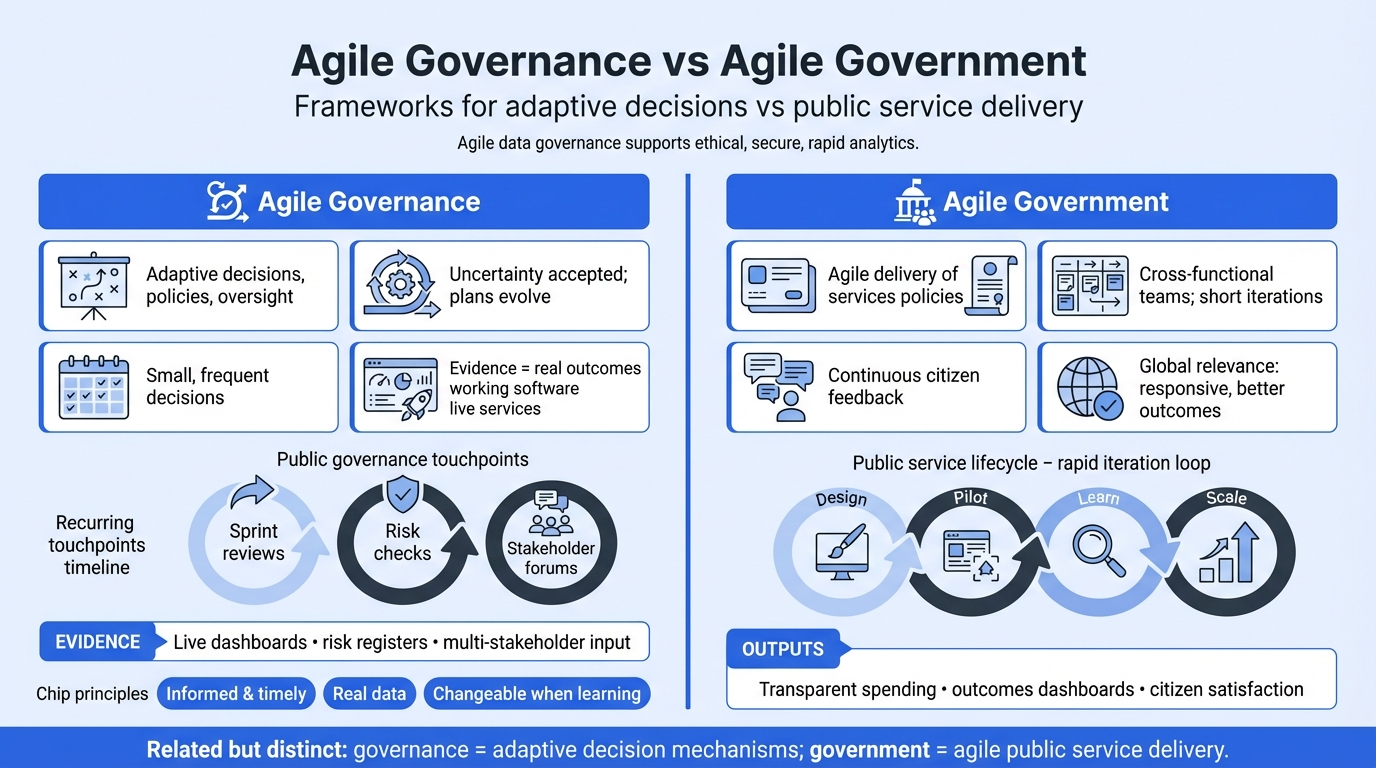
- Agile government usually describes how public institutions deliver services and policies using : Cross‑functional teams, short iterations, and continuous feedback from citizens.
- Agile governance describes how decisions, policies, and oversight are designed and run adaptively.
In the public sector, agile governance might involve:
- Iterative policy design, where regulations are piloted and refined based on real‑world results.
- Multi‑stakeholder forums that meet regularly to review evidence and adjust direction.
- Transparent mechanisms to show how taxpayer money is used and what outcomes it delivers.
Adopting agile approaches in government organizations enhances responsiveness and service delivery, allowing public institutions to and deliver better outcomes for citizens. These practices have global relevance, supporting effective governance in both local and international contexts.
Why agile governance matters in the age of constant change
In a world of constant disruption, many organizations talk about "being agile" while still relying on governance designed for a slow, predictable environment. This mismatch increases risk, slows value delivery, and erodes trust between leaders and teams. It matters because:
- Change is faster and riskier: , cloud, and AI let small teams ship new services quickly, but also amplify privacy, cybersecurity, and ethical risks. Static, stage‑gate governance cannot keep pace, so either work slows to fit the process, or teams bypass controls and create unmanaged risk.
- Old governance creates friction and mistrust: Long approvals, duplicated paperwork, and conflicting rules delay products, services, and policy changes. Leaders then see Agile as undisciplined because they lack timely, relevant data, while teams see governance as an obstacle rather than a support system.
- Faster, better‑informed decisions: Frequent, data‑driven reviews and clear decision rights shorten the path from idea to value, while still maintaining ethical, regulatory, and financial controls. Agile governance increases productivity by enabling self-organizing, cross-functional teams to deliver value efficiently through enhanced accountability, continuous feedback, and .
- Stronger strategy–execution alignment: Funding, portfolio choices, and day‑to‑day work are continuously realigned to strategic outcomes, helping organizations shift resources toward what is actually working. There is an emphasis on prioritizing work based on value and constraints, ensuring high-value features and stories are delivered to maximize organizational investment and align with .
- Autonomy with clarity instead of chaos: Leaders gain transparency without micromanaging; teams get clear priorities and boundaries, plus the freedom to choose how to deliver. Governance is no longer about more rules, but about the right rules, applied proportionately to risk.
- Continuous learning in governance itself: Policies and processes are regularly inspected and adapted. When a rule creates unnecessary delay, the model includes a way to change it quickly, building a culture where governance evolves with technology, markets, and society rather than lagging behind.
Agile governance is a lightweight, flexible approach that prioritizes rapid value flow and responsiveness to change. It emphasizes responsiveness, continuous feedback, and the capacity to adapt swiftly to emerging risks and opportunities, making it essential for organizations facing constant disruption.
See what methodology smart teams are applying
Core principles of effective agile governance
Effective agile governance is less about a fixed template and more about a small set of principles that guide structures, roles, and day‑to‑day decisions. The foundation of a good governance model is in the structure and how you bring work to the people within it. These principles help you stay in control without slowing down.
Outcome‑focused, not activity‑focused: Governance should focus on whether you are creating value, , and supporting strategy—not on how many documents, meetings, or checklists have been completed. Metrics emphasize flow, quality, and impact instead of counting reports or sign‑offs.
Lightweight, enabling controls: The goal is clearer, more proportional controls, not simply "more" or "less" control. Good controls:
- Set principles and boundaries instead of prescribing every step.
- Scale with risk, so low‑risk work moves quickly, while high‑risk work gets deeper scrutiny.
- They are easy to understand and update. For example, a concise, regularly reviewed business case can replace heavy upfront paperwork; an agile data governance framework can make data rules explicit without blocking experimentation.
Transparency and shared visibility: When work, risks, and decisions are visible, people need fewer meetings and reports to stay aligned. Agile governance makes:
- Work is visible through backlogs, roadmaps, and boards.
- and dependencies are visible early.
- Decisions and trade‑offs understandable to those affected. This also lets an agile PMO governance function curate real‑time information instead of compiling static reports.
- Including diverse perspectives and concerns, such as architecture, product, project, and analyst concerns, at the Portfolio and Program levels is essential to building well-rounded teams capable of addressing various .
Empowered and accountable decision‑making: Decisions should be taken where knowledge is highest, within clear limits. That means:
- Defining decision domains (scope, architecture, budget, policy).
- Assigning clear owners for each domain.
- Giving guidance and criteria for good decisions. Teams handle everyday trade‑offs; leadership sets direction and risk appetite. Interactions become more frequent, evidence‑based, and collaborative.
Iterative learning and continuous improvement: Empowering teams in agile governance fosters a culture of innovation through experimentation and calculated risks. Regular feedback loops are used to inspect and adapt processes, ensuring governance remains supportive rather than burdensome.
Ethics, risk, and compliance by design: Rather than adding controls at the end, agile governance weaves them into normal work. It asks how to build ethical choices, risk controls, and into systems, pipelines, and decisions from the start. This reduces rework and shows stakeholders that speed does not come at the expense of responsibility.
Focus on outcomes, keep controls lightweight and risk‑based, make everything visible, push decisions to where knowledge lives, improve continuously, and build ethics and compliance in from day one. From there, you can design specific forums, processes, and metrics that fit your organization's context and maturity.
Turn your governance principles into daily practice
An agile governance framework you can adapt with Lark
This framework offers a simple, adaptable way to make agile governance real in your organization, whether you are leading a business transformation, shaping agile data governance, or modernizing public services. like help turn agile governance into a visible, data‑informed, continuously improving system rather than a static set of rules.
Step 1: Discover your current governance reality
Begin by creating a clear, shared understanding of how governance operates today. Map decision flows, approvals, and controls from idea to funding, change, and risk escalation, including both formal processes and informal workarounds. Identify steps that cause delays, confusion, rework, or conflicting rules, and , including leadership, PMO, risk, compliance, delivery teams, and, where relevant, customers or citizens. Documenting these insights gives you a baseline and reinforces that governance is a shared responsibility, not the job of a single department.
How Lark helps: Making work and decisions transparent in real time
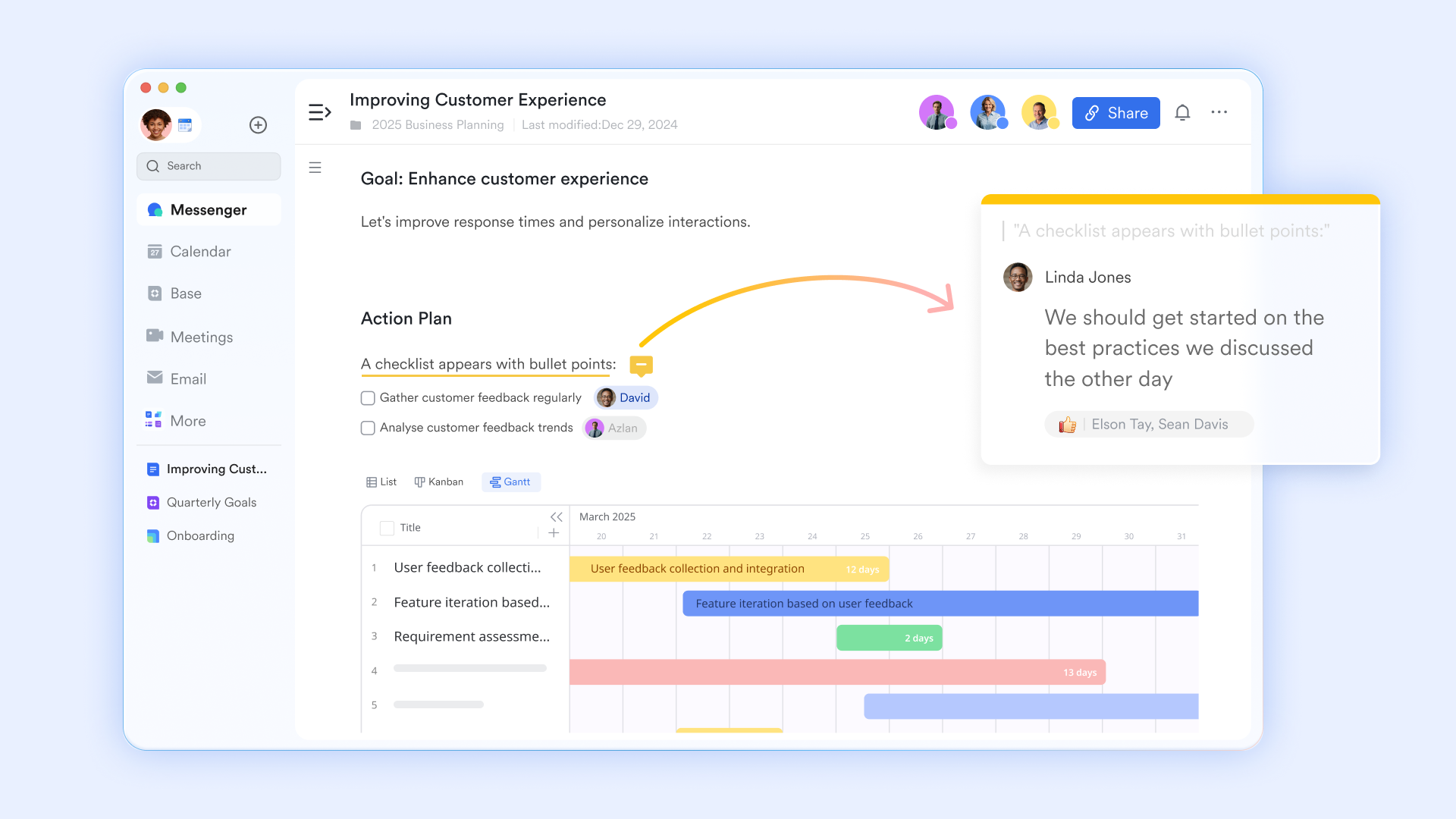
lets you capture principles, boundaries, non‑negotiables, and current governance rules in one place that everyone can read, comment on, and keep up to date; rich content, such as tables, timelines, synced blocks, and code blocks, can be inserted in a document, making complex processes easier to understand.
allows you to build structured registers for risks, decisions, OKRs, and , with multiple views and filters, so teams can see live governance data rather than static reports. Kanban, table, and gallery views, combined with flexible permissions, give different roles (teams, product owners, PMO, executives) tailored views over the same data, so facts are shared while access is controlled. Shared Base views let multiple teams work from one backlog or roadmap while keeping their own filtered perspectives, making cross‑team dependencies and priorities easier to manage and aligning funding and capacity with strategy. 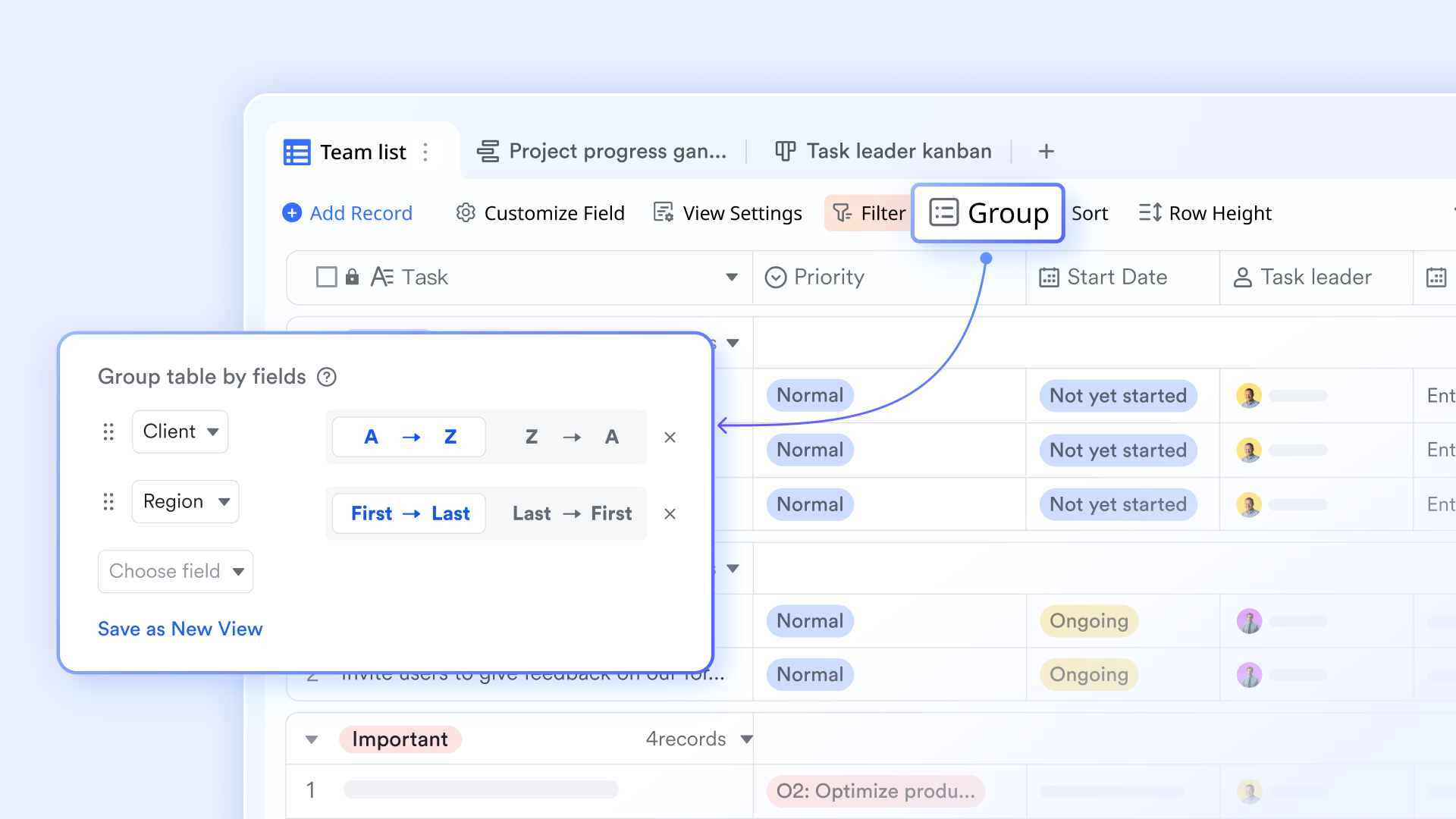
Step 2: Design your agile governance principles and guardrails
Once the current reality is understood, the organization co‑creates a small set of explicit principles that emphasize outcomes, proportional controls, transparency, and continuous learning. It then clarifies decision rights using simple tools so that everyone knows who is responsible, accountable, consulted, and informed, and, where appropriate, sketches domain‑specific models such as an agile data governance framework for particularly sensitive areas.
How Lark helps: Supporting portfolio and value‑stream governance, plus lightweight controls
Using together with and automation function, you can create a single intake channel for projects, initiatives, and change requests that automatically populate your portfolio and value‑stream views, which you can then sort and filter by strategic theme, risk level, or expected value.
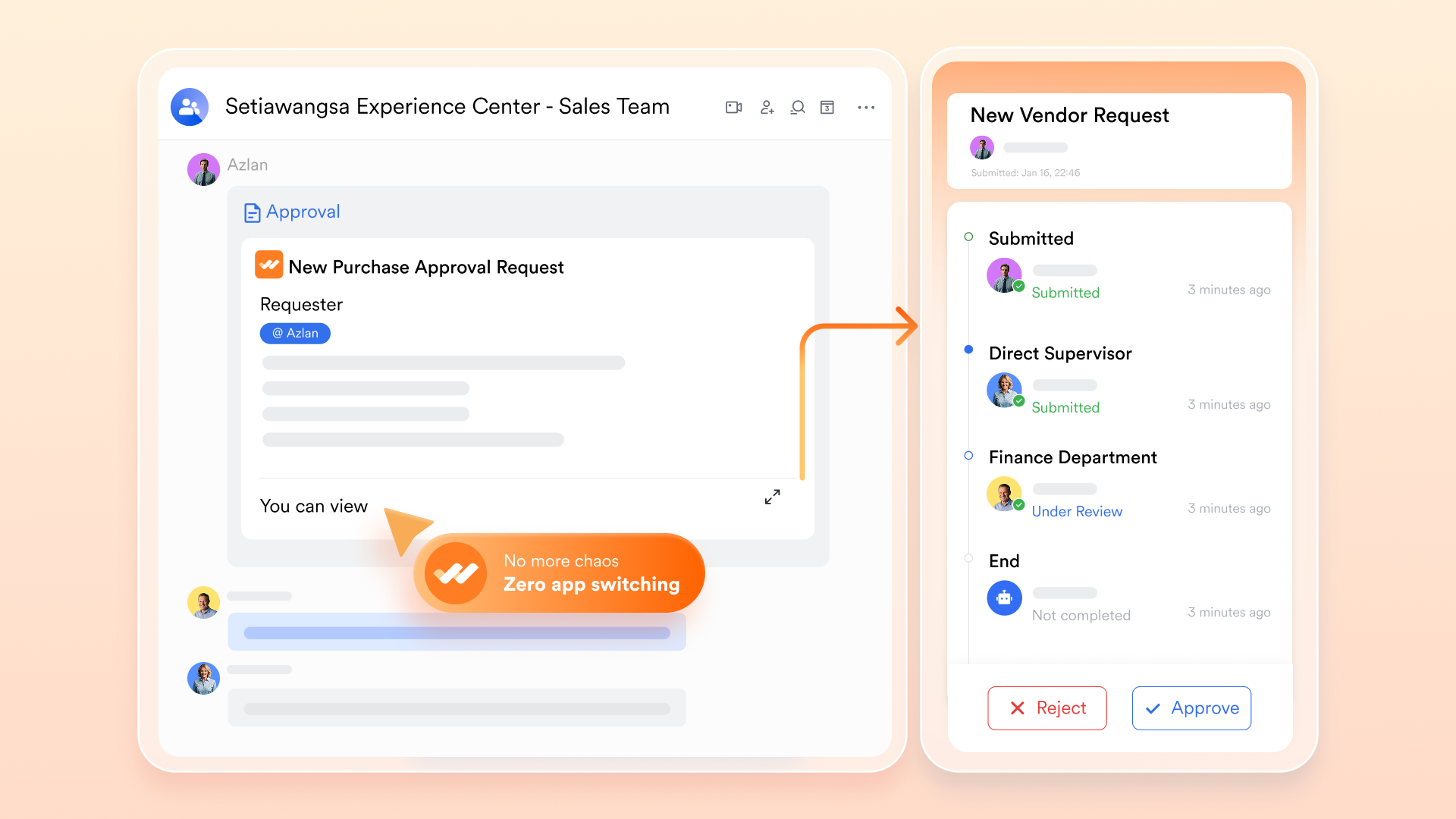
provides lightweight but for budget, access, change, and release decisions, allowing you to break large, infrequent approvals into smaller, more frequent ones and apply conditional logic so low‑risk items move quickly while high‑risk items follow stricter paths. Together, these capabilities make principles and guardrails concrete by encoding them into visible portfolios and practical, risk‑based workflows.
Step 3: Deploy in focused pilots
Instead of changing everything at once, the organization applies the new governance model in a few carefully chosen pilots, selecting teams, value streams, or programs with motivated leaders, manageable risk, and clear strategic relevance. It then adjusts their governance touchpoints to be more agile—for example, by using shorter reviews, lighter documentation, more frequent funding or prioritization decisions, and integrated risk discussions—while tracking exactly what is changing.
How Lark helps: Turning governance meetings into decision‑making sessions
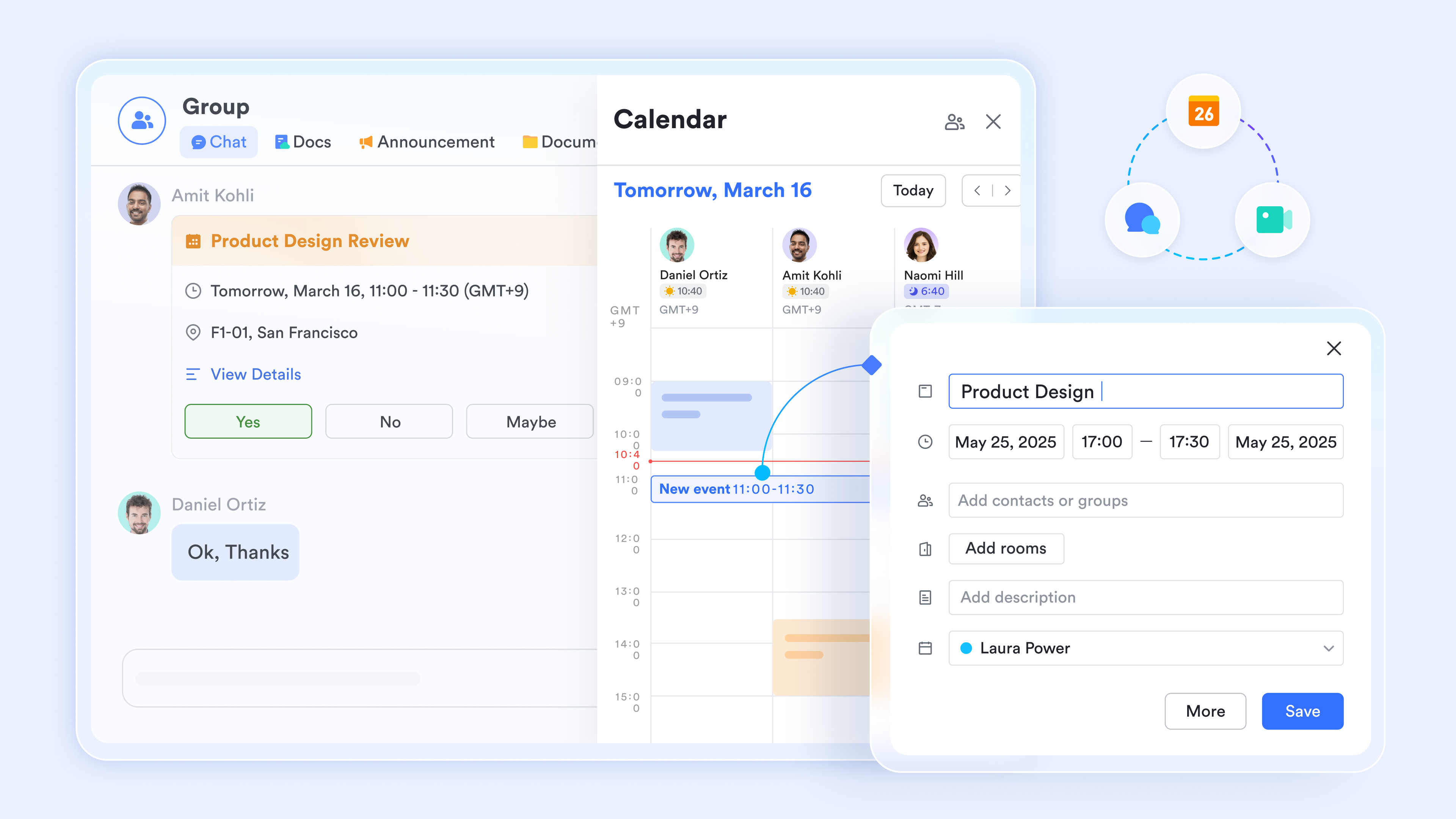
and make it easy to set up regular governance rhythms for pilot areas—such as portfolio reviews, risk reviews, and OKR check‑ins, with attached Lark Docs holding shared agendas and pre‑reads so time is spent deciding, not updating slides.
With Magic Share in Lark Meetings, participants co‑edit the same Docs or Base view on screen, capturing decisions, actions, and owners in real time instead of writing minutes later. can summarize discussions and decisions automatically and convert them into tasks, ensuring follow‑through. Dedicated Lark groups for each value stream or governance forum keep conversations, files, and decisions together in one place, making pilots easier to monitor and audit. 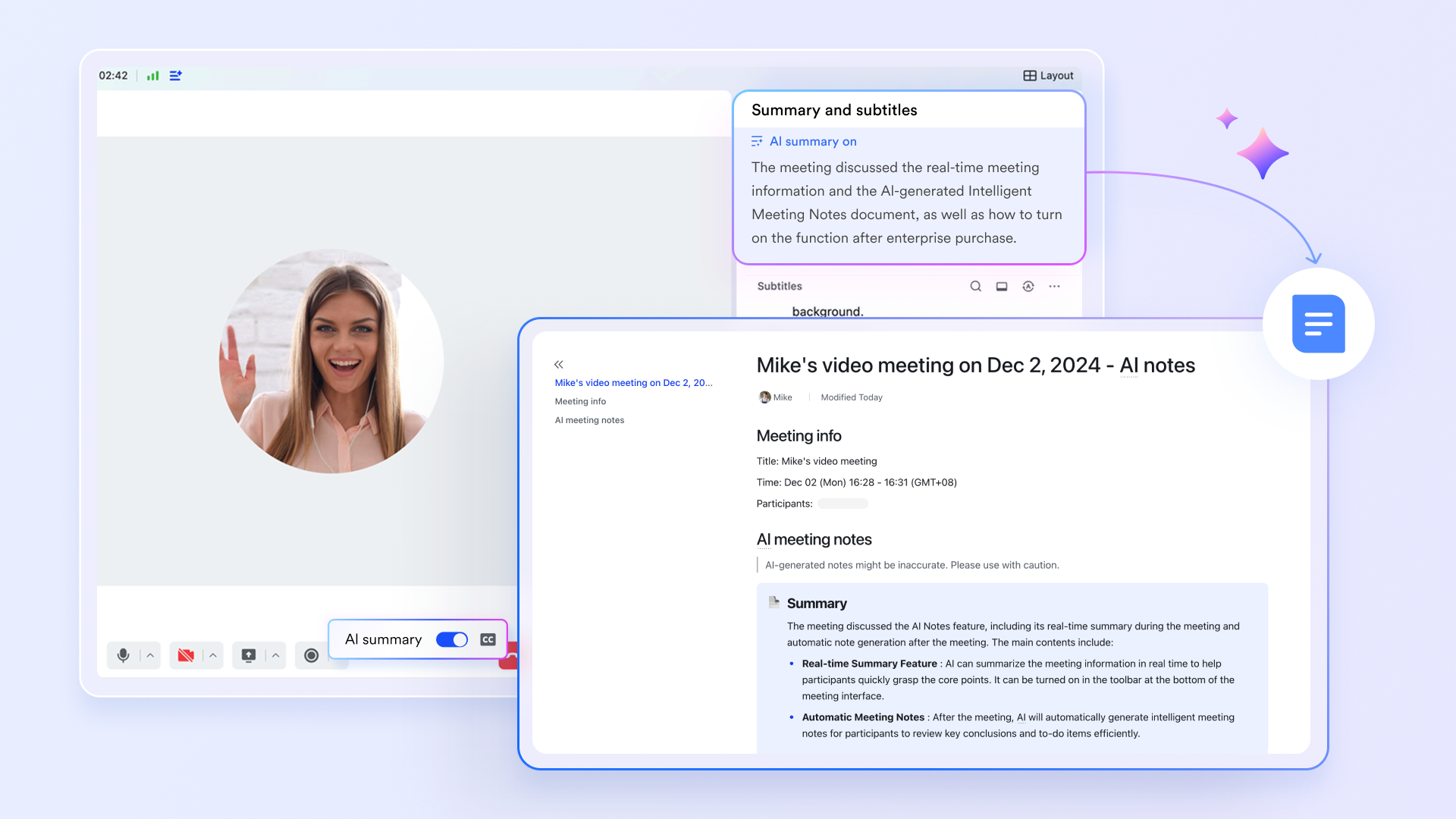
Step 4: Develop, scale, and evolve
The framework uses what it learns from pilots to refine policies, principles, guardrails, roles, and ceremonies, removing or reworking any changes that add complexity without clear benefit. It then scales successful patterns to additional teams and value streams, adapting them to local context, risk profiles, and capabilities rather than copying them blindly. Over time, the organization establishes a regular cadence to review and improve the governance framework itself, using data, feedback, and shifts in the external environment so that governance remains a responsive, evolving system that keeps the organization aligned, compliant, and trustworthy while still supporting speed and learning.
How Lark helps: Visualizing goals and metrics, and supporting continuous improvement
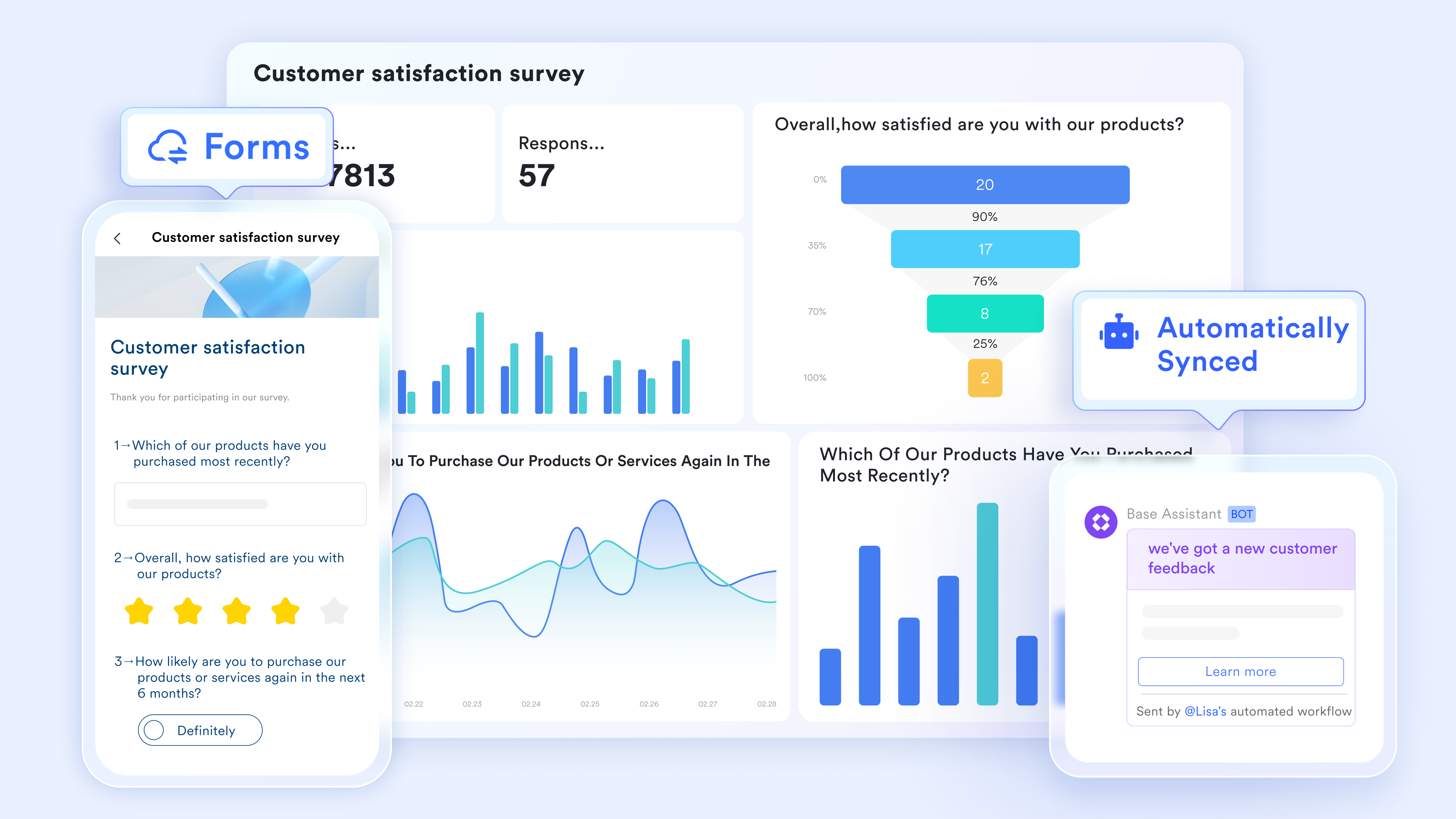
With Lark Base, you can break strategic goals into team‑level OKRs, link them to concrete projects and tasks, and through dashboards and charts that surface both achievements and risks, so governance conversations can center on "outcomes, risks, and next moves" rather than adherence to an original plan. 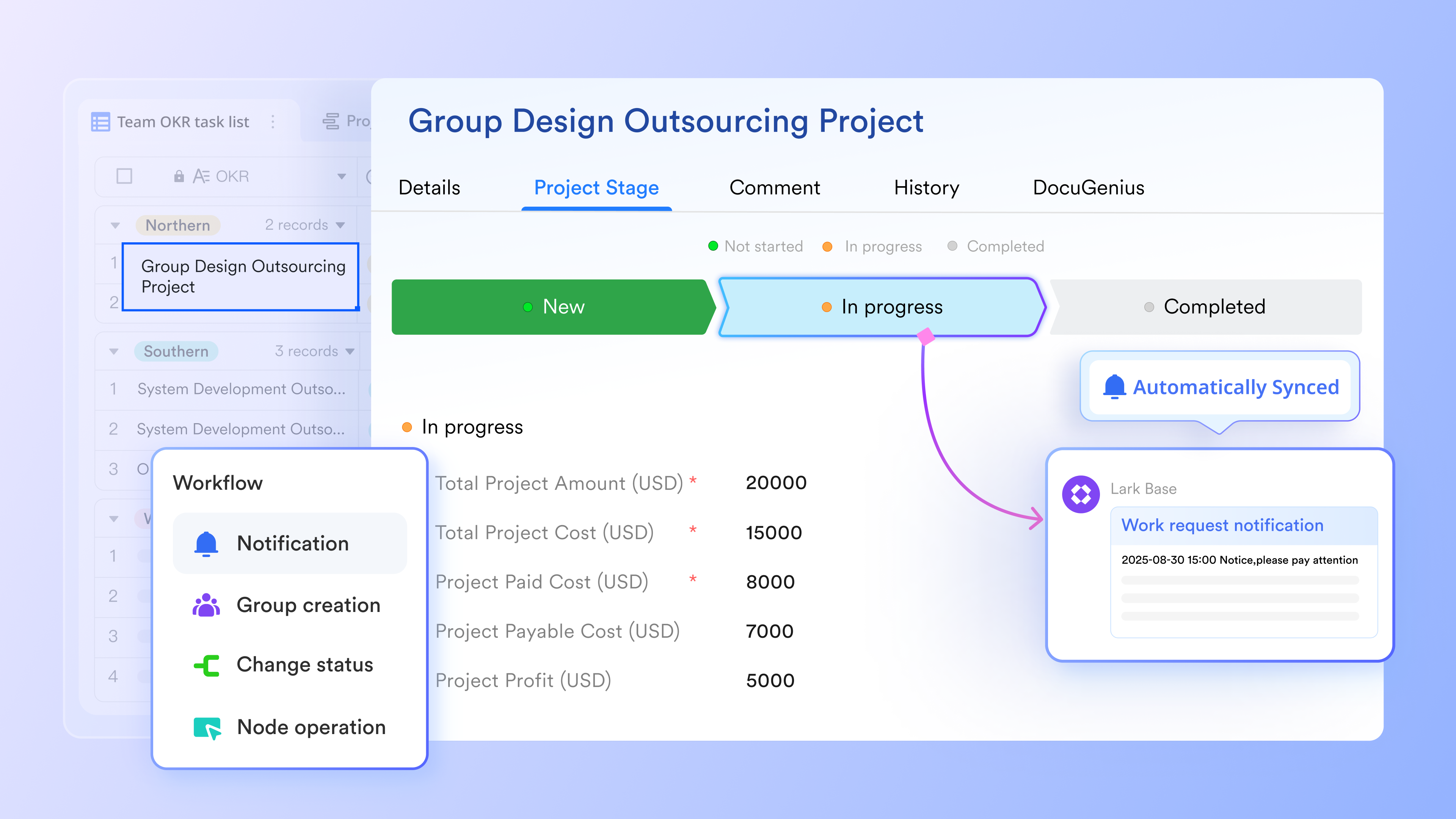
The same Base datasets can show flow metrics such as cycle time, lead time, throughput, and release frequency alongside outcome metrics such as satisfaction, quality, and incidents, giving governance forums a balanced view in a single system.
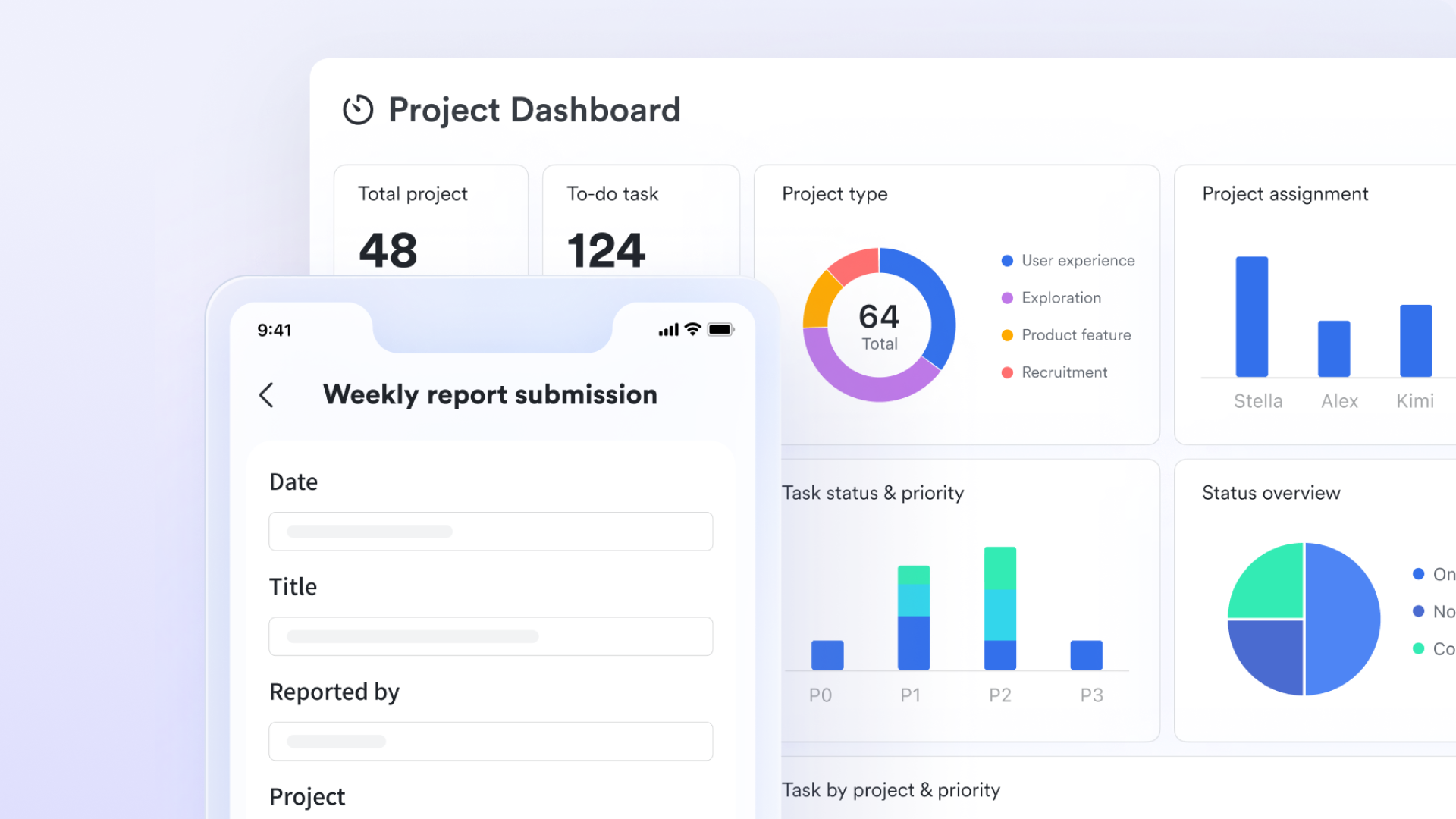
Because all of this lives in the same collaborative workspace as Docs, Meetings, Approval, and Messenger, feedback about what works can be captured quickly, and governance practices can be revised, communicated, and rolled out iteratively.
for Lark:
- Starter plan: that includes 11 powerful tools for up to 20 users. It also comes with 100GB of storage space, 1000 automation runs, AI translations, and more. No credit card needed.
- Pro plan: (billed annually) for up to 500 users. It includes everything in Starter plus group calling for up to 500 attendees, 15TB of storage space, 50,000 automation runs, and more.
- Enterprise plan: for custom pricing. Supports unlimited users and includes even more automation runs and advanced security, compliance, and management features.
For small teams with simple communication needs

18 months message history
1000 Base automation runs/month
2000 rows per table in Base
Most POPULAR
For companies with comprehensive collaboration and management needs
Unlimited message history
500-participant video meetings
50k Base automation runs/month
20k rows per table in Base
For large companies with advanced security and organizational management needs
Get a personalized demo and pricing
Unlimited message history
500-participant video meetings
15 TB storage + 30 GB storage/user
500k Base automation runs/month
50k Base automation runs/month
Most POPULAR
For companies with comprehensive collaboration and management needs
Unlimited message history
500-participant video meetings
50k Base automation runs/month
20k rows per table in Base
From traditional to agile governance: Common pitfalls and how to avoid them
Moving from traditional to agile governance is challenging because old habits and structures were built for a slower, more predictable world. If they are not updated, they quietly block agility. Four recurring pitfalls are especially important to watch. Here are the key pitfalls and how to address them:
Pitfall 1 - Equating agile governance with "no rules": Dropping controls without offering clear alternatives creates fear and chaos; Leaders fear non‑compliance, teams feel unsafe, and support functions re‑impose heavy checks. How to avoid:
- Define a few non‑negotiables (e.g., safety, privacy, key regulations).
- Clarify where teams are free to experiment.
- Make expectations visible with short guidelines and simple decision aids.
Pitfall 2 - Keeping all the old gates and paperwork: Using agile language while keeping the same heavy approvals leads to "Waterfall in disguise." Decisions are slow, learning is late, and teams game the system. How to avoid:
- Replace big, infrequent gates with shorter, regular checkpoints.
- to what truly informs decisions.
- Protect only critical approvals; streamline or automate the rest.
Pitfall 3 - Misaligned incentives and metrics: If success is still judged mainly on "on time, on budget, on scope," people resist change and hide risk. Teams avoid pivots even when evidence demands them. How to avoid:
- Shift focus to outcomes and impact (value, quality, ).
- Reward learning and early course‑correction.
- Balance leading indicators (flow, cycle time) with lagging ones (outcomes, incidents).
Pitfall 4 - Treating governance as a one‑time project: Treating governance redesign as a one‑off exercise ignores ongoing changes in technology, , and societal expectations. Governance soon drifts out of sync, and local workarounds proliferate. How to avoid:
- Treat governance as a living system that is regularly reviewed.
- Build cadences to update policies and forums based on real data.
- Capture and spread learning from local experiments and pilots.
Practical strategies to navigate all four:
- Start with small pilots in selected teams or value streams.
- Run co‑design workshops with , leadership, finance, legal, risk, and audit.
- Test small policy changes before broad rollout.
- Involve legal, risk, and audit early as partners, not gatekeepers.
- Create simple feedback loops so people can flag unhelpful rules quickly.
Shifting to agile governance is not about abandoning control or rebranding old processes. It is about replacing "heavy and rigid" with "clear, proportional, and evolving." By spotting these pitfalls early and experimenting with practical fixes, organizations can build governance that protects what matters while enabling real speed, learning, and innovation.
Transform daily work into an agile, seamless flow
Benefits of adopting agile governance
Agile governance only creates value when it changes how funding, oversight, , and leadership work in everyday practice. The goal is to keep necessary control while making it easier for teams to deliver outcomes quickly and responsibly. These are the key shifts in practice:
- Rethinking funding and : Traditional governance fixes annual budgets around predefined projects. Agile governance moves toward incremental, value‑based funding. Organizations fund products or value streams instead of one‑off projects. Portfolio boards meet more frequently, review evidence of value and risk, and shift money toward what works while stopping or shrinking low‑value work.
- Transforming risk and compliance oversight: Instead of checking risk and compliance late, agile governance builds them into the flow of work. Teams assess risks during planning and refinement. Governance forums review risk trends alongside delivery progress. Where possible, and "compliance as code" handle repetitive checks such as security scans or policy enforcement.
- and performance reviews: Agile governance favors concise, visual information: dashboards and simple views of flow, quality, risk, and outcomes that are discussed regularly. emphasize team‑based outcomes, collaboration, and learning. Leaders look at how teams responded to new information and managed risk, not just whether they followed the original plan.
- Updating leadership behaviors and decision forums: Leadership habits are a critical lever. Agile governance shifts leadership meetings from status reporting to decision‑making. Leaders practice asking better questions—about learning, options, and emerging risks—and they work actively to clear structural, cultural, and resource impediments.
These changes show agile governance in action: Funding that follows value, oversight that is built into delivery, reporting that supports real decisions, and leadership that unblocks rather than controls. Together, they turn governance from a hurdle into a practical enabler of responsible speed and continuous improvement.
Governing agile teams and value streams in practice
Agile governance is real only when it shapes everyday decisions and how value actually flows. It is less about policies on paper and more about how leaders, teams, and stakeholders coordinate to deliver outcomes safely and sustainably. Key elements in practice:
Team‑level governance: At the team level, good governance gives Scrum, Kanban, and hybrid teams clarity and autonomy.
- clear roles (product owner, scrum master, developers), transparent backlogs linked to strategy, and regular inspect‑and‑adapt cycles with stakeholders.
- : explicit policies (WIP limits, priorities), to show flow and blockers, and regular reviews to adjust priorities and fix systemic issues.
In all cases, decision rights must be explicit: what teams decide alone, when they must consult, and what must be escalated. Clear boundaries reduce friction and confusion with functions like risk and compliance.
Governance across value streams and programs: Many critical decisions span multiple teams, so governance must also operate at the value stream and program level. Value‑stream‑based governance:
- Focuses on end‑to‑end flow from idea to realized benefit.
- Makes dependencies and handoffs (including suppliers and compliance steps) visible.
- Aligns funding and prioritization with how value is actually created.
This often involves value stream owners, program/portfolio reviews that look at outcomes and risks for the whole stream, and shared backlogs/roadmaps across teams. Agile PMOs can then curate information, support decisions, and remove system‑level impediments instead of enforcing rigid templates.
Balancing autonomy and alignment: A core challenge is giving teams room to move while keeping the organization coherent. Effective agile governance uses:
- Minimum standards (security, accessibility, data protection) as a "floor," not a ceiling.
- Choice within boundaries, such as a small set of approved practices or platforms.
When to standardize versus allow variation depends on risk, economies of scale, and learning potential. High‑risk areas need tighter, more uniform controls; low‑risk or exploratory areas can tolerate more experimentation.
Metrics that support the flow of value: Good metrics enable learning; bad ones drive gaming. A balanced agile governance approach tracks:
- Leading indicators: Cycle/lead time, throughput, deployment frequency—to expose bottlenecks early.
- Lagging indicators: , reliability, risk, and compliance outcomes—to assess real‑world impact.
Metrics should be actionable, transparent, and combined with qualitative insight. Rather than chasing vanity numbers, governance forums use data to ask better questions and make better decisions.
Governing agile teams and value streams in practice means combining clear team‑level rules, end‑to‑end value‑stream oversight, thoughtful guardrails on autonomy, and meaningful metrics. When these elements work together, governance becomes an enabler of responsible speed and sustained impact, not a brake on progress.
Turn your agile governance playbook into a living system
Conclusion
Agile governance is not a destination or a static framework; it is an ongoing commitment to responsible agility. By rethinking funding, oversight, reporting, and leadership behaviors, organizations create conditions where teams can move fast without losing sight of risk, ethics, or accountability. The most effective journeys start small: Choose one governance practice to modernize, run a focused experiment, and learn from the results. As you scale these changes, collaborative platforms such as can help keep decisions, data, and discussions transparent, making it easier for everyone to participate in shaping better governance.
FAQs
What is governance in Agile?
In , governance is the way an organization directs and oversees agile teams, so they deliver value responsibly. It covers how decisions are made, how risk and compliance are managed, and how progress is monitored, while still allowing teams enough autonomy to respond quickly to change. Good agile governance is lightweight, principle‑based, and focused on outcomes rather than documents or rigid procedures.
What are the 4 principles of Agile?
The Agile Manifesto defines 12 principles, not just four. However, people often group or summarize them into a smaller set of themes. A common way to express "four principles" is:
- Focus on customer value and early, continuous delivery.
- Welcome change and adapt plans frequently.
- Collaborate closely across business and technical roles.
- Continuously inspect, learn, and improve.
These capture the spirit of the full set of Agile principles in a simplified form.
What is the 3 5 3 rule in Agile?
The 3‑5‑3 rule is a memory aid for Scrum, one of the most widely used Agile frameworks. It stands for:
- 3 roles: Product Owner, Scrum Master, and Developers.
- 5 events: Sprint, Sprint Planning, Daily Scrum, Sprint Review, Sprint Retrospective.
- 3 artifacts: Product Backlog, Sprint Backlog, Increment.
This shorthand helps people remember the core elements of Scrum as defined in the Scrum Guide.
What are the 4 P's of governance?
Different authors use slightly different versions of the "4 P's of governance." A commonly used set is:
- Purpose – the mission, vision, and strategic goals governance is meant to support.
- People – roles, responsibilities, and decision rights (boards, leaders, teams).
- Process – the structures, policies, and practices used to make and monitor decisions.
- Performance – how outcomes, risks, and behaviors are measured and improved over time.
In an agile context, these 4 P's are designed to be adaptive, transparent, and aligned with Agile values and principles.
Related reading