Are you managing every task, conversation, and deadline in a central workspace that the whole team can access in real time? I used to juggle at least five to six different tools to run even simple projects, but hunting down information across so many tabs just made me feel distracted and unproductive. If these pain points sound familiar, it's probably time to try some new tools.
I've tried dozens of project management tools over the years, and I've found firsthand that the software you choose has a noticeable effect on team dynamics and productivity. To find out how effective the tools are in the real world, I put the top contenders through hands-on testing to see how they handle different workflows, goals, and team needs.
If you're short on time, take a quick look at my top 3 picks:
- Lark is excellent for teams looking for an AI-powered superapp that unifies chat, documents, calendars, and more. The biggest tradeoff is that new users may need time to learn the full feature set.
- Asana is great for Agile teams needing flexible task management. Keep in mind, though, that the free plan is limited and the lack of complex task dependencies can frustrate teams as they scale.
- Monday.com excels with highly visual and customizable boards. The main drawback is all those customization options can get complex to set up and maintain as your workflows grow.
Why you can trust our reviews
Our recommendations rely entirely on hands-on testing by real people who understand the daily complexities of project management. We've actively tested over a hundred tools based on a custom scoring system with six dimensions: core PM features (30%), ease of use (20%), customization and integrations (15%), customer reviews (15%), pricing (10%), and support (10%). Plus, we regularly check and update all pricing and feature information to guarantee accuracy. Our goal is to share authentic, practical insights so you can find the platform that genuinely improves your team's workflow. Read our for a deeper dive into our process.
Top project management tools comparison table
To sum up, if you want to get all your work done on a single platform, go for Lark. For simplicity, Trello will be the best, while Asana and Jira are both great for agile project management. If you're looking for a truly usable free plan (not just a free trial) that provides essential tools and AI access for small to medium-sized teams, Lark again is your best bet.
Get the best project management tool for free
20 best project management software in 2026: In-depth reviews
1. Lark: Best for all-in-one project management & collaboration
is an AI-powered collaboration platform with a , , , , , , and other essential tools. Previously, I used separate apps for planning, messaging, documentation, task tracking, and everything in between, so project delays and missed updates were common. After switching to Lark, collaboration within and across teams became a lot smoother, and everyone stays aligned with all the necessary context and data in a unified workspace. The AI agents share that context as well, which makes them genuinely useful for both routine work, such as drafting updates and summarizing discussions, and advanced tasks like research and analysis. Whether it's sharing ideas, assigning tasks, or following up on deliverables, everything stays organized and visible, so every team member always knows what's next.
Not only will projects run more smoothly, but costs can be lowered substantially as well. For example, a company with 100 employees using Slack, Zoom, and Asana can save around per year by switching to Lark. Get started right away with this free or .
Key features:
- Work smarter with AI: Save hours on reporting with AI that generates , sprint recaps, and feedback analysis. It also automatically captures key points, action items, and task owners after every meeting.
- Sync project info instantly: Kick things off with a project where everyone can share ideas and stay aligned from the start. All discussions stay in one place, so the whole team is always on the same page.
- Track project progress: Manage every task in with clear owners, deadlines, and priorities. Switch between Gantt, kanban, or other views to see the big picture or zoom into the details. Reassign work easily with drag-and-drop when workloads shift.
- Automate routine tasks: Keep your projects moving without manual follow-ups. Set up auto-reminders, status updates, and notifications without coding, so your team always stays aligned and focused on the work that matters.
- Streamline approvals: Handle —including travel allowances, budgets, or resources—directly in your chat feed. Managers can respond instantly without switching tools, helping decisions happen faster and keeping projects moving smoothly.
Pros and cons:
Supported platforms: Web, iOS, Android, , Windows, Linux
Integrations: Supports connecting to almost any third-party app with
Not ideal for: Companies required to maintain communication and project management in separate, isolated systems
Reviews:

"What amazes me most is how seamlessly Lark brings people, tools and workflows so easily together, making it easy for ideas to spark, evolve and take shape, turning everyday conversations into real innovations, no matter where they come from in the organization."

Cubic Wu
Chief Information Officer
Pricing:
- Starter plan: that includes 11 powerful tools for up to 20 users. It also comes with 100GB of storage space, 1000 automation runs, AI translations, and more. No credit card needed.
- Basic plan: (billed annually) for up to 500 users. It includes everything in Starter and unlimited message history, 5TB of storage space, 1,000 automation runs, and more. Some users may need to to purchase this plan.
- Pro plan: (billed annually) for up to 500 users. It includes everything in Basic plus group calling for up to 500 attendees, 15TB of storage space, 50,000 automation runs, and more.
- Enterprise plan: for custom pricing. Supports unlimited users and includes even more automation runs and advanced security, compliance, and management features.
For small teams with simple communication needs

18 months message history
1000 Base automation runs/month
2000 rows per table in Base
Most POPULAR
For companies with comprehensive collaboration and management needs
Unlimited message history
500-participant video meetings
50k Base automation runs/month
20k rows per table in Base
For large companies with advanced security and organizational management needs
Get a personalized demo and pricing
Unlimited message history
500-participant video meetings
15 TB storage + 30 GB storage/user
500k Base automation runs/month
50k Base automation runs/month
Most POPULAR
For companies with comprehensive collaboration and management needs
Unlimited message history
500-participant video meetings
50k Base automation runs/month
20k rows per table in Base
2. Asana: Best for agile teams & cross-functional workflows
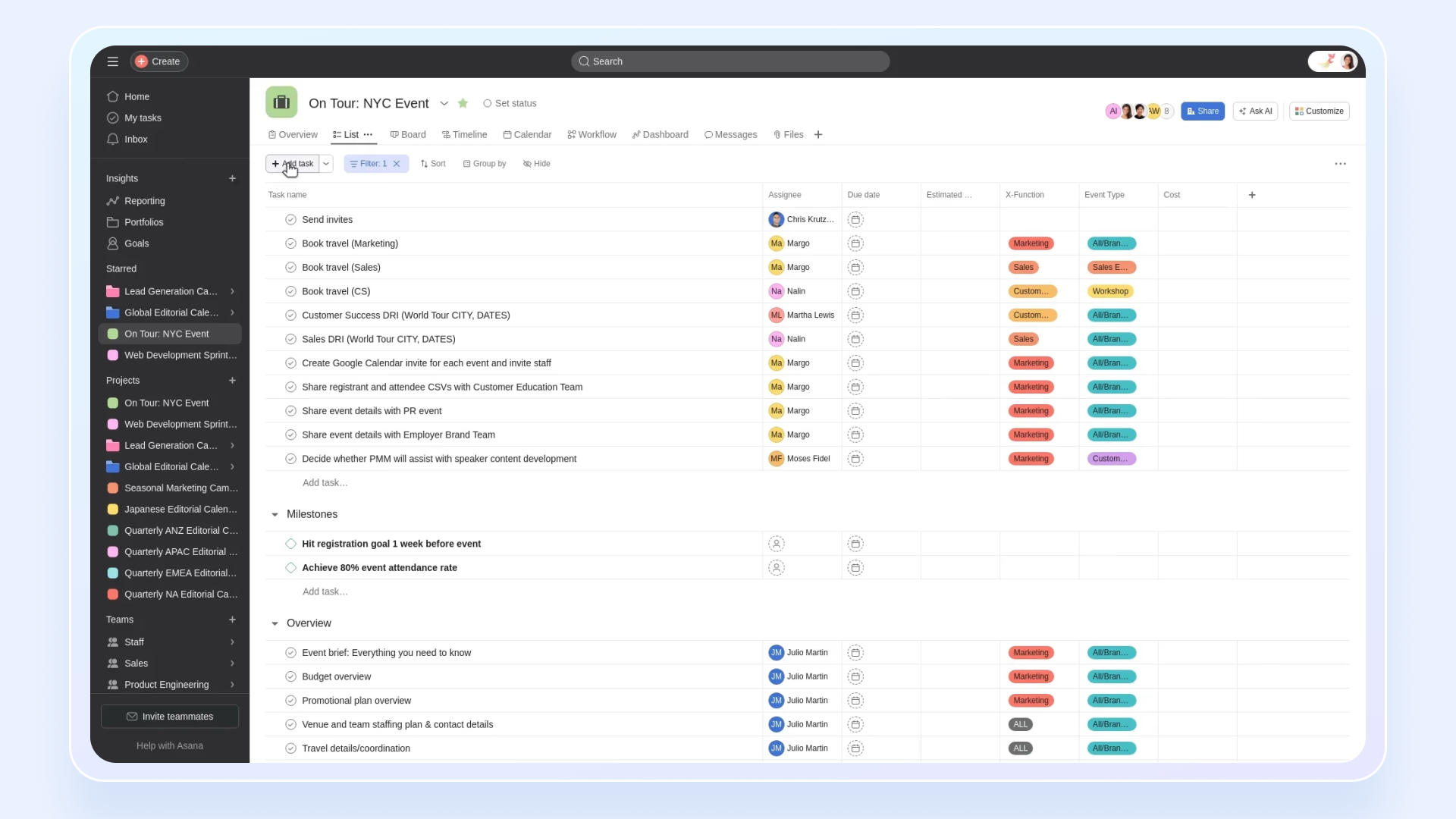
Image source: asana.com
is a flexible work management platform that helps teams organize their daily tasks and long-term using lists, boards, and timelines. It offers a user-friendly interface that simplifies task creation, assignment, and tracking. It is also particularly popular among teams that emphasize Agile methodologies.
What stands out to me is how it packs a deep feature set into an interface that stays easy to use. I appreciate how easy it is for a new user to log in and understand what they need to do without relying on extensive training materials. The Portfolios feature is particularly useful for managers who need to check the status of multiple projects at a glance. It provides a highly visual way to track progress, which makes the routine process of updating task statuses much more engaging for the average team member.
Key features:
- Multiple visualization modes: Offers list, board, and timeline views to suit different working styles.
- Integrated workflow automation: Connects with other tools and apps to boost efficiency.
- Agile empowerment: Customizable boards aid in the smooth execution of Agile methodologies.
- Portfolio management: Ability to bundle projects into portfolios for overall visibility.
Pros and cons:
Supported platforms: Web, iOS, Android, Mac, Windows
Integrations: Slack, Microsoft Teams, Salesforce, GitHub, Zapier, and more
Not ideal for: Enterprises managing massive-scale projects with intricate dependencies, or teams wanting advanced features on a free plan
Reviews:
Pricing:
- Personal: Free for up to 2 users - Offers unlimited tasks, projects, and basic management
- Starter: $10.99/user/month (billed annually) for unlimited users - Moving to this level introduces Gantt charts, advanced search, and task dependencies
- Advanced: $24.99/user/month (billed annually) for unlimited users - Stepping up brings in workload views, goal tracking, and portfolio management
- Enterprise/Enterprise+: Custom pricing (billed annually) for unlimited users - The highest tiers unlock advanced admin controls, comprehensive security, and dedicated support
Read more about Asana:
3. Monday.com: Best for visual management & customizable workflows
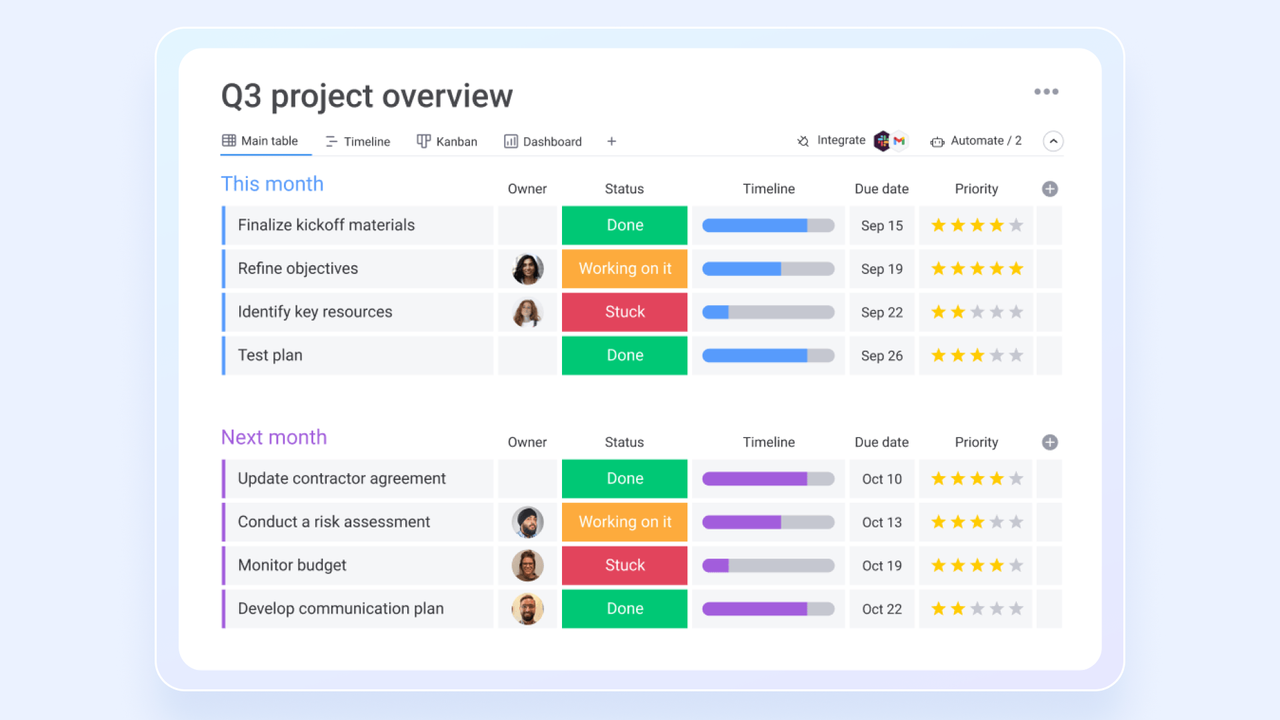
Image source: monday.com
operates as a customizable work operating system built around flexible boards, allowing teams to track everything from project milestones to CRM pipelines. The boards can be interlinked, making it especially beneficial for teams that require a customizable and dynamic work operating system.
Its primary strength is its highly visual and adaptable design, which helps make project tracking feel less tedious. I like how customizable the boards are for various industries, allowing users to shape the software to fit their specific operational needs. The automation is a strong point too. I can just set up a rule to change a status or ping a teammate when a task wraps, and the busywork mostly takes care of itself. It effectively saves me a lot of manual data entry that comes with managing projects.
Key features:
- Visual layout: Provides a highly engaging, intuitive visual interface.
- Customizable boards: Tailor workflows based on team-specific needs.
- Automation capabilities: Users can integrate automated notifications and workflow triggers.
- Integration friendly: Easily connects with various third-party business tools.
Pros and cons:
Supported platforms: Web, iOS, Android, Mac, Windows
Integrations: Slack, Microsoft Teams, Salesforce, GitHub, Zendesk, and more
Not ideal for: Large teams or enterprises with strict budget limitations, or organizations needing highly specialized PM features
Reviews:
Pricing:
- Free: Free for up to 2 users - Provides up to 3 boards and basic templates at no cost
- Basic: $9/user/month (billed annually) for unlimited users - This plan expands capabilities to include unlimited boards, 5GB file storage, and AI credits
- Standard: $12/user/month (billed annually) for unlimited users - Upgrading introduces timeline/Gantt views, guest access, and 250 monthly automations
- Pro: $19/user/month (billed annually) for unlimited users - Moving up unlocks private boards, time tracking, and 25,000 monthly automations
- Enterprise: Custom pricing (billed annually) for unlimited users - The top tier brings multi-level access, advanced analytics, and enterprise-grade security
Read more about monday.com:
4. Trello: Best for simple kanban-style task management
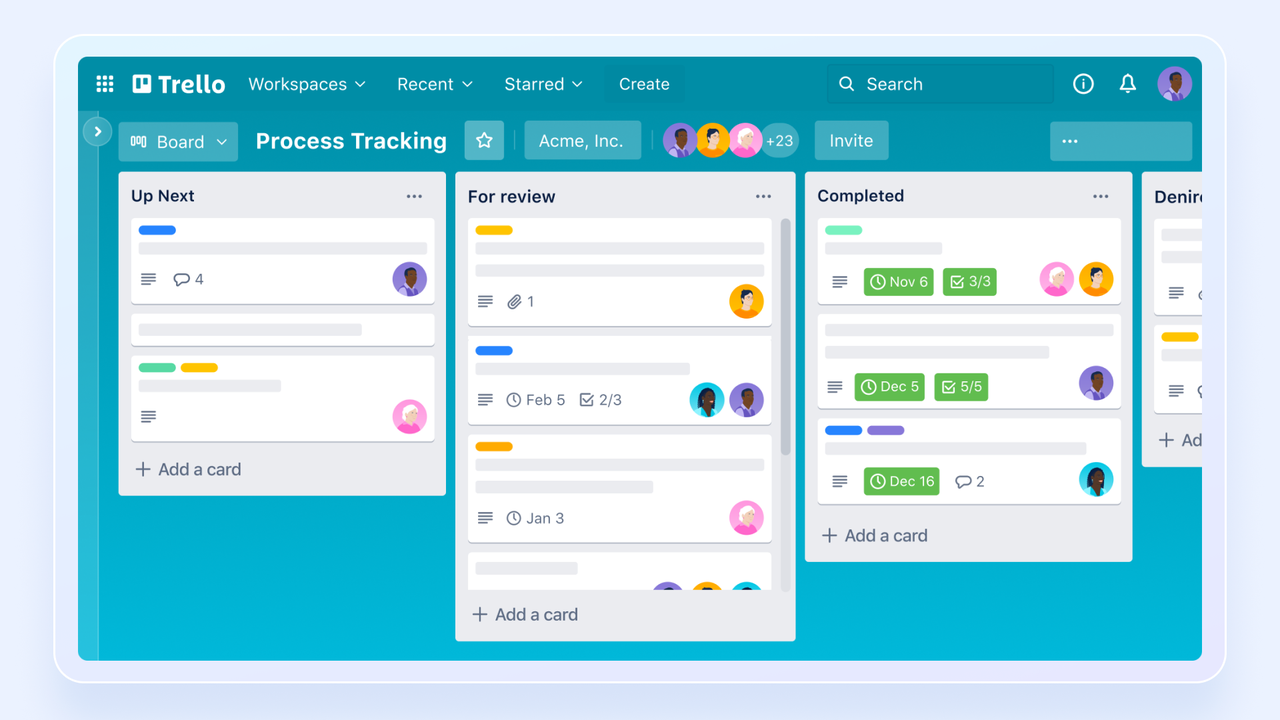
Image source: trello.com
is a visual and straightforward project management tool based entirely on moving digital cards across a Kanban board to represent different stages of work. The kanban board interface and intuitive drag-and-drop functionality make it especially effective for quickly tracking progress and collaborating on small to medium-sized projects.
Undoubtedly, Trello's primary appeal is its simplicity and intuitive design. I like that a new user can understand how to navigate a Trello board in a matter of minutes without needing formal training. Moving a card from one column to the next provides a clear, immediate visual indicator of progress, which works very well for freelancers or small teams managing standard tasks. The available power-ups allow users to add specific functionalities, like calendar views, without cluttering the core experience.
Key features:
- Kanban boards: Offers an intuitive drag-and-drop interface that makes task tracking simple.
- Collaboration: Promotes transparency and communication with visually accessible boards.
- Ease of use: Minimal learning curve contributes to rapid team adoption.
- Integration: Easily integrates with Google apps, such as Google Calendar, and other collaborative tools.
Pros and cons:
Supported platforms: Web, iOS, Android, Mac, Windows
Integrations: Slack, Jira, Google Drive, MailChimp, Miro, and more
Not ideal for: Complex projects requiring detailed reporting, task dependencies, or large-scale organization across multiple teams
Reviews:
Pricing:
- Free: Free for unlimited users - Includes up to 10 boards and 250 monthly workspace automations
- Standard: $5/user/month (billed annually) for unlimited users - Upgrading introduces unlimited boards, advanced checklists, and custom fields
- Premium: $10/user/month (billed annually) for unlimited users - Moving up unlocks multiple workspace views like Timeline and Calendar, plus advanced admin controls
- Enterprise: $17.50/user/month (billed annually) for unlimited users - This top plan brings organization-wide permissions and free SSO
Read more about Trello:
5. ClickUp: Best for customization and reporting features
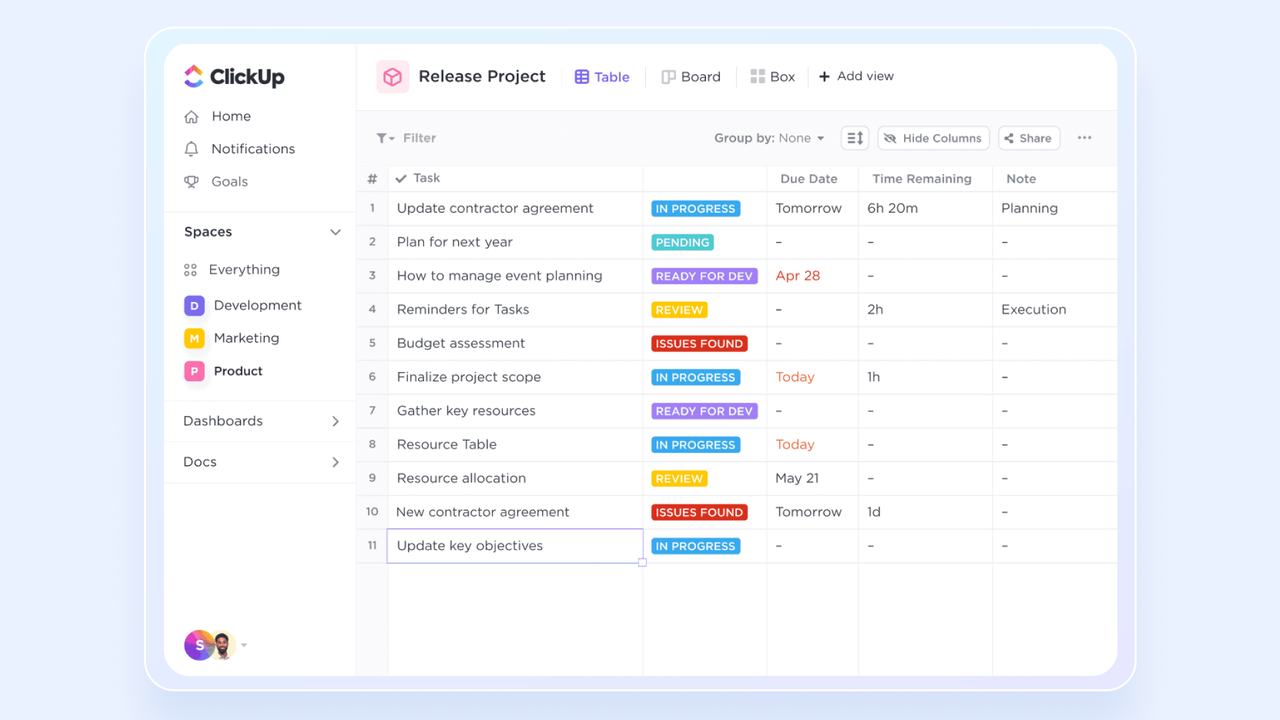
Image source: clickup.com
positions itself as an all-in-one workspace, pulling tasks, documents, digital whiteboards, and team communication into a single environment. This consolidation is particularly advantageous for teams weary of juggling multiple tools.
Its approach to consolidating multiple tools into one platform is what makes it unique, providing value for teams looking to reduce their software subscriptions. I appreciate that it attempts to minimize context switching by keeping wikis, spreadsheets, and tasks in one centralized . The customization options are extensive, allowing users to view their data as lists, workload charts, or mind maps based on their personal preferences. It offers a lot of flexibility for users who prefer to tailor their digital workspace to their exact specifications.
Key features:
- Integrated platform: Combines various project management functionalities, reducing the need for additional software.
- Customizable views: Supports list, board, and calendar views, among others.
- Robust integration: Easily connects with well-known software and tools for a seamless experience.
- Deep functionality: Offers extensive customization that allows power users to tweak almost every element of their practice.
Pros and cons:
Supported platforms: Web, iOS, Android, Mac, Windows, Linux
Integrations: Slack, Microsoft Teams, Google Drive, HubSpot, Zapier, and more
Not ideal for: Smaller teams, beginners, or users who prefer a simple, streamlined interface without feature bloat.
Reviews:
Pricing:
- Free Forever: Free for unlimited users - Features unlimited tasks, Kanban boards, collaborative docs, and 60MB storage
- Unlimited: $7/user/month (billed annually) for unlimited users - This level removes storage limits while introducing unlimited integrations and Gantt charts
- Business: $12/user/month (billed annually) for unlimited users - Stepping up unlocks advanced time tracking, unlimited dashboards, and workload management
- Enterprise: Custom pricing (billed annually) for unlimited users - This custom-priced plan brings white-labeling, advanced permissions, and dedicated onboarding
Read more about ClickUp:
6. Wrike: Best for large teams with structured workflows
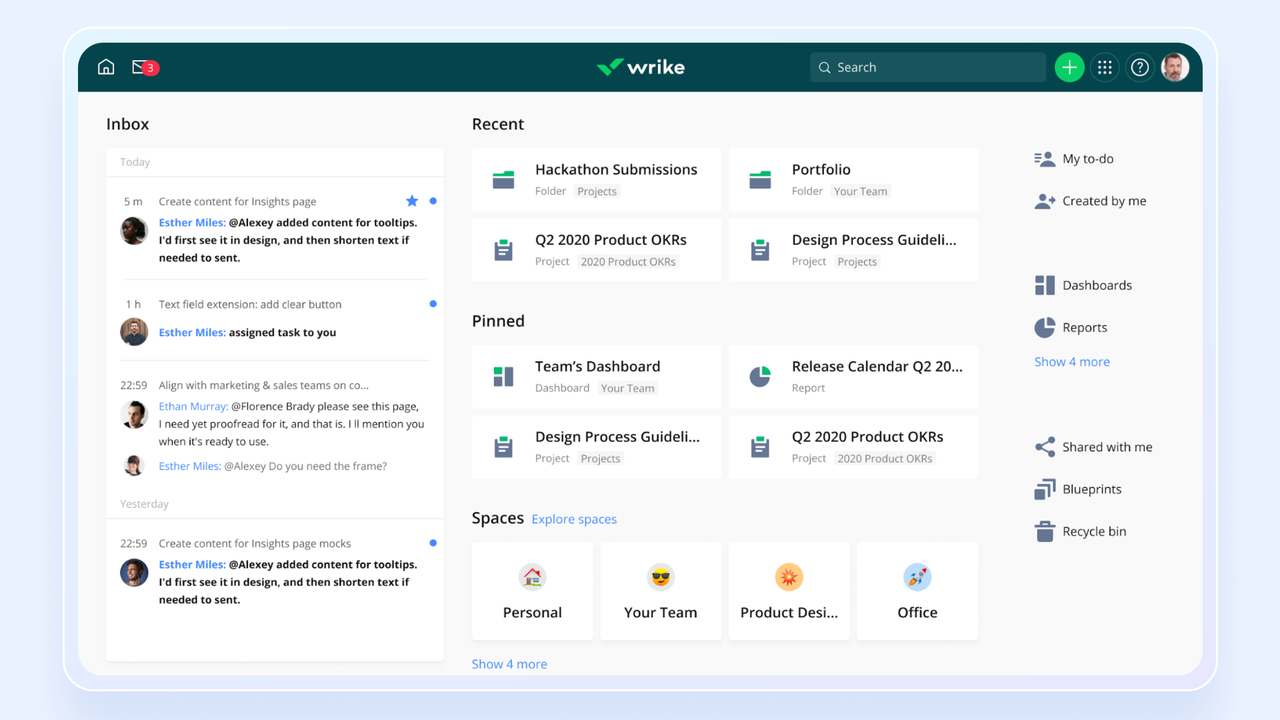
Image source: wrike.com
is a highly scalable project management platform built for enterprise-level needs. It's good for managing complex projects and gives you deep visibility into resource allocation and team workloads. That makes it a strong fit for large organizations that lean on structured planning and detailed oversight.
I find its analytics and resource allocation tools to be highly effective for large-scale operations. It reliably handles extensive amounts of interconnected tasks across different departments, which is a practical necessity for enterprise users and large agencies. The custom request forms are a very useful feature, automatically converting incoming requests into structured projects with assigned tasks and deadlines. If management needs to track workload capacity across hundreds of employees, Wrike provides the necessary infrastructure to do so clearly.
Key features:
- Enterprise-grade resource management: Offers advanced workload views and effort-planning tools.
- Customizable workflows: Allows teams to build custom request forms, dashboards, and automated workflows.
- Multiple work views: Supports Gantt charts, boards, tables, and calendars to suit different needs.
- Powerful analytics: Provides advanced analytics and reporting for in-depth performance tracking.
Pros and cons:
Supported platforms: Web, iOS, Android, Mac, Windows
Integrations: Microsoft Teams, Salesforce, GitHub, Jira, Quickbooks, and more
Not ideal for: Smaller teams, organizations with tight budgets, or those looking for a tool with a quick and easy onboarding process.
Reviews:
Pricing:
- Free: Free for unlimited users - Offers centralized task management and 2GB overall storage
- Team: $10/user/month (billed annually) for up to 25 users - Upgrading unlocks interactive Gantt charts, customized workflows, and shareable dashboards
- Business: $24.80/user/month (billed annually) for up to 200 users - Moving to this tier introduces time tracking, resource management, and advanced reporting
- Enterprise/Pinnacle: Custom pricing (billed annually) for unlimited users - The highest plans bring capacity forecasting, budgeting tools, and enterprise security
Read more about Wrike:
7. Smartsheet: Best for traditional spreadsheet users
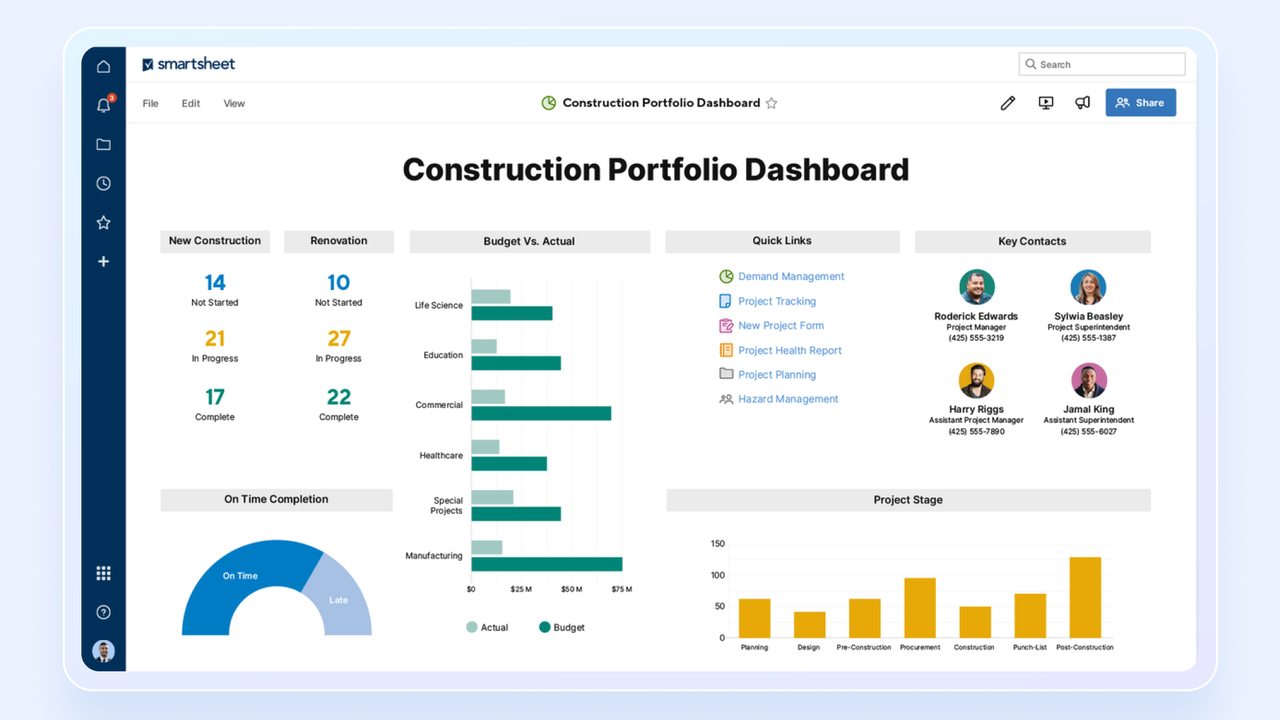
Image source: smartsheet.com
stands out for its familiar, spreadsheet-based layout that appeals to users who prefer structured, grid-like project management. Its automation and reporting tools are best for teams that mostly rely on spreadsheets.
I appreciate that its interface is immediately familiar to anyone who has used Excel, which significantly lowers the barrier to entry for teams transitioning from older methods. It takes a classic format and turns it into a collaborative tool where users can attach files directly to rows and switch their view to a Gantt chart when needed. The ability to build external-facing forms that feed data directly into the master sheet is a practical way to collect client requests or survey responses. It bridges the gap between traditional data entry and modern task tracking effectively.
Key features:
- Spreadsheet interface: An intuitive grid layout makes it accessible for users with Excel experience.
- Automation: Delivers extensive automation capabilities that allow dynamic process adjustments.
- Robust reporting: Provides in-depth and customizable reporting for complex projects.
- Integration options: Easily connects with popular business tools for smoother workflows.
Pros and cons:
Supported platforms: Web, iOS, Android, Mac, Windows
Integrations: Jira, Salesforce, Microsoft Teams, Slack, Adobe CC, and more
Not ideal for: Teams averse to traditional spreadsheet layouts, or budget-conscious users who want advanced features without add-on costs
Reviews:
Pricing:
- Pro: $9/user/month (billed annually) for up to 10 users - Includes unlimited sheets, basic dashboards, and 250 monthly automations
- Business: $19/user/month (billed annually) for unlimited users - Upgrading unlocks unlimited guests, advanced reporting, and team workload tracking
- Enterprise/Advanced: Custom pricing (billed annually) for unlimited users - These custom-priced tiers introduce enterprise-grade governance, SSO, and advanced IT controls
Read more about Smartsheet:
8. Jira: Best agile project management software
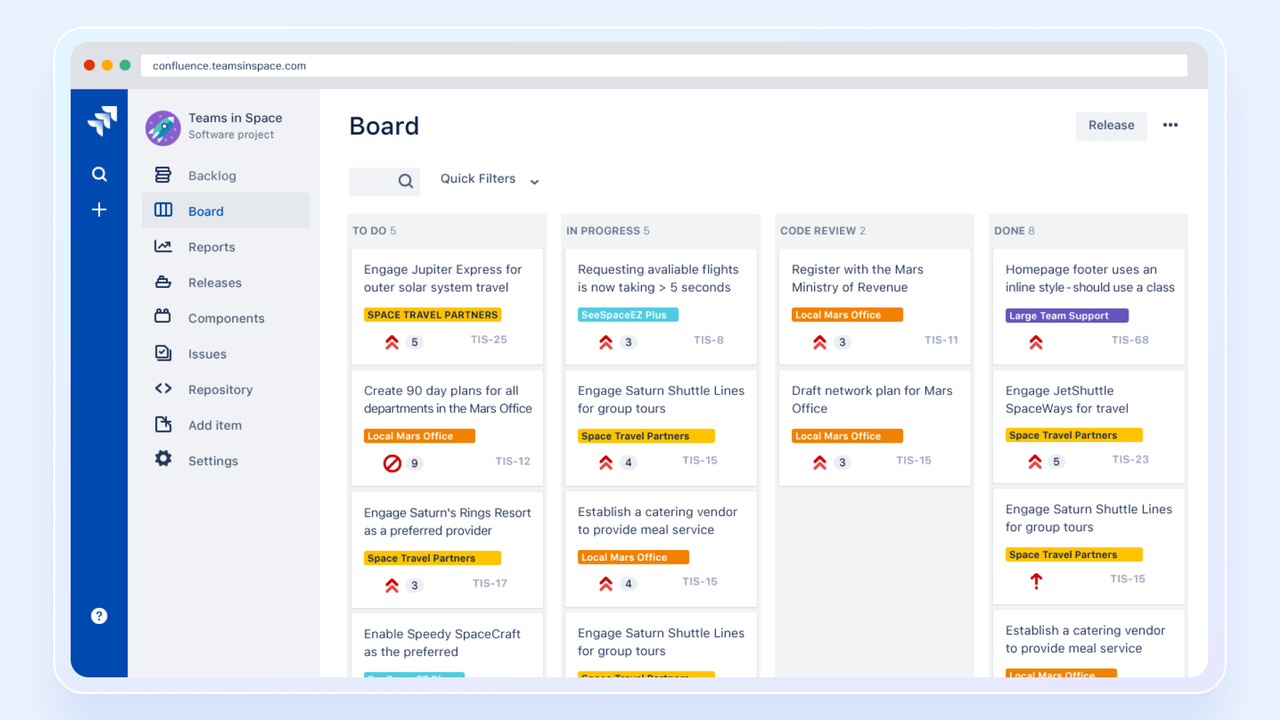
Image source: atlassian.com
, developed by Atlassian, is one of the most popular agile project management software on the market. Although it is primarily designed for software development and IT teams, its comprehensive issue-tracking capabilities and support for Agile and methodologies have made it a staple among technical teams.
I respect how well it aligns with the specific needs of software developers, acting as a reliable central hub for technical teams. Its extensive ecosystem of plugins in the Atlassian Marketplace allows users to connect it to almost any other development tool they use. I particularly like how it integrates with code repositories, linking specific lines of code directly to a project task ticket so managers can track technical progress accurately. For teams utilizing Scrum or Agile methodologies, it provides all the necessary structural frameworks.
Key features:
- Agile and scrum focus: Provides robust support for sprint planning, backlog management, and iterative development.
- Customization and plugins: Extensive customization options through a wide ecosystem of plugins.
- Issue tracking: Efficiently manages bug tracking and task assignment.
- Detailed reporting: Offers real-time insight into project progress and team performance.
Pros and cons:
Supported platforms: Web, iOS, Android, Mac, Windows
Integrations: Slack, Microsoft Teams, GitHub, Zendesk, Trello, and more
Not ideal for: Non-technical teams, simple projects, or organizations doing traditional project management outside of software development
Reviews:
Pricing:
- Free: Free for up to 10 users - Provides unlimited project boards, basic reporting, and 2GB storage
- Standard: $7.91/user/month (billed annually) for up to 100,000 users - This plan introduces user roles, audit logs, 250GB storage, and AI features
- Premium: $14.53/user/month (billed annually) for up to 100,000 users - Stepping up unlocks advanced cross-team planning, unlimited storage, and 24/7 support
- Enterprise: Custom pricing (billed annually) for unlimited users - The top tier brings multiple instances, advanced admin controls, and a 99.95% uptime SLA
Read more about Jira:
9. Microsoft Planner: Best for team task management inside the Microsoft 365 ecosystem
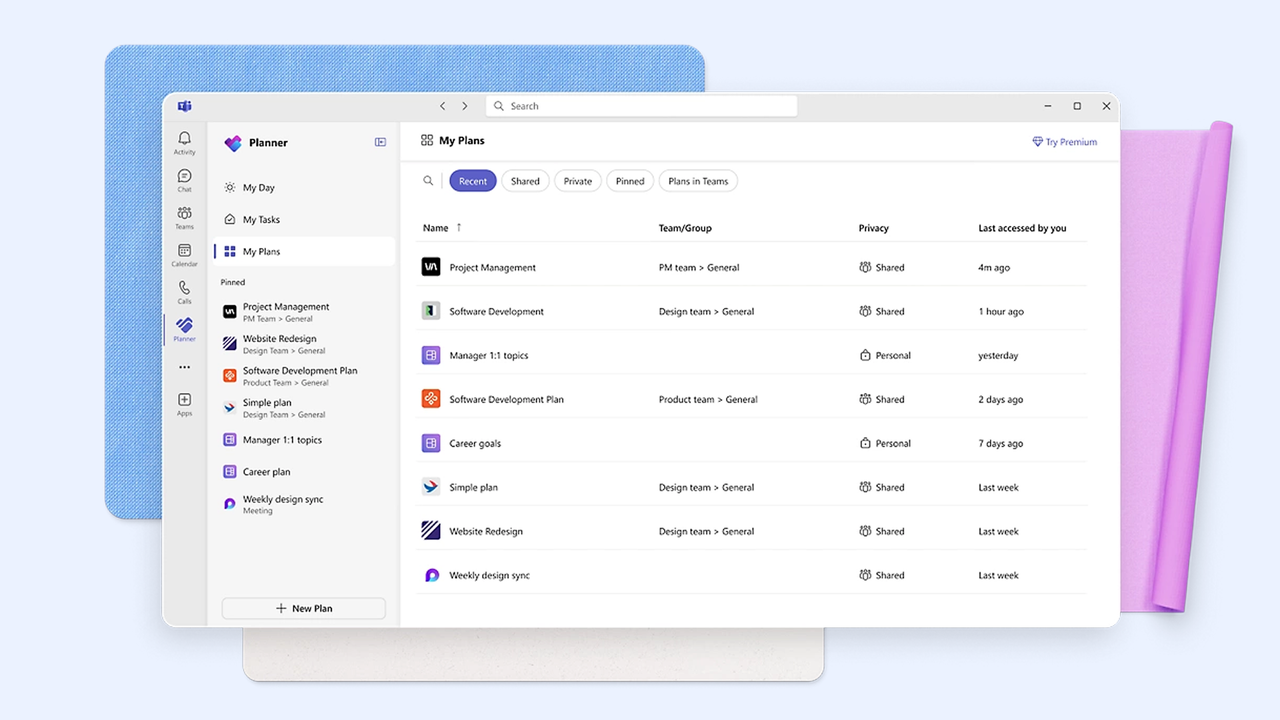
Image source: microsoft.com
is a task and work management tool built natively into the Microsoft 365 ecosystem. In 2025, Microsoft consolidated its work management apps, retiring Project for the web in August 2025 and folding its capabilities into a single, unified Planner experience that spans from simple to-do lists to enterprise project management. The version included with most Microsoft 365 business subscriptions centers on collaborative, board-style task management, offering Grid, Board, Schedule, and Charts views for organizing and tracking teamwork.
I find its integration with Microsoft Teams and Outlook to be highly practical since it allows users to manage tasks directly from their communication channels. This tight integration makes it a logical and secure choice for enterprise environments that already rely on the Windows ecosystem for their daily operations. The ability to build detailed Gantt charts and map out strict task dependencies supports project managers who need to forecast timelines accurately. It provides a reliable framework for corporate planning and resource management.
Key features:
- Powerful scheduling: Offers advanced scheduling tools, including Gantt charts and dependency mapping.
- Resource management: Provides detailed tools for tracking resources across complex projects.
- Familiar Microsoft interface: Seamless integration with other Microsoft products, such as Microsoft Teams, enhances usability.
- Detailed reporting: Suitable for large projects with extensive task hierarchies.
Pros and cons:
Supported platforms: Web, iOS, Android
Integrations: Microsoft Teams, SharePoint, Microsoft 365 apps, and more
Not ideal for: Smaller teams, organizations with limited software budgets, or teams operating entirely outside of the Microsoft ecosystem
Reviews:
Pricing:
- Plan 1: $10/user/month (billed annually) for unlimited users - This level introduces timeline views, task dependencies, and premium templates
- Plan 3: $30/user/month (billed annually) for unlimited users - Upgrading unlocks advanced dependencies, task history, and detailed resource assignments
- Plan 5: $55/user/month (billed annually) for unlimited users - The highest tier brings enterprise portfolio management, demand management, and advanced resource allocation
Read more about Microsoft Planner:
10. Adobe Workfront: Best enterprise project management software
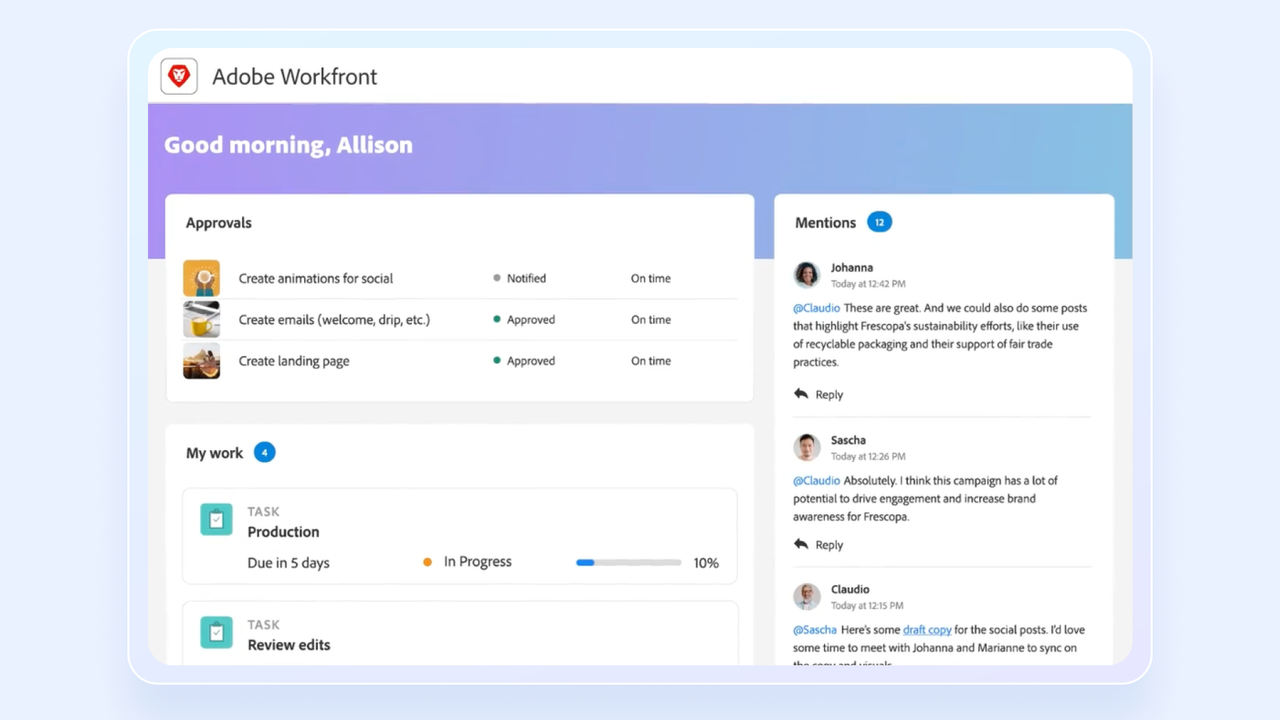
Image source: business.adobe.com
is a popular enterprise project management software, catering to large organizations with diverse project management needs. Its comprehensive features include resource management, portfolio planning, and detailed reporting. Additionally, the integration with Adobe Creative Cloud provides added value for creative teams.
I appreciate how it allows creatives to remain in their native Adobe applications, like Photoshop or Premiere Pro, while still keeping project managers informed of their progress. It effectively connects project data with the actual creative design process. The built-in proofing tools are notably useful, enabling stakeholders to leave specific feedback directly on a video timeline or a PDF draft. This reduces miscommunication and streamlines the revision cycle for design agencies.
Key features:
- Enterprise-grade functionality: Designed for large organizations with complex project structures.
- Resource and portfolio management: Enables detailed oversight of projects and resource allocation.
- Creative cloud integration: Seamlessly pairs with Adobe Creative Cloud, benefiting creative teams.
- Robust reporting: Provides in-depth reports for extensive project performance analysis.
Pros and cons:
Supported platforms: Web, iOS, Android
Integrations: Adobe Creative Cloud, Jira, Slack, Microsoft Teams, and more
Not ideal for: Smaller teams, simple project workflows, or organizations lacking specialized personnel to configure the platform
Reviews:
Pricing:
- Select: Custom pricing (billed annually) for unlimited users - Offers essential enterprise work management, resource management, and reporting
- Prime: Custom pricing (billed annually) for unlimited users - Upgrading expands Select features with strategic portfolio planning and enhanced compliance
- Ultimate: Custom pricing (billed annually) for unlimited users - The top tier brings workflow automation and enterprise-grade scalability to the Prime features
Read more about Adobe Workfront:
11. ProofHub: Best for teams needing a predictable pricing model
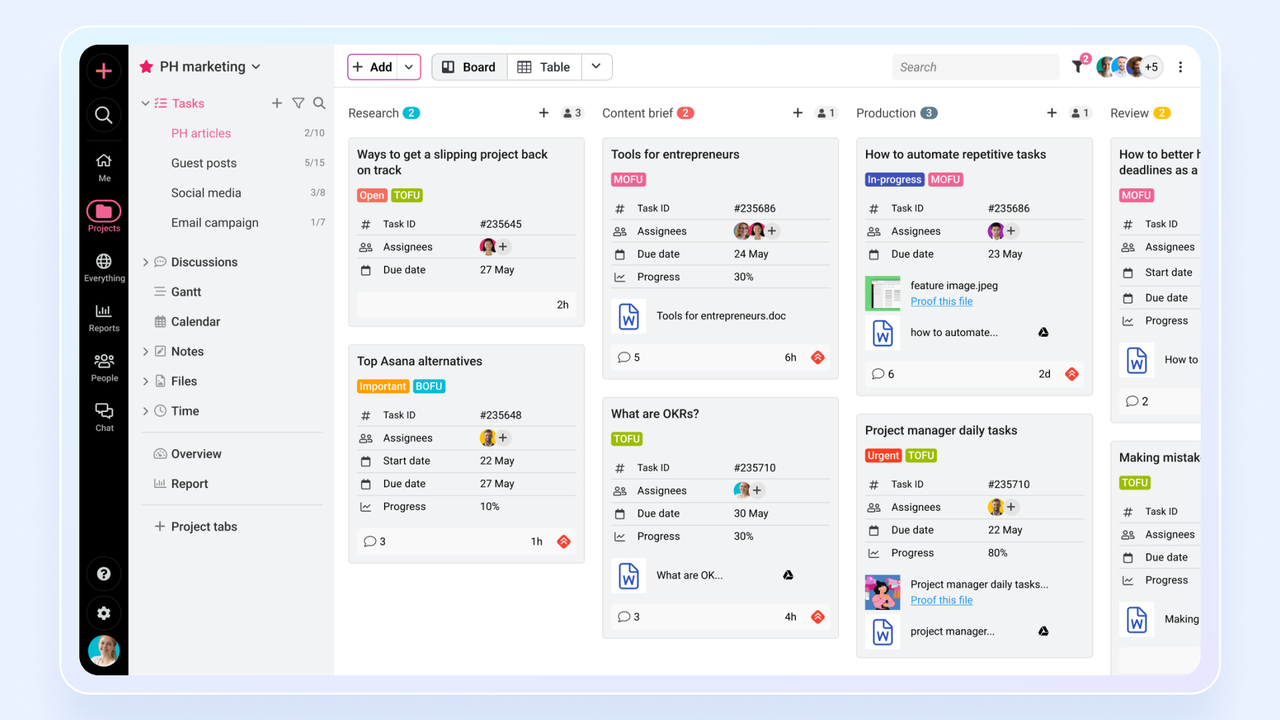
Image source: proofhub.com
ProofHub offers an all-in-one platform that centralizes project management and team collaboration into a single, cohesive space. Its flat-rate, unlimited-user pricing model distinguishes it from competitors that charge per seat. This means that a growing company can add new employees or invite freelance contractors into the system without steadily increasing their monthly software expenses.
Beyond the pricing, it provides a solid combination of features, including built-in group chat and document proofing tools alongside standard task lists. It serves as a practical, all-in-one management solution for mid-sized teams monitoring their overhead costs.
Key features:
- Flat-rate pricing: A single monthly fee for unlimited users, removing financial penalties for team growth.
- Integrated toolset: Combines task management, Gantt charts, discussions, and online proofing tools.
- Custom roles: Provides granular control over user permissions and access levels.
- Centralized collaboration: Keeps all communications, files, and approvals in one place to maintain clarity.
Pros and cons:
Supported platforms: Web, iOS, Android, Mac, Windows
Integrations: Slack, Box, Dropbox, Google Calendar, QuickBooks, and more
Not ideal for: Enterprises requiring highly specialized Agile frameworks, or teams heavily reliant on a massive ecosystem of third-party integrations
Reviews:
Pricing:
- Essential: $45/month flat fee (billed annually) for unlimited users - Manages up to 40 projects with 15GB storage
- Ultimate Control: $89/month flat fee (billed annually) for unlimited users - Upgrading unlocks unlimited projects, 100GB storage, and custom roles
12. Basecamp: Best for SMBs favoring low administrative overhead
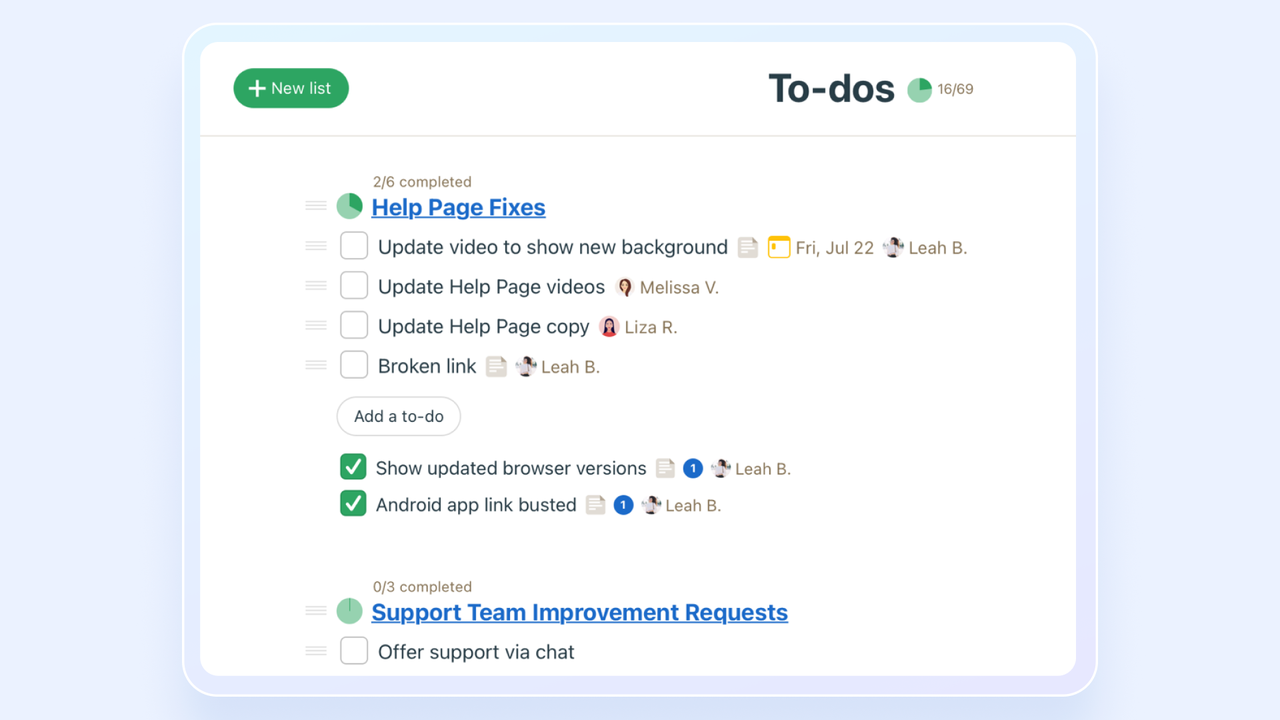
Image source: basecamp.com
is designed around simplicity and clear communication, consolidating to-do lists, messages, scheduling, and file storage into one place. Its minimalist, non-technical approach is perfect for teams that want to reduce complexity and administrative overhead, focusing on collaboration rather than intricate project tracking features.
I appreciate its focus on clear, text-based communication, which encourages teams to move away from scattered email threads. It deliberately omits complex project management features like Gantt charts to maintain a simple, uncluttered user experience. The automated daily check-in feature, which prompts team members to share what they worked on, is a practical way to maintain alignment without scheduling additional meetings. It is a fitting tool for companies that prioritize straightforward collaboration over detailed metric tracking.
Key features:
- Centralized project spaces: Each project has a single page with all its to-dos, schedules, documents, and discussions.
- Message boards & pings: Replaces scattered email chains and chats with organized, topic-based conversations.
- Hill charts: A unique visual tool to track the progress of to-do lists without relying on percentages or estimates.
- Simple flat-rate pricing: Offers an all-inclusive plan with unlimited projects and users for a single monthly fee.
Pros and cons:
Supported platforms: Web, iOS, Android, Mac, Windows
Integrations: Zapier, Google Sheets, Slack, Airtable, HubSpot, and more
Not ideal for: Teams needing advanced tracking tools like Gantt charts, task dependencies, and detailed metric reporting
Reviews:
Pricing:
- Free: Free for up to 20 users - Allows management of 1 active project with 1GB storage
- Plus: $15/user/month (billed annually) for unlimited users - This tier introduces unlimited projects, 500GB storage, and month-to-month billing
- Pro Unlimited: $299/month flat fee (billed annually) for unlimited users - The premium option unlocks 5TB storage and priority support
Read more about Basecamp:
13. Zoho Projects: Best for organizations with basic project management needs
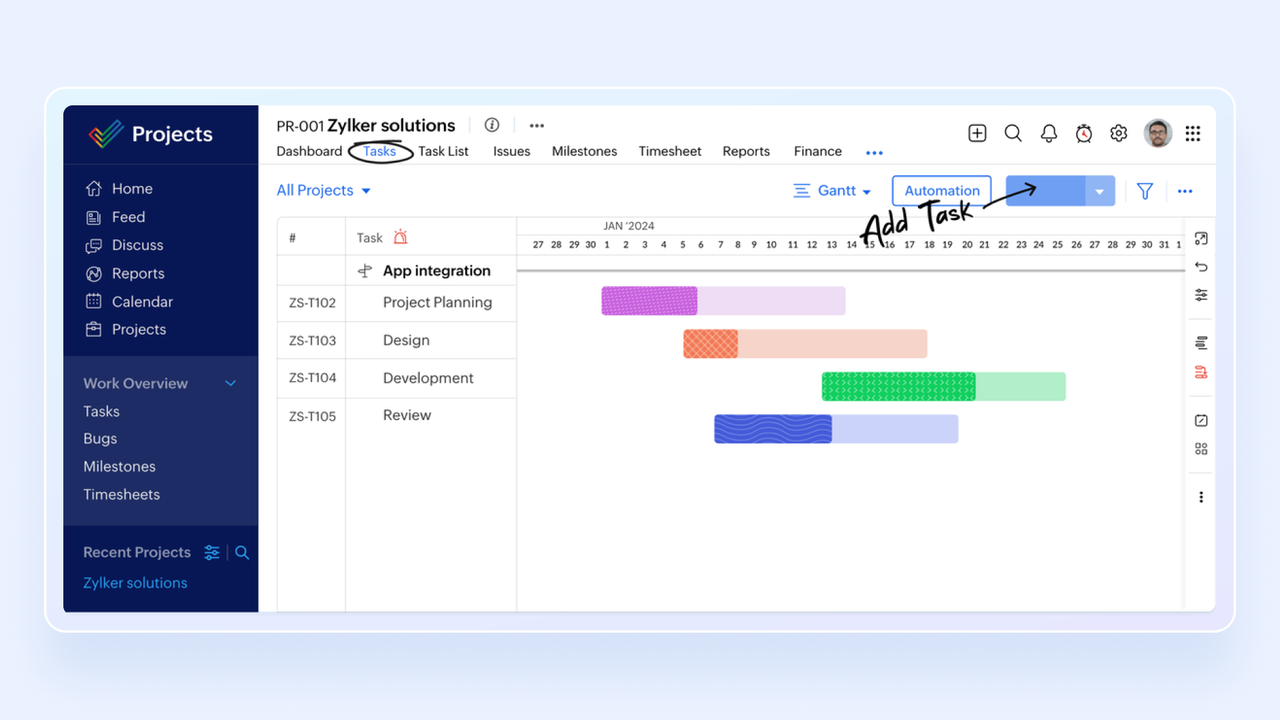
Image source: zoho.com
is a traditional project management tool featuring task lists, Gantt charts, and timesheets, serving as a core component of the broader Zoho application suite.
I find it offers an extremely wide range of features at competitive prices. Zoho Projects works particularly well if your team is already using the Zoho ecosystem, so data can flow from their CRM platform through to their invoicing software. The built-in timers for tracking billable hours are practical for service-based businesses that need to monitor their time closely. For organizations already utilizing Zoho applications, it is a logical addition to their operational workflow.
Key features:
- Comprehensive task management: Includes milestones, task lists, dependencies, and recurring tasks.
- Time and issue tracking: Offers built-in timesheets, billing, and an issue tracker to manage bugs and problems.
- Gantt and kanban views: Provides flexible project visualization with drag-and-drop Gantt charts and kanban boards.
- Zoho ecosystem integration: Connects seamlessly with other Zoho apps like Zoho CRM, Books, and Desk.
Pros and cons:
Supported platforms: Web, iOS, Android
Integrations: Zoho CRM, Google Calendar, GitHub, Zendesk, Zapier, and more
Not ideal for: Teams that prioritize cutting-edge, highly modern user interfaces, or larger teams hoping to rely entirely on a free plan
Reviews:
Pricing:
- Free: Free for up to 5 users - Supports up to 3 projects with basic task lists and milestones
- Premium: $4/user/month (billed annually) for unlimited users - Upgrading unlocks unlimited projects, advanced Gantt charts, and 100GB storage
- Enterprise: $9/user/month (billed annually) for unlimited users - Moving up brings global Gantt charts, custom roles, and 120GB storage
Read more about Zoho:
14. Scoro: Best professional services project management software
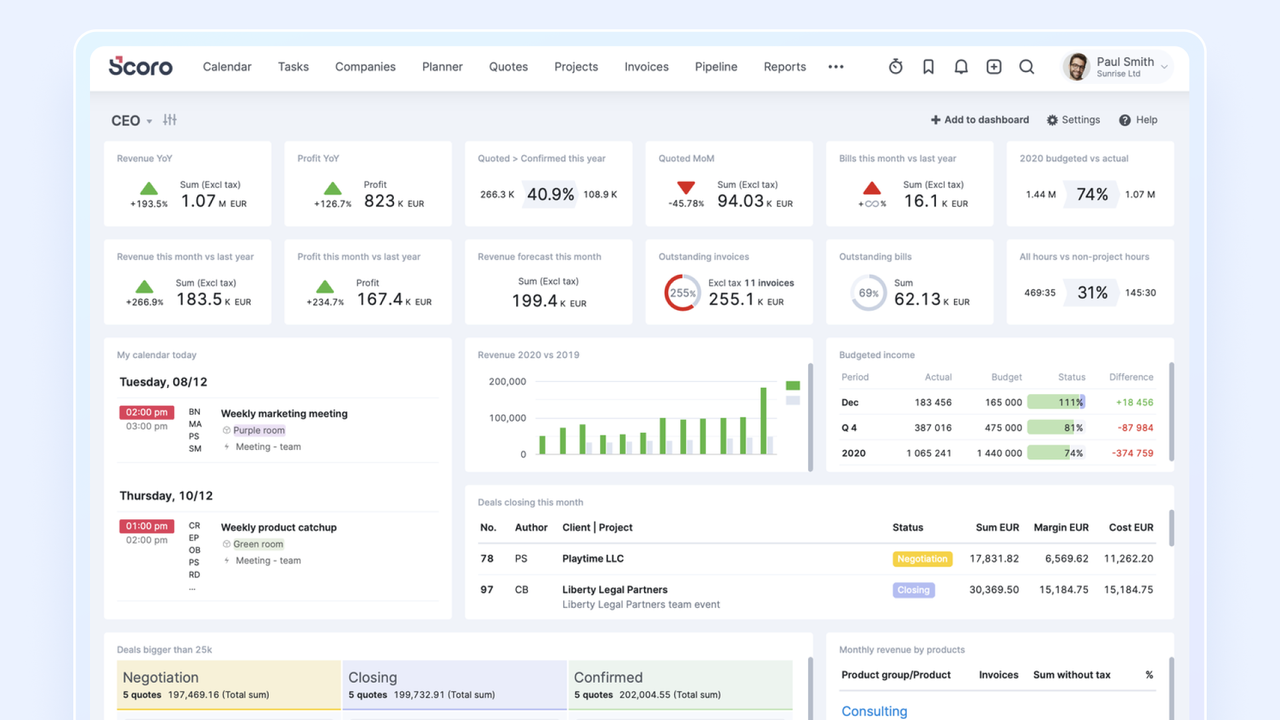
Image source: scoro.com
is an end-to-end work management platform that combines project management with CRM, billing, and financial reporting. It is specifically designed for professional services firms, agencies, and consultancies that need a single source of truth to manage the entire client work lifecycle, from the initial quote to the final invoice.
I view Scoro as a thorough solution for professional services that need to align their billable hours with overall business profitability. The main advantage is its ability to connect individual project tasks directly to financial outcomes, allowing executives to see the profit margins of a specific client in real time. By tracking the entire process from the initial sales proposal to the final invoice, it reduces the need to use multiple separate software platforms.
Key features:
- Integrated business hub: Unifies project management, sales, billing, and reporting in one system.
- Financial management: Tracks project profitability, budgets, and labor costs in real-time.
- Detailed time tracking & billing: Offers advanced timesheet management and automated billing workflows.
- Real-time dashboards: Provides a 360-degree view of business performance and project health.
Pros and cons:
Supported platforms: Web, iOS, Android
Integrations: Salesforce, Slack, Google Calendar, QuickBooks, Xero, and more
Not ideal for: Small teams, budget-conscious organizations, or teams wanting a fast, simple setup without minimum user requirements
Reviews:
Pricing:
- Essential: $26/user/month (billed annually) for unlimited users - Includes task boards, basic Gantt charts, and quoting features
- Standard: $37/user/month (billed annually) for unlimited users - This level introduces project budgets, recurring tasks, and detailed financial reports
- Pro: $63/user/month (billed annually) for unlimited users - Upgrading unlocks advanced capacity forecasting and resource planning
- Ultimate: Custom pricing (billed annually) for unlimited users - The top tier brings advanced automation, multiple custom fields, and tailored onboarding
Read more about Scoro:
15. Teamhood: Best for combining detailed scheduling with Agile responsiveness
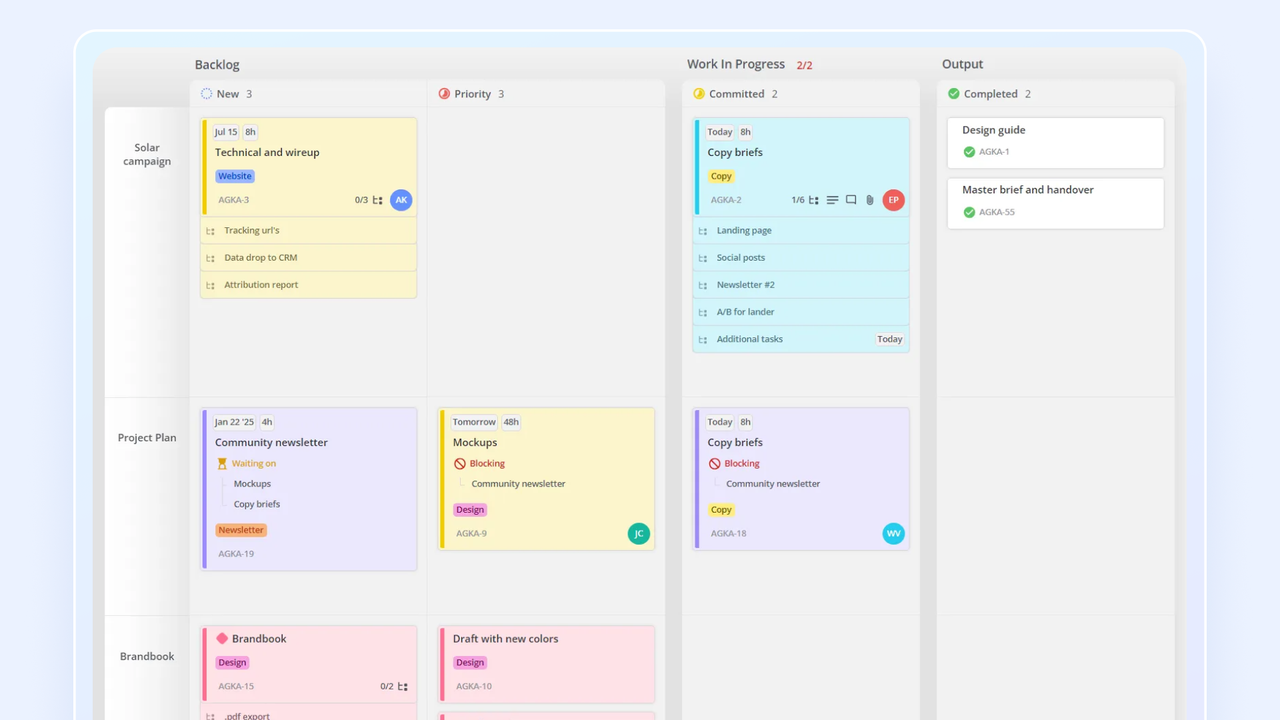
Image source: teamhood.com
Teamhood is a visual project management tool that supports hybrid methodologies by seamlessly integrating detailed Gantt chart scheduling with flexible kanban boards. This approach makes it particularly useful for teams in engineering and manufacturing, which need to manage long-term plans while maintaining day-to-day agility.
I like how clearly it visualizes team workloads, making it easy for managers to identify when an employee is overbooked. It handles hybrid project management smoothly, allowing for structured, top-level planning while enabling the team to execute tasks with Agile flexibility. The advanced Kanban boards are well-designed, featuring swimlanes that let you monitor multiple sub-projects on a single screen without visual clutter. It serves as a practical middle ground for engineering and product development teams.
Key features:
- Hybrid PM support: Natively combines interactive Gantt charts and kanban boards in one view.
- Visual workload management: Provides clear views of team member capacity and workload distribution.
- Advanced kanban boards: Features swimlanes for managing multiple projects or teams on a single board.
- Time tracking: Includes built-in time tracking with estimates and reporting on individual tasks.
Pros and cons:
Supported platforms: Web, iOS, Android, Mac, Windows
Integrations: Jira, Slack, MS Teams, Azure DevOps, Zapier, and more
Not ideal for: Mobile-first users who need a robust mobile app, or teams relying on a vast library of established third-party integrations
Reviews:
Pricing:
- Personal: Free for up to 10 users - Provides basic Kanban boards and foundational task management
- Team: €9/user/month (billed annually) for teams with over 3 users - This plan introduces advanced task visualization and basic project tracking
- Business: €18/user/month (billed annually) for teams with over 3 users - Upgrading unlocks comprehensive portfolio management and advanced team collaboration
- Enterprise: Custom pricing (billed annually) for teams with over 25 users - This plan includes more automations, SSO, user provisioning, and advanced security and admin controls
Note: Teamhood's official pricing is in euros.
16. Notion: Best marketing project management software for documentation and task management
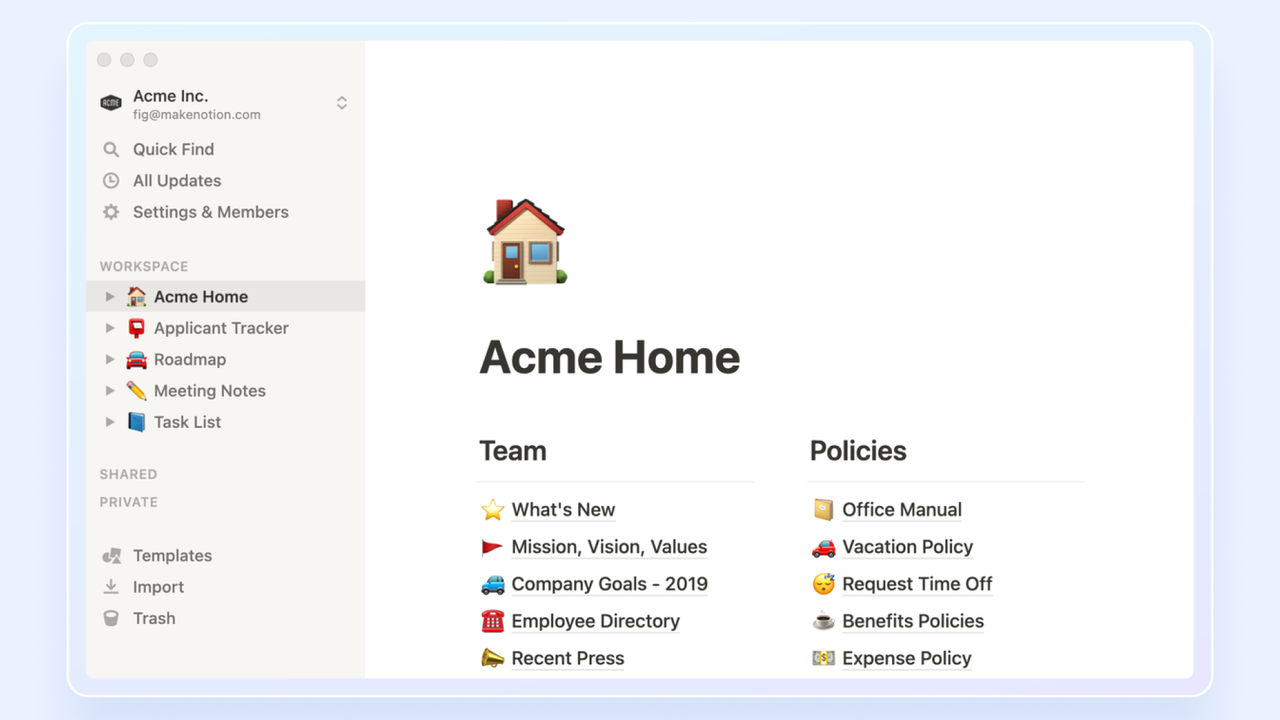
Image source: notion.com
Notion is an all-in-one workspace that combines notes, documents, wikis, and project management into a single, highly customizable platform. It has a modular, building-block design that allows teams to create their own tools and workflows, making it perfect for those who want to unify their knowledge base with their task management system.
I appreciate how it merges knowledge management with task tracking, reducing the need to switch between a document editor and a separate task application. Its flexibility allows users to embed a Kanban board directly into a meeting agenda or a policy document. This adaptability means teams can build custom internal tools and databases that align with their specific operational processes. It functions well for users who prefer to design their own structural frameworks.
Key features:
- Modular workspace: Uses "blocks" to build custom pages with text, databases, calendars, and more.
- Powerful databases: Create flexible databases with multiple views (boards, lists, galleries, timelines) to track anything.
- Integrated docs & tasks: Seamlessly link documents and meeting notes directly to project tasks and timelines. Assign tasks to team members in docs.
- Collaborative environment: Supports real-time editing, comments, and mentions to keep teams in sync.
Pros and cons:
Supported platforms: Web, iOS, Android, Mac, Windows
Integrations: Slack, Google Drive, Jira, GitHub, Make, and more
Not ideal for: Teams wanting a ready-made project management solution right out of the box, or those requiring built-in time tracking and advanced reporting
Reviews:
Pricing:
- Free: Free for up to 10 guests - Allows unlimited blocks for individuals and a 5MB file upload limit
- Plus: $10/user/month (billed annually) for unlimited users - Moving to this tier introduces unlimited blocks for teams, unlimited uploads, and a 30-day page history
- Business: $20/user/month (billed annually) for unlimited users - Stepping up unlocks advanced page permissions, a 90-day history, and integrated AI
- Enterprise: Custom pricing (billed annually) for unlimited users - The highest plan brings advanced security controls, audit logs, and unlimited page history
Read more about Notion:
17. Airtable: Best for flexible automated data organization
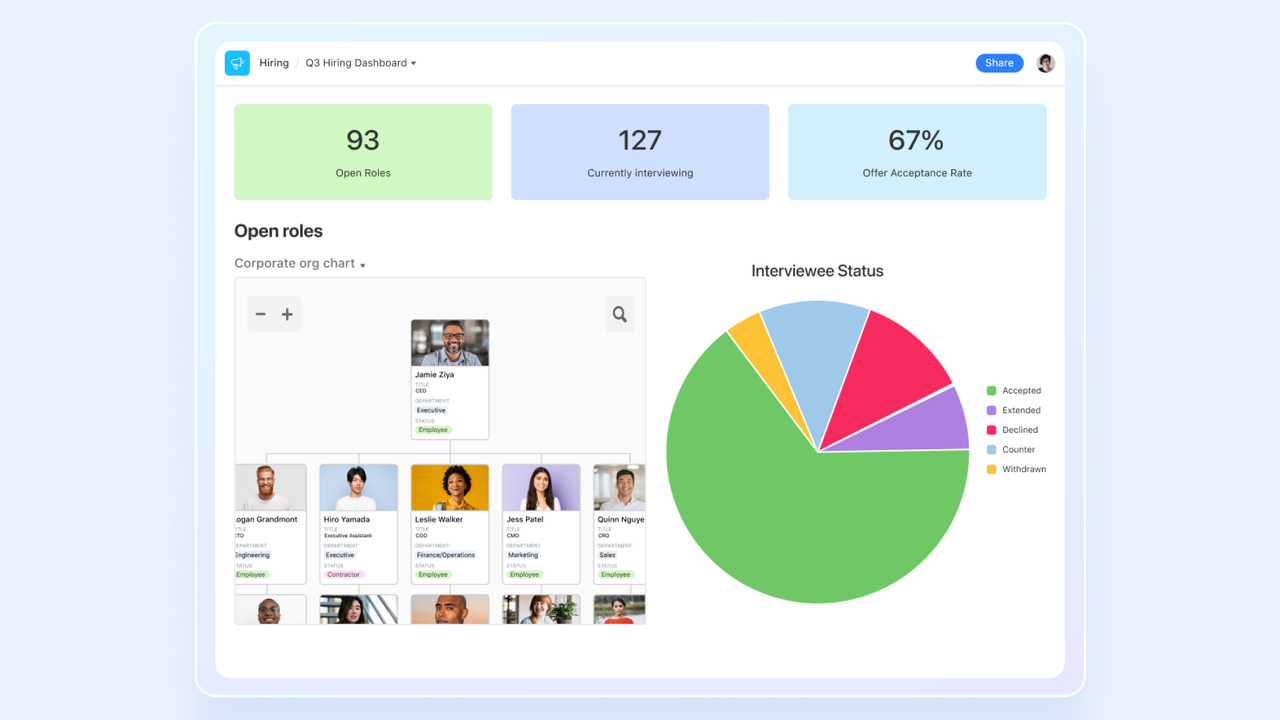
Image source: airtable.com
elevates the familiar spreadsheet into a powerful and flexible database, allowing users to organize any type of information, project, or data. Its ability to create relationships between data, build custom views, and automate workflows makes it ideal for teams that need to manage complex information in a collaborative and visual way.
I am most impressed by its flexibility and its automation capabilities, which can reduce the need for manual data entry. It is highly effective for linking complex datasets together—such as connecting a specific task to a client profile and an inventory item—to build custom workflows. The Interface Designer is a practical feature that I used often, which allows users to build simplified dashboards so management can view high-level metrics without navigating the raw database.
Key features:
- Spreadsheet-database hybrid: Combines the simplicity of a spreadsheet with the power of a relational database.
- Multiple custom views: Transform data into various views like kanban, Gantt, Calendar, Gallery, and Form.
- Powerful automation: Build custom workflows to streamline repetitive tasks and workflows.
- Interface designer: Create custom visual interfaces and dashboards using its drag and drop functionality.
Pros and cons:
Supported platforms: Web, iOS, Android, Mac, Windows
Integrations: Salesforce, Jira, Google Drive, Box, Zendesk, and more
Not ideal for: Organizations looking for a plug-and-play PM tool, or rapidly scaling teams that need advanced features without escalating costs
Reviews:
Pricing:
- Free: Free for up to 5 editors - Includes unlimited bases with up to 1,000 records per base
- Team: $20/user/month (billed annually) for unlimited users - This level expands limits to 50,000 records per base, 25,000 automation runs, and standard sync
- Business: $45/user/month (billed annually) for unlimited users - Upgrading unlocks 125,000 records per base, 100,000 automation runs, and advanced admin controls
- Enterprise Scale: Custom pricing (billed annually) for unlimited users - The top tier brings 500,000 records per base, enterprise API access, and robust security
Read more about Airtable:
18. Teamwork: Best for client-facing teams
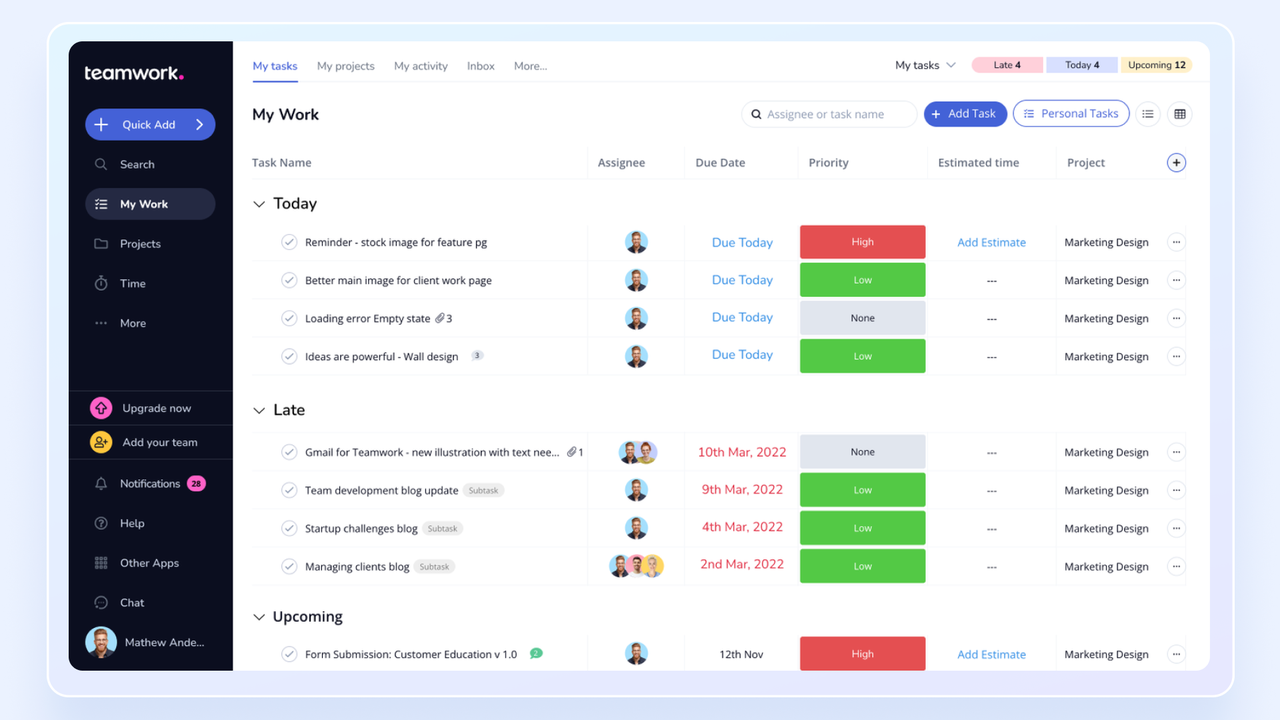
Image source: teamwork.com
is a project management platform built specifically for client work and service-based businesses. It gives you a solid set of tools for managing projects, tracking time, and billing clients. The biggest advantage is that client collaboration and communication live in the same place, so everything stays in one environment.
I find its built-in profitability tracking and its ability to convert logged hours directly into invoices to be highly practical. It addresses the agency model well by making external client collaboration straightforward. Additionally, permission settings can be configured to allow managers to invite clients into the platform to view timelines and approve deliverables while keeping internal drafts and team communications private.
Key features:
- Client collaboration: Allows clients to be invited to projects with specific permissions to view progress and comment.
- Integrated time tracking & billing: Track time on tasks and generate invoices directly from projects.
- Portfolio management: Get a high-level view of all projects to manage resources and priorities effectively.
- Profitability tracking: A built-in feature to track project budgets and ensure profitability.
Pros and cons:
Supported platforms: Web, iOS, Android, Mac, Windows
Integrations: Slack, MS Office, QuickBooks, HubSpot, Stripe, and more
Not ideal for: Users who prefer a minimalist interface, or budget-conscious teams requiring advanced reporting without paying for top-tier plans
Reviews:
Pricing:
- Free: Free for up to 5 users - Supports up to 2 projects with basic milestone and time tracking
- Deliver: $10.99/user/month (billed annually) for unlimited users - This tier introduces up to 300 projects, templates, and automations
- Grow: $19.99/user/month (billed annually) for unlimited users - Stepping up unlocks up to 600 projects, workload management, and advanced budgeting
- Scale: $54.99/user/month (billed annually) for unlimited users - The top plan brings unlimited projects, advanced reporting, and profitability tracking
Read more about Teamwork:
19. Motion: Best for AI-powered scheduling and project management
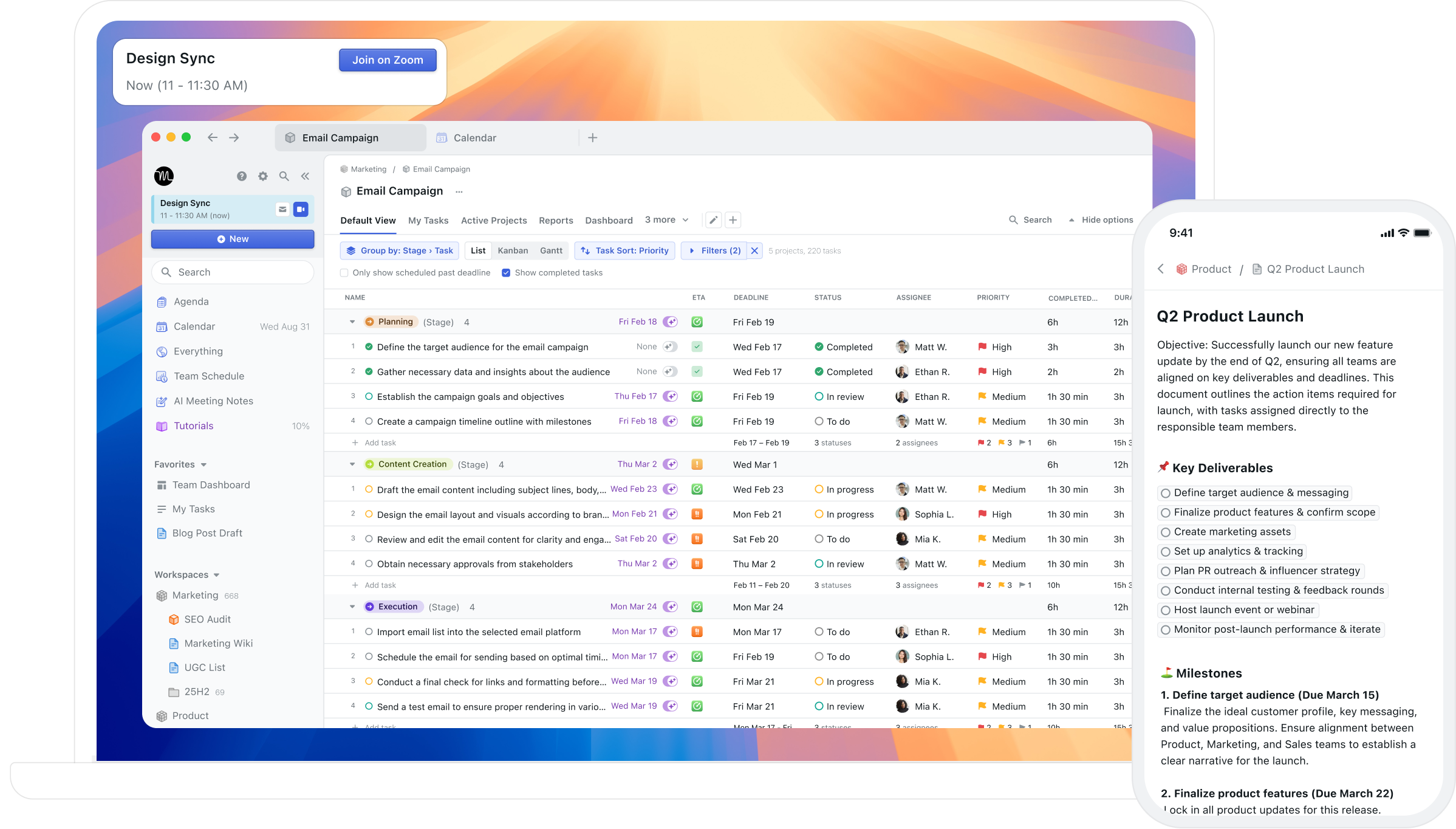
Image source: usemotion.com
Motion is an AI-powered productivity platform that merges your task list with your calendar, automatically scheduling work into open time blocks based on deadlines, priorities, and time estimates. Founded in 2019, it has grown from a simple auto-scheduler into a full productivity suite that combines AI task planning, project management, meeting scheduling, and docs in a single workspace. It's designed for professionals and teams who want to stop manually time-blocking their days and let AI handle the cognitive load of deciding when work gets done.
What I like most about this platform is its intelligent auto-scheduling engine, which places tasks into optimal calendar slots and dynamically reshuffles them whenever plans change, such as when a meeting is added or moved. Motion's AI Project Manager can generate an entire project, with tasks, deadlines, and assignees, from a short description, and it works backward from deadlines to flag at-risk work days or weeks in advance. When paired with team capacity planning and automatic status updates, it removes much of the manual babysitting that traditional PM tools require, making it a strong fit for busy individuals, founders, and small-to-mid-sized teams.
Key features:
- AI auto-scheduling: Automatically time-blocks tasks into your calendar and re-optimizes your plan dozens of times a day as priorities and meetings change.
- AI project management: Build entire projects in seconds, with tasks, deadlines, and assignees, and view work in list, board, timeline, and Gantt formats.
- Deadline intelligence: Works backward from due dates to schedule work in chunks and proactively warns you when a task or project is at risk of slipping.
- AI meetings and docs: An AI notetaker captures meeting summaries and action items, while AI Docs turn messy notes into organized tasks and projects.
Pros and cons:
Supported platforms: Web, iOS, Android, Desktop
Integrations: Google Calendar, Outlook, iCloud, Gmail, Zoom, Google Meet, Microsoft Teams, Slack, and more
Not ideal for: Teams on a tight budget seeking a free plan, or users who need a tool to discover and capture tasks for them rather than schedule tasks they already know about
Reviews:
Pricing:
- Pro AI: $19/user/month (billed annually) - includes chat, projects, tasks, and other collaboration tools and 7,500 AI credits.
- Business AI: $29/user/month (billed annually. Includes everything in Pro AI and advanced dashboards and reports, timeline and Gantt charts, and more.
20. Hive: Best for flexible, user-driven project management
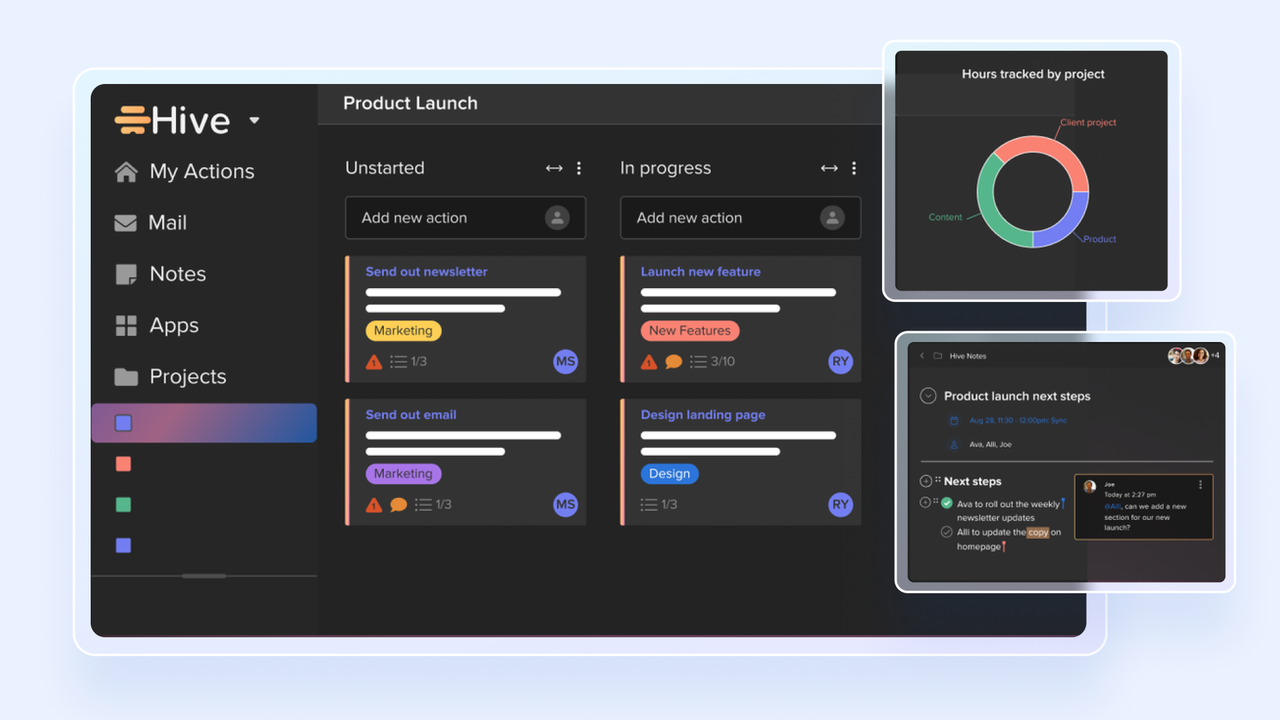
Image source: g2.com
markets itself as the first democratic project management platform, built based on user feedback. It aims to be a flexible workspace that centralizes project tasks, team communication, and files, with multiple project views and deep integrations.
I appreciate that it includes an email inbox and team chat directly in the main dashboard, which helps reduce context switching throughout the workday. The ability to turn an incoming client email into an actionable task card within the same window is a practical workflow improvement. Moreover, allowing users to vote on upcoming features is a transparent approach to software development that keeps the platform aligned with actual user needs.
Key features:
- Multiple project views: Switch seamlessly between Gantt, kanban, calendar, and table views to visualize work your way.
- Native chat and email: Integrate messaging and email directly into your workspace to reduce context switching.
- Action cards: Assign tasks with multiple steps, attach files, and create dependencies to manage complex workstreams.
- Powerful analytics: Get detailed reports on team productivity and project progress to make data-driven decisions.
Pros and cons:
Supported platforms: Web, iOS, Android, Mac, Windows
Integrations: Jira, Slack, GitHub, Box, Shopify, Salesforce, and more
Not ideal for: Teams that strongly prefer a minimalist, uncluttered design
Reviews:
Pricing:
- Free: Free for up to 10 members - Includes unlimited tasks, native messaging, and 200MB storage
- Starter: $5/user/month (billed annually) for up to 10 members - This level introduces up to 10 active projects, Gantt views, and unlimited storage
- Teams: $12/user/month (billed annually) for unlimited users - Upgrading unlocks unlimited projects, advanced time tracking, and customizable dashboards
- Enterprise: Custom pricing (billed annually) for unlimited users - The highest tier brings enterprise-grade security, custom analytics, and dedicated onboarding
Learn more about Hive:
Best project management tools in 2026: Video
Want a video version instead? Press play below to watch our top three project management recommendations.
Other project management tools for 2026
These are the project management tools I tested that didn't make the top 20, but they might still be a good fit depending on your needs.
- : An intuitive Gantt chart tool for project planning and scheduling. Teams can visualize tasks, set dependencies, and track progress with a simple drag-and-drop interface.
- ProjectManager: A comprehensive platform combining task management, Gantt charts, and resource planning. ProjectManager allows teams to assign tasks, monitor workloads, and generate reports to keep projects on track.
- : A web-based Gantt chart solution that simplifies project scheduling and collaboration. Users can create timelines, assign tasks, and track progress visually, with built-in time tracking.
- : A free task management tool with lightweight project management features. It helps users create projects, set priorities, and track deadlines, ideal for individuals or small teams.
- Forecast: An AI-powered platform that automates planning, resource allocation, and project insights. It offers time tracking, budget management, and predictive analytics to optimize workflows.
- Zenhub: A project management tool built into GitHub for software development teams. It enables sprint planning, issue tracking, and workflow visualization without leaving the development environment.
- Taiga: A project management platform for agile teams, supporting Scrum and Kanban workflows. Users can manage backlogs, sprints, and tasks while tracking progress through intuitive boards and dashboards.
- OpenProject: Another open-source project management tool. It offers Gantt charts, task tracking, time tracking, and collaborative project planning for both small and large teams.
- : A collaborative online whiteboard for project planning and visualization. Teams can map workflows, brainstorm, and organize tasks using templates such as Kanban boards and mind maps.
Project management tools by use case
Best project management collaboration tools
Recommended tools: Lark, Asana
Why it fits: Lark excels here by unifying chat, documents, and tasks into a single workspace, eliminating data silos between departments. Asana is highly effective at cross-functional alignment due to its portfolio views and timeline dependencies, allowing different teams to see how their work impacts the bigger picture.
Potential pitfalls: Tool adoption resistance. If one department refuses to leave their legacy apps, the cross-functional visibility breaks down.
Best project management tool for field and remote teams
Recommended tools: Lark, Trello
Why it fits: Lark features an incredibly robust mobile app that retains desktop-level functionality, allowing field workers and remote teams to submit approvals, chat, and update project records on the go. Trello offers a highly visual, swipe-friendly mobile interface that makes quick, on-the-go task updates effortless for field teams.
Potential pitfalls: Complex planning features like adjusting Gantt charts or building automations are inherently difficult to execute on mobile screens.
Best project management tool for security and compliance
Recommended tools: Microsoft Planner, Wrike
Why it fits: Microsoft Planner natively inherits the enterprise-grade security, compliance protocols, and governance of the Microsoft 365 ecosystem. Wrike offers enterprise tiers designed specifically for strict compliance, featuring advanced admin controls, SSO, and detailed audit logs.
Potential pitfalls: Rigid permissions and strict governance can create bottlenecks, slowing down fast-moving tasks. Additionally, accessing these compliance features almost always requires the most expensive enterprise tiers.
Best open-source project management tool
Recommended tools: OpenProject, Taiga
Why it fits: OpenProject provides a comprehensive, open-source alternative to traditional enterprise tools, complete with Gantt charts and time tracking. Taiga is a powerful open-source option specifically tailored for agile teams running strict Scrum and Kanban workflows.
Potential pitfalls: Self-hosting requires dedicated in-house technical expertise to maintain, secure, and update the software. Furthermore, community support may not resolve urgent issues as quickly as dedicated enterprise customer service.
Best agile project management tool
Recommended tools: Jira, Teamhood
Why it fits: Jira provides robust support for sprint planning, backlog management, and Scrum frameworks. Teamhood natively combines Kanban boards with detailed scheduling for flexible, agile execution.
Potential pitfalls: Jira's complexity can be overwhelming for non-technical teams, while Teamhood has fewer third-party integrations compared to older tools.
Read more: .
Best construction and real estate project management software
Recommended tools: Lark, Wrike
Why it fits: Lark's robust mobile app allows on-site workers to share real-time updates, photos, and approvals directly from the field. Wrike handles the complex, multi-phase scheduling, strict task dependencies, resource allocation, and Gantt charts needed by back-office project managers.
Potential pitfalls: Wrike's advanced features have a steep learning curve and can be expensive to scale, while Lark may require initial configuration to align perfectly with highly traditional construction workflows.
Read more: .
Best free project management tool
Recommended tools: Lark, ClickUp
Why it fits: Lark offers a highly generous free tier that includes 100GB of storage and core tools for up to 20 users. ClickUp provides a feature-rich free plan for unlimited users, including Kanban boards and collaborative docs.
Potential pitfalls: Free plans eventually hit storage limits or restrict access to advanced reporting, automations, and enterprise security features as the team scales.
Read more: .
Project management tools by business size
To make choosing the right PM tool even easier, here's a breakdown of common considerations and platform suggestions based on your business size:
Project management tools by team function
How to choose the right project management tool for your team
Here are some quick tips on finding a project management tool that your team will love. The "best" platform isn't necessarily just the one with the most features, but rather one that your team will actually use every day.
Before you jump into the free trials, take a minute to define what you actually need. I've seen teams struggle with powerful, expensive software simply because it was too complicated for their needs. Ask yourself these key questions to narrow down your search:
- How complex are your projects? If you're managing simple to-do lists, a clean kanban board is perfect. If you're juggling complex projects with multi-stage dependencies, you'll need robust Gantt charts and resource management, like those in Lark and Microsoft Planner.
- What's your preferred workflow? Do you prefer Agile sprints? A tool like Jira is built for that. Do you prefer highly visual, customizable boards? Lark, Monday.com, or ClickUp might be your best bet. Are you a traditional spreadsheet user? Smartsheet will feel right at home.
- What are your reporting needs? Determine if you need real-time analytics to track team performance, budgets, and project health. If deep reporting and custom dashboards are a priority, platforms like Lark, Asana, or Smartsheet are highly recommended.
- Do you need client collaboration? Consider how often you need to share progress or deliverables with external stakeholders. If client transparency is key, look for tools that offer secure guest access or client portals, like Basecamp or Notion.
- How much automation do you need? Evaluate how much time your team wastes on repetitive administrative tasks. To streamline your processes, choose tools with strong no-code automation builders and integrations, such as Lark or Monday.com.
- What's your budget? Price models vary wildly. Most charge per user, but some (like ProofHub) offer flat-rate pricing. Don't just look at the starting price. You also need to look at what features are locked behind higher-priced tiers.
- What's your team size and structure? A tool with a generous free plan for small teams (like Lark or Trello) has different benefits than an enterprise-grade platform (like Adobe Workfront) built for advanced security and managing hundreds of users.
How we evaluate project management tools
There's no such thing as the best project management tool because what works great for one team could be a nightmare for another. Still, the platforms that your team will actually use and that genuinely boost efficiency share a few common traits. To pinpoint exactly what those are, we drew on years of real-world experience managing projects to identify the main reasons software adoptions either thrive or fail.
To help you skip the trial and error, we conducted hands-on testing across a wide range of platforms and scored them based on a custom framework. We weighted these criteria based on their actual day-to-day impact—assigning the bulk of the score to the core features and usability that determine whether a team will actually use the tool.
Core PM features (30%)
These carry the most weight in our assessment. We rigorously test the foundational elements of each platform, including task management, advanced scheduling with Gantt charts and interactive calendars, resource allocation, real-time collaboration, and the depth of reporting.
Ease of use (20%)
No matter how great a tool claims to be, it's worthless if your team refuses to use it. We evaluated the user interface, overall user experience, and the initial learning curve to determine how quickly a new team can successfully onboard and navigate the platform.
Customization and integrations (15%)
These are vital for ensuring the software works the way you do. We analyze how well the platform adapts to your unique processes by assessing custom workflows, diverse data views like Kanban or timelines, and how easily it plugs into the tech stack your team already relies on.
Customer reviews (15%)
To ensure our assessment aligns with everyday reality, we don't just rely on our own testing. We aggregate and parse through verified customer reviews and community discussions across trusted platforms like , , and to identify recurring praises, hidden limitations, and common pain points.
Pricing and scalability (10%)
This helps us break down the true cost of ownership. Our analysis weighs the feature set of each tier against its price point and evaluates whether the platform can reliably scale alongside your growing team, project volume, and business complexity.
Support and resources (10%)
We verify the responsiveness and reliability of customer service channels while assessing the availability of self-serve resources, such as help centers, AI assistants, video tutorials, and active community forums.
For more information about our review methodology, read the full rundown of.
What features should I look for in project management tools?
What is considered a good solution depends on your team's specific needs. A may be better if you're only tracking basic to-dos, but for more complex workflows, project management software often includes:
Comprehensive task management
The ability to create, assign, prioritize tasks, set deadlines, add subtasks, define dependencies, track status (such as moving from To-Do to In Progress to Completed), and utilize tags for flexible categorization and quick search filtering is fundamental for accountability and progress monitoring.
Effective collaboration tools
Features like built-in instant messaging, real-time commenting on tasks, an @mention feature for immediate notifications, and convenient file sharing with version control to track document modification histories help centralize discussions and significantly reduce your team's reliance on scattered external communication apps. Additionally, a shared calendar should integrate member schedules with key project milestones to ensure everyone is aligned.
Visual planning and scheduling
for timeline visualization and dependency tracking, kanban boards for workflow management, list views for straightforward task overviews, and project calendars provide clear visual overviews that help project teams understand project structure, identify critical paths and milestones, and grasp status at a glance.
Insightful reporting and analytics
Customizable dashboards and project management reporting tools that provide data-driven insights into project progress, task distribution, resource utilization, budget tracking, and potential bottlenecks are essential for informed decision-making. The system should also automatically aggregate data into progress reports for seamless stakeholder communication.
Resource allocation and planning
Capabilities to manage team members' workloads, track their availability, and allocate them effectively to tasks and projects ensure optimal use of your most valuable assets and help prevent burnout or idle time. The best resource management tools give you a single view of who is free and who is stretched, so you can rebalance project resources before anyone is overloaded. For budget-driven projects, strict financial oversight is required to monitor actual expenditures and ensure limits are not exceeded.
Time management and tracking
Integrated time tracking features are crucial for accurately billing clients, processing payroll, analyzing project profitability, understanding where team effort is being expended, and aiding in cost control and labor analysis.
Project portfolio management
The ability to oversee multiple projects in a single view allows organizations to track overarching status, identify cross-project risks early, and strategically reallocate resources when business priorities shift.
Customizability and workflow automation
The ability to tailor the platform (e.g., custom fields, statuses, templates) to your organization's specific processes and to automate repetitive tasks (like notifications or task creation based on triggers) significantly enhances efficiency. The best project tools let you stand up these rules in just a few clicks, with no scripting required. This must include real-time notifications that alert relevant personnel when statuses change, deadlines approach, or new comments are posted so critical information is never missed.
Mobile accessibility
Robust mobile applications for iOS and Android allow team members to stay updated, manage tasks, and collaborate while away from their desks, ensuring productivity for remote or field-based project teams.
Robust integration ecosystem
The tool should connect with the third-party apps you already use, such as CRM, accounting, file storage, communication tools, email clients, calendars, and development tools. Another key factor is Open APIs, since it opens the door to custom development and data syncing. Together, these keep data flowing and let the platform scale as your business grows.
Comprehensive customer service and support
Readily available knowledge bases, in-app tutorials, and direct customer support channels ensure that teams can quickly troubleshoot issues and maximize platform adoption without prolonged downtime.
How AI features work in project management tools
The bigger shift in 2026 is what the AI is allowed to do. Just a year ago, it could basically just draft text and answer simple questions. Today, a lot of tools come with advanced AI features and agents that can act on the task itself. Here are the five trends worth knowing before you buy.
Agents that actually do the work
Hand off a repeatable job, such as intake, status chasing, or first-draft creation, and the agent executes it inside your existing boards instead of just suggesting what to do. For example, Lark's AnyGen Teammates and Asana's AI Teammates can pick up a task and run it end-to-end.
Summarize-and-catch-up as a default
Every serious tool now condenses long threads, docs, and meetings into a few lines, which matters most when you join a project late and need the gist without reading three weeks of comments. Lark AI Meeting Notes, for instance, generates a summary doc and organizes decisions into searchable chapters.
Turning plain language into tasks and workflows
Instead of building an automation by hand, you describe what you want and the tool assembles it, which finally opens automation to teams that never had time to learn the builders. monday's AI Blocks, for example, turn a plain-language request into a working workflow.
Data analysis with context
The more useful implementations live in the table itself, where a column can translate, categorize, or summarize its own rows, so tagging that used to be manual just happens. For example, the built-in AI in Lark Base can help you make sense of your data with the click of a button.
Predictive signals and risk flags
AI can read historical and in-flight data to flag slipping timelines and workload imbalances before they become problems. It is the most oversold category, so treat vendor demos skeptically, but the direction is genuine. Some tools, such as Wrike's, have shown that they are capable of surfacinge at-risk work early.
What are the benefits of project management software?
A good project management tool can make a big difference for both project managers and team members. Here are some key benefits:
Improved organization and centralized information
Workers spend 20% of their workweek looking for information or tracking a colleague down. Project management software acts as a single source of truth, centralizing all project-related information, including tasks, deadlines, documents, communications, and resources. This reduces confusion, minimizes scattered information, and ensures everyone is working with the most up-to-date details. Enhanced team collaboration
These platforms facilitate seamless teamwork by providing features for real-time communication, clear task assignments, file sharing, and progress updates. Indeed, ineffective communication is the main cause of project failure 33% of the time, according to PMI. Naturally, remote or distributed teams are especially vulnerable, and ensuring everyone stays connected and aligned is paramount. Visual project timelines
Gain clear oversight of your project's schedule with features like Gantt charts and timelines. These visual project timelines allow teams to easily see task dependencies, critical paths, milestones, and overall project progress at a glance, making it easier to anticipate bottlenecks and manage deadlines effectively.
Streamlined task management
Efficiently create, assign, track, and manage tasks. With features like priority setting, status updates, and notifications, teams can stay on top of their responsibilities, leading to increased accountability and better workload distribution.
Improved resource management
Optimize the allocation and utilization of resources, including personnel, budget, and equipment. Project management tools offer visibility into resource availability and workloads, helping to prevent overallocation and ensure project resources are used effectively.
Higher efficiency
By improving planning, tracking, and collaboration, PM software helps teams to complete projects efficiently. Clear visibility into progress and potential roadblocks allows for proactive adjustments, so projects can stay on schedule and budget.
Better risk management
Many tools offer features to identify, track, and mitigate potential risks. Early identification of issues allows teams to address them proactively, minimizing their impact on the project's timeline and budget.
Standardized processes and reporting
Implement consistent project management methodologies across your organization. These tools often come with reporting features that provide valuable insights into project performance, team productivity, and resource allocation, aiding in data-driven decision-making.
Increased accountability
With clearly defined roles, responsibilities, and transparent task tracking, team members are more accountable for their contributions, leading to improved ownership and performance.
Reap these benefits with Lark
How do I ensure successful implementation?
According to a , 70% of digital initiatives fail to reach their goal, so choosing the right software is only half the battle. Many companies face challenges during implementation, often not because of the tool itself, but due to a lack of a proper execution strategy. Rolling out the software successfully is what is critical for long-term success. Why? Because a powerful tool that no one uses is worthless.
Here are a few tips to ensure smooth team adoption:
- Get leadership buy-in: Implementation should be championed from the top down. Management should clearly articulate the core objectives of introducing the new tool (e.g., boosting efficiency, improving cross-departmental communication) and specify its significance for the company's future to build team consensus. When leaders actively use and advocate for the new tool, it signals its importance and encourages the rest of the team to get on board.
- Implement a phased rollout: Rolling out a complex system comprehensively all at once can easily trigger confusion and resistance. You can select a medium-sized team with a higher acceptance of digital tools for a small-scale pilot instead. The key is to set clear phased goals and treat the implementation itself as a project to be gradually expanded.
- Establish clear "Rules of the Road": Don't just give your team a login and wish them luck, but use this opportunity to review and optimize your existing project workflows. Create and share a simple document outlining how the tool should be used. For example: "All task requests must be submitted via the form," or "Follow uniform task naming rules." Additionally, you can use built-in templates to ensure consistency across the organization.
- Provide hands-on training: Host a training session (or two) to walk the team through the core workflows they'll be using every day to demonstrate how the new tool practically simplifies their daily tasks so they proactively embrace the change. Record the session so new hires can watch it later. You can also establish an internal community or dedicated Q&A channels (such as a mutual support group) for real-time troubleshooting.
- Celebrate early wins: Once the tool is up and running, highlight a project that was completed more smoothly or a process that was made easier because of the new software. Showing tangible benefits and recognizing individuals who actively use the tool is a good way to win over skeptics and build momentum. Furthermore, continuously collect users' pain points through surveys or meetings, flexibly adjusting system configurations or workflows based on this feedback.
- Integrate with existing systems: To prevent the new tool from becoming just another "information silo," ensure it integrates smoothly with your existing systems (like CRM, ERP, or HR) right from the planning phase. All-in-one platforms offer an advantage in this regard, as they can save you from cumbersome API integrations and constant app switching.
Read more: , , .
What are the different types of project management software?
The market offers a diverse range of project management apps, each tailored to different needs, team structures, and project complexities:
Cloud-based (SaaS) solutions
These platforms are hosted by the vendor and accessed via the internet. They offer significant advantages in terms of accessibility (from anywhere with an internet connection), real-time data synchronization for all users, automatic updates, and typically operate on a subscription-based pricing model, which can be cost-effective.
Agile project management tools
Specifically designed to support methodologies like , , or , these tools are popular in software development and other fast-paced industries. They often feature sprint planning boards, backlog grooming capabilities, burndown/burnup charts, and facilitate iterative development cycles and continuous feedback.
Integrated/all-in-one platforms
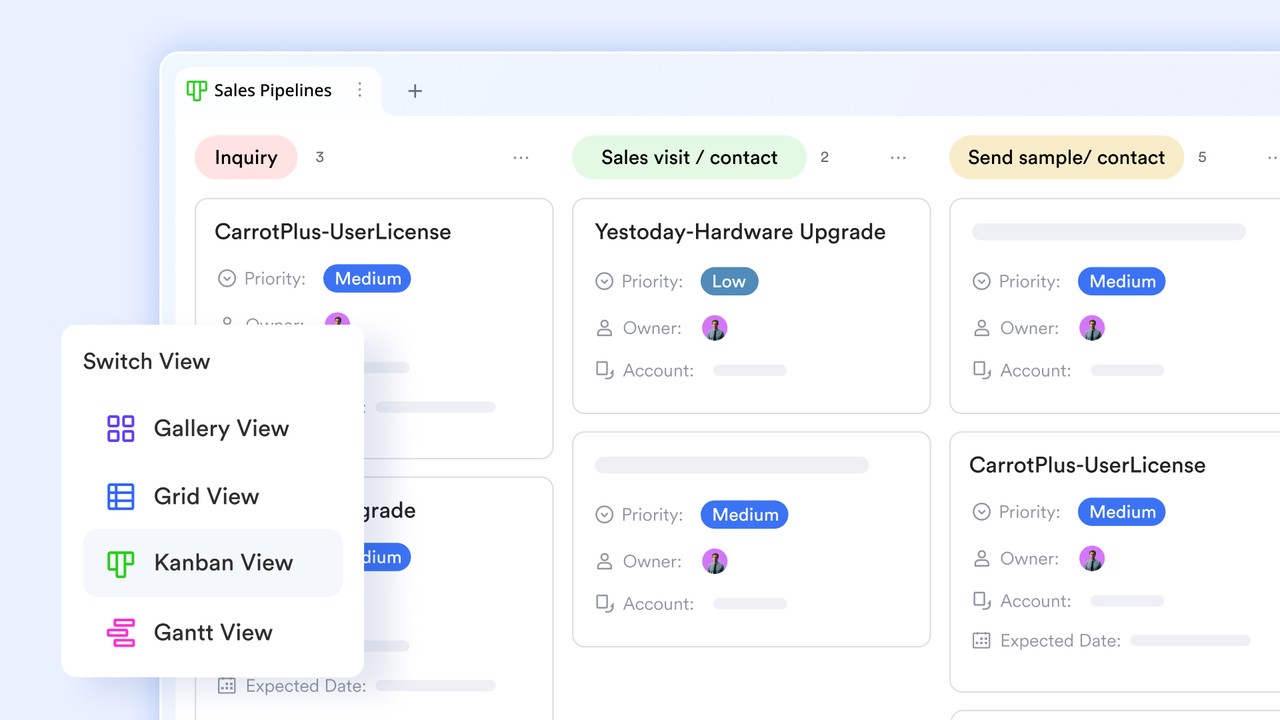
These aim to provide a holistic suite of functionalities beyond core project management. They often combine project planning with document management, team communication channels (chat/forums), time tracking, invoicing, and sometimes even CRM features, thereby reducing the need for multiple disparate software tools.
Traditional/Waterfall focused software
Some tools are geared more towards traditional project management methodologies like Waterfall, which emphasize linear phases and upfront planning. These often feature robust Gantt chart capabilities, critical path analysis, and detailed dependency management, making them suitable for projects with well-defined scopes and sequential tasks.
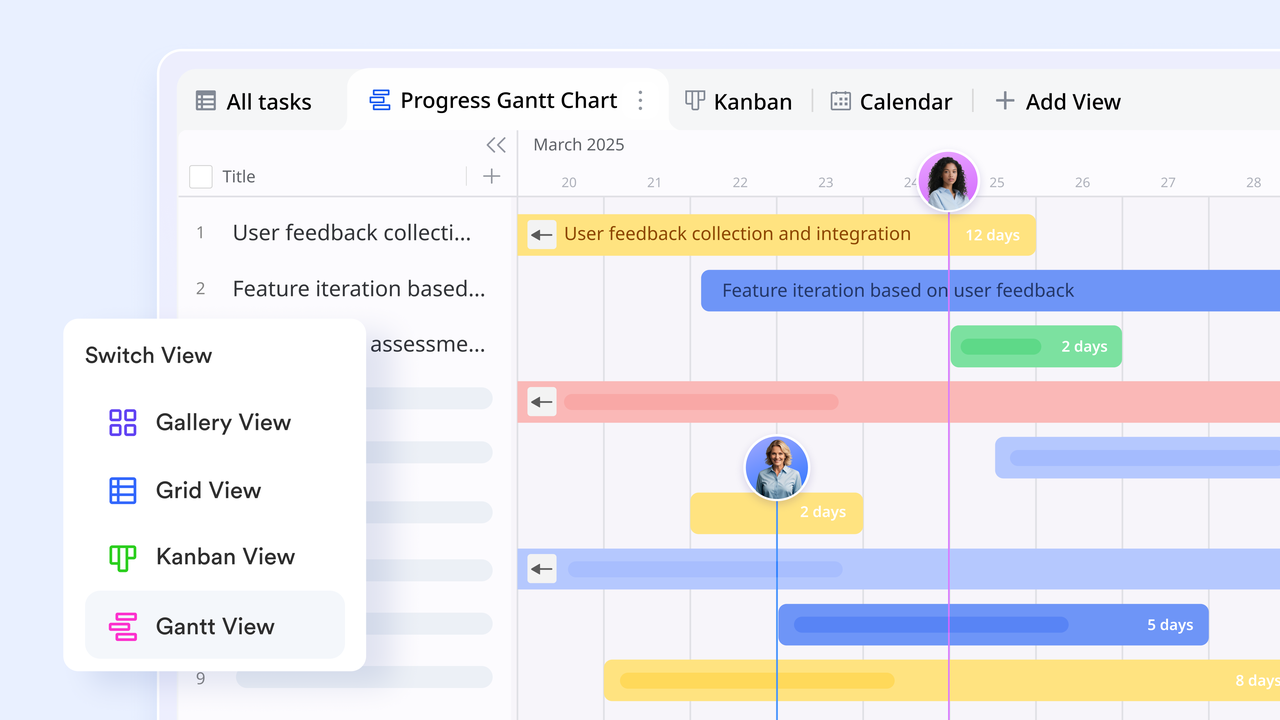
Understanding these distinct categories allows organizations to select a solution that best aligns with their established workflows, typical project complexity, and collaborative requirements.
Read more:
Conclusion
With the right project management tool, your team's day-to-day work can become easier. You can spend less time in confusing email threads or figuring out who's doing what, and more time actually getting things done together.
Of all the tools tested and reviewed, I found Lark's solution to be above the rest. Task management, knowledge management, scheduling, videoconferencing, calendar, messaging, and document tools are unified on one platform. Everything just clicks when you can consolidate your operations, like from sales, campaign management for , applicant trackers for , and more on a single platform.
Try Lark for free, no credit card needed
FAQs on project management tools
What are some key terms for project management?
There is no shortage of jargon and technical terms in the world of project management. Here are a few that you should know:
- RACI matrix: A framework used to clarify team roles and responsibilities for specific tasks, standing for Responsible, Accountable, Consulted, and Informed. For more examples, see RACI Matrix Examples: Define Roles & Improve Accountability.
- RAID log: A central project management document used to track four key areas: Risks (potential problems), Actions (tasks to be done), Issues (current problems), and Dependencies (tasks that rely on others). It serves as a living cheat sheet for the project's health.
- Risk map: A visual tool, often in the form of a matrix, used to plot project risks based on their likelihood of occurring and their potential impact. The goal is to help project managers prioritize which threats need immediate mitigation.
- Stakeholder map: A visual categorization of all parties involved in or affected by a project. It typically plots stakeholders based on their level of interest and power or influence, helping the team determine the best communication strategy for each person.
- Project sponsor: A senior executive or key stakeholder who champions the project, secures funding, and provides high-level direction and approval.
- Lean principles: A methodology focused on maximizing customer value while relentlessly identifying and eliminating waste or inefficiencies in a workflow.
- Scope creep: The gradual, uncontrolled expansion of a project's requirements or deliverables (or scope) beyond the initially agreed-upon boundaries.
- Pomodoro technique: A popular time management method where work is broken down into highly focused intervals (traditionally 25 minutes), separated by short breaks to prevent burnout.
- Work Breakdown Structure (WBS): A deliverable-oriented, hierarchical breakdown of a project into smaller, more manageable pieces of work, so scope, schedule, and cost can be planned and tracked at each level.
What are project management tools?
Project management tools provide a central workspace for teams to plan, organize, and execute their work. Consider such a tool your single source of truth for any project. Inside this digital hub, you can define objectives, build schedules, assign tasks, and manage resources, all while keeping the entire team aligned and on schedule. Most are online project management tools, so the whole team works from the same live view in any browser.
More than just a task tracker, a great platform boosts collaboration and offers real-time visibility into a project's health. Scattered email chains and messy spreadsheets are replaced by visual timelines, automated workflows, and dashboards instead. As a result, teams can spot risks, adapt to changes, and stay focused on successful delivery.
Is there any project management software with free plans?
Yes, there are free project management software, such as Lark, ClickUp, and Monday. Most project management tools also offer limited-time free trials, such as Asana, Trello, and Jira.
Unlike other project management software, Lark's free plan is very generous, giving up to 20 members access to 11 powerful tools and workflow automation. With Lark, teams not only get a free project management tool, but also task management software, knowledge management, team collaboration, and more.
Read more: The Ultimate Guide to Free Project Management Software.
What's the best personal project management tool?
The best personal project management tool really depends on your specific habits and workflows, but if you want a single platform that can handle absolutely everything, Lark is my top pick. It's refreshing to use such a versatile workspace where you can manage your personal calendar, notes, messages, and daily tasks without needing to constantly switch between different apps. If you just want a lightweight, visual board for simple personal to-dos, Trello is a solid runner-up.
What is the best project management software for small teams or businesses?
For small businesses or small teams, simplicity and budget friendliness are key. Lark delivers in both aspects, with an all-in-one solution that unifies project management with chat, documents, and approvals. Its free forever plan, which supports up to 20 users, makes it an exceptionally cost-effective and powerful option for growing teams.
Which project management tool is easiest to use?
With its simple drag-and-drop boards, Trello is incredibly easy to learn for basic task tracking. For a more comprehensive solution, Lark's all-in-one platform makes completing day-to-day tasks and collaboration a lot easier, without the need for constant app switching.
Which project management tools support both Gantt and Kanban?
Lark, Wrike, and Hive all allow users to seamlessly switch back and forth between Gantt and Kanban views as needed. Additionally, Teamhood is notable because it natively combines interactive Gantt scheduling with Kanban swimlanes on a single screen.
What is the best project management software for enterprise teams?
Adobe Workfront and Wrike are excellent traditional enterprise choices, offering comprehensive features like strategic portfolio planning and massive-scale resource management. Lark is also a top contender for large organizations looking to consolidate their software stack into a single, AI-powered superapp. Lark's Enterprise plan provides the advanced security, compliance, and management controls that large teams require, while significantly lowering overall software costs.
What are the best project management tools for different industries?
Your project management needs may differ depending on the industry you're in. Here are some of our guides to help you find the right tools:
Technology
Marketing
Professional services
Construction
Others
How can I use AI for project management?
60% of project managers are eager to explore AI, according to a McKinsey report, so the growth potential of this technology is high. The landscape is also evolving rapidly, and its role in project management is changing just as fast. Today, you can use AI to automatically generate complete project schedules from a simple brief, summarize long meetings into clearly assigned action items, and balance team workloads in real time. You can now also use AI to flag unclear tasks, generate weekly progress summaries, or highlight key feedback insights. In short, as AI technology advances, the use cases for project management will expand as well.
To learn more, see 10 Must-Have AI Project Management Tools for Smarter Work.
What project management tools do you recommend for switching from Excel?
If you are moving away from Excel, look for a tool that keeps the familiar grid view while adding real project management power. Lark is a strong choice, since its Base offers spreadsheet-style tables alongside Gantt and Kanban views, automations, and built-in messaging and docs. Asana, monday.com, and Smartsheet also ease the transition for teams that want a structured, collaborative upgrade.
This article was last updated on Aug 31, 2026.
- Aug 31, 2026: Added new section on AI trends in project management tools and updated product ranking and details
- July 1, 2026: Updated product descriptions
- May 8, 2026: Added a main tradeoff column to the comparison table.
- April 20, 2026: Updated the latest pricing for all products, added a guide for choosing project management tools based on use cases, added integration support, and add-on details for some products.
Related reading